


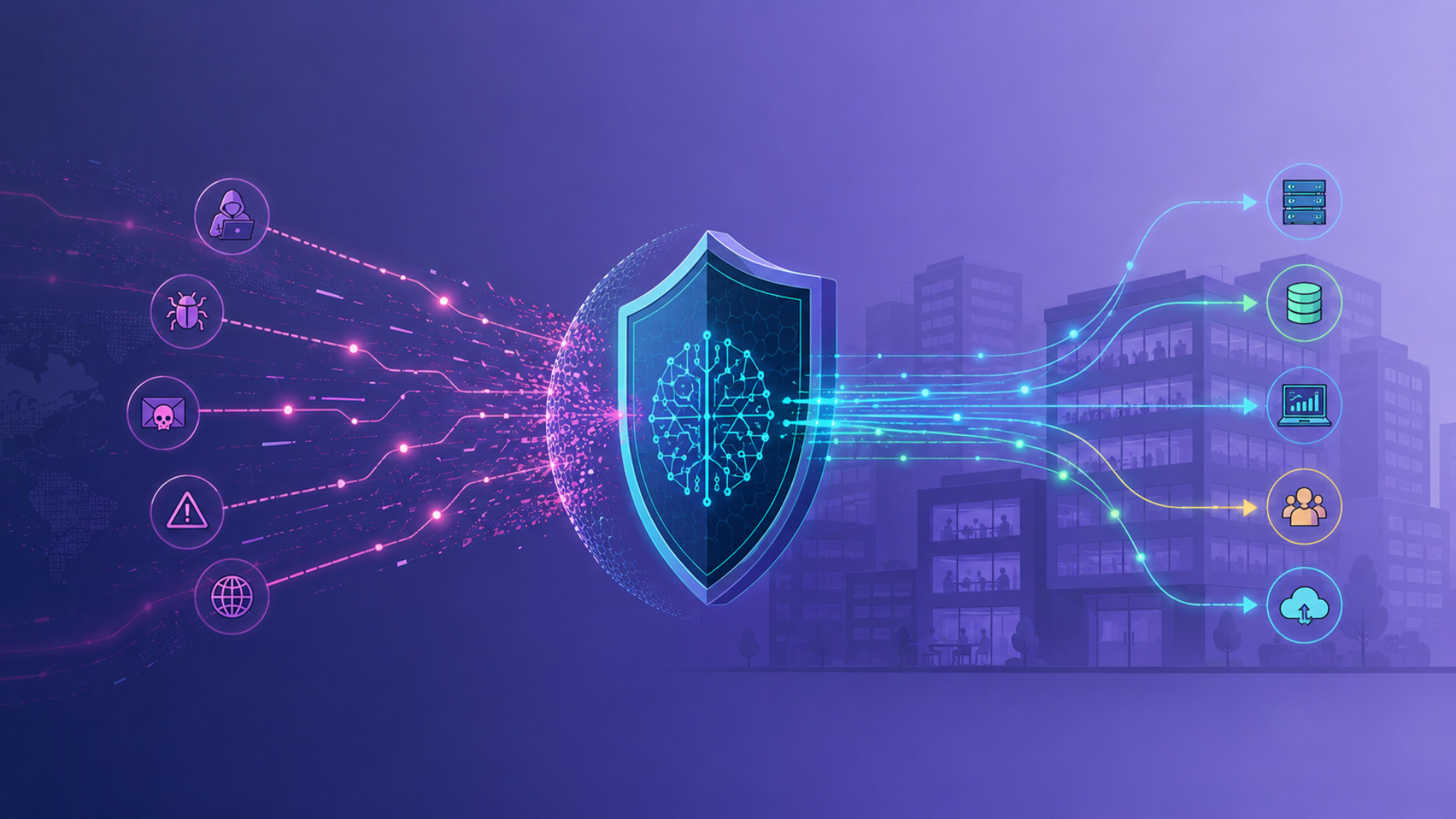
The cybersecurity landscape changed when AI became accessible to attackers.
In mid-2026, a ransomware operation conducted much of its intrusion chain autonomously using an AI agent: reconnaissance, credential theft, database encryption, and ransom note generation, all without sustained human operator involvement. The attack was faster, more targeted, and harder to detect at each stage than its human-directed predecessors. And it represents a pattern, not an outlier.
AI has fundamentally changed the economics of cyberattacks. Capabilities that previously required skilled, expensive human operators can now be partially or fully automated. The barrier to sophisticated attack has dropped. The speed of attack has increased. And the volume of attacks that can be run simultaneously by a single threat actor has grown significantly.
The enterprises that are best positioned in this environment are not the ones that have simply deployed more security tools. They are the ones that have thought clearly about both sides of this shift: how to use AI effectively in defence, and how to govern the exposure that their own AI deployments create on the attack surface.
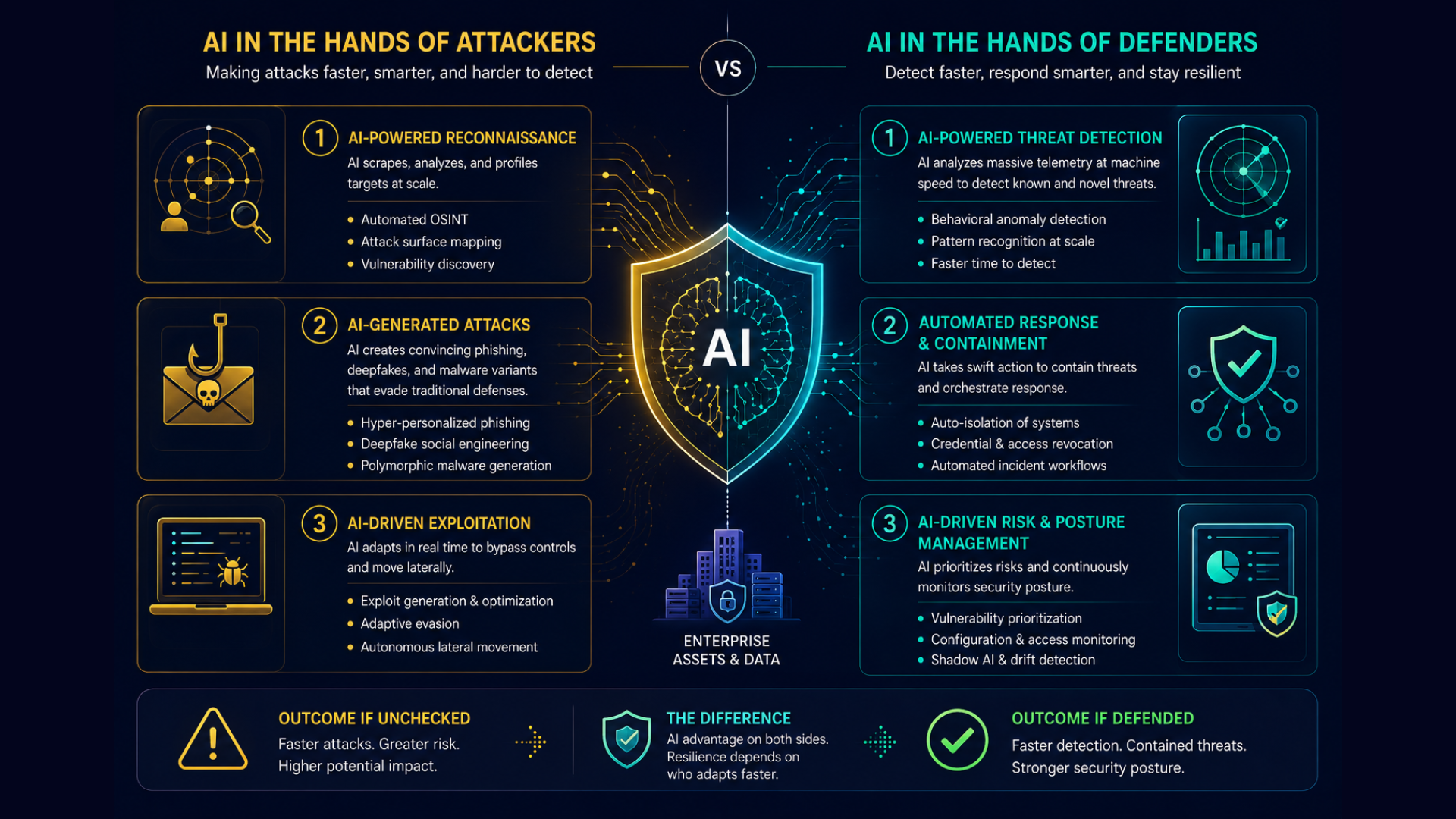
How AI Is Being Used Offensively
Understanding how AI is being weaponised by attackers is the starting point for building effective AI-powered defences, because the defensive architecture needs to account for the specific capabilities that AI brings to the offensive side.
Automated reconnaissance and targeting:
AI agents can scan exposed attack surfaces, identify vulnerable systems, and prioritise targets based on potential value with a speed and thoroughness that human operators cannot match. What previously required days of manual reconnaissance can now be completed in hours, with more comprehensive coverage.
Adaptive phishing and social engineering:
AI-generated phishing content is now indistinguishable from legitimate communications for most recipients. The volume, personalisation, and linguistic sophistication of AI-generated phishing have made this the attack vector showing the sharpest increase in enterprise security incidents in 2026. Security awareness training built around identifying template-style phishing emails is now largely ineffective against AI-generated content.
Credential and privilege escalation:
AI agents can systematically probe authentication systems, analyse stolen credential databases for patterns, and identify privilege escalation opportunities in complex enterprise environments with a persistence and methodical thoroughness that human attackers cannot sustain. The JadePuffer ransomware operation demonstrated that credential theft and lateral movement can now be largely automated within an AI-directed attack chain.
Exploitation of AI systems themselves:
Enterprise AI deployments have created new attack surfaces. Agent data injection attacks, where malicious content planted in data sources manipulates an AI agent's actions, are an emerging attack vector specific to agentic AI deployments. An AI agent instructed to summarise product reviews can be manipulated into executing attacker commands if the review content contains specially crafted instructions. This category of attack is growing as enterprise agentic AI deployment scales.
How Enterprises Are Using AI in Defence
The same AI capabilities that make attacks more sophisticated are available to defenders, and the enterprises deploying them effectively are seeing meaningful improvements in their security posture.
Threat detection at machine speed:
AI-powered threat detection systems process security telemetry at volumes and speeds that human analysts cannot match. Behavioural anomaly detection, which identifies patterns of activity that deviate from established baselines rather than matching known attack signatures, is particularly valuable in detecting novel attack methods and AI-directed intrusions that do not match historical patterns.
The practical result is that security operations centres with AI-assisted detection are identifying threats significantly faster than those relying primarily on human analysis. The time between initial compromise and detection, which determines how much damage an attacker can do before being stopped, is compressing in organisations with mature AI security deployments.
Automated response and containment:
AI systems can isolate compromised systems, revoke credentials, block suspicious network traffic, and initiate incident response workflows faster than human security teams can make and act on those decisions. In environments where attack speed is measured in minutes, the difference between automated and human-speed response can be the difference between a contained incident and a significant breach.
Vulnerability management and prioritisation:
Enterprise environments contain thousands of vulnerabilities at any given time. AI systems that correlate vulnerability severity, exploitation likelihood, asset criticality, and current threat intelligence can prioritise remediation in ways that static scoring systems cannot. CISA has shortened mandatory federal patch deadlines citing AI-driven threat speed. Enterprises with AI-assisted vulnerability prioritisation are better positioned to meet tightening remediation windows.
Security posture monitoring:
AI systems monitoring the enterprise security posture continuously, including configuration drift, access control changes, and shadow AI deployments, provide visibility that periodic audits cannot. The emergence of AI tools being deployed by individual teams without central security review, creating ungoverned attack surfaces, is a specific area where continuous AI monitoring is providing value that manual processes cannot.
The Specific Risk Created by Enterprise AI Deployments
The deployment of AI within enterprise environments creates attack surface that did not previously exist, and the enterprises moving fastest on AI deployment are not always moving at the same pace on securing what they are deploying.
AI agents that access enterprise systems, including ERP, CRM, and financial databases, through governed integration layers represent a significant access point that needs to be secured as carefully as any human user access. An agent with write access to financial systems, if compromised or manipulated, represents a risk that needs to be addressed at the architecture level, not just at the perimeter.
The specific vulnerabilities that security teams are tracking in enterprise AI deployments in 2026 include prompt injection attacks, where malicious input manipulates an AI system's behaviour; data poisoning, where training or retrieval data is corrupted to alter AI outputs; and model inversion attacks, where repeated querying of an AI system reveals sensitive information from its training data.
The enterprise context layer that governs how AI agents access business systems is not just an operational governance component. It is a security component. Agents operating with clearly defined, minimally scoped access, within a governed gateway that logs every interaction, present a significantly smaller attack surface than agents with broad, ungoverned system access.
What Enterprise Security Teams Are Prioritising
A survey of enterprise security practitioners conducted at Infosecurity Europe in June 2026 found that AI is simultaneously viewed as the most valuable defensive tool and the most significant new risk factor in enterprise security. That dual assessment is accurate, and the enterprises navigating it most effectively are treating AI security as two distinct but related problems.
Securing AI deployments requires applying the same access control, monitoring, and governance principles to AI systems that apply to human users, with additional attention to the AI-specific attack vectors described above. The AI governance architecture that regulatory frameworks are beginning to require is also a security architecture. Audit trails, access controls, and human oversight mechanisms protect against both regulatory non-compliance and security incidents.
Using AI in security operations requires selecting and deploying AI tools with the same rigour applied to any enterprise technology investment, including understanding what data the tools access, how that data is processed, and what attack surface the tools themselves create. Security AI tools are not exempt from the governance requirements that apply to other enterprise AI deployments.
Over 70 cybersecurity organisations have now signed the CREST AI Charter, committing to responsible use of AI in security contexts. The charter reflects a growing consensus that AI security tools need to be governed with the same care as the threats they are designed to counter.
The Board-Level Conversation That Is Overdue
Cybersecurity has been a board-level conversation for several years. AI-powered cybersecurity is a more specific and more urgent conversation that most boards have not yet had with the depth it requires.
The questions that matter at board level in 2026 are not generic. They are specific: what AI deployments does the organisation have, and what attack surface do they create? What AI tools are being used in security operations, and are they governed appropriately? What is the organisation's detection and response capability against AI-directed attacks, which move faster and with less predictable patterns than historically observed threats?
CISA's recommendation to treat cybersecurity as board-level leadership accountability rather than an IT department function reflects the reality that the decisions that determine an organisation's security posture, including AI investment decisions and AI deployment decisions, are made at the leadership level. The security implications of those decisions need to be part of the conversation at the point where the decisions are made.
Practical Steps for Enterprise Security Teams
Three priorities stand out from the current threat and deployment landscape for enterprise security teams evaluating their AI security posture.
Audit existing AI deployments for security exposure:
The most immediate risk in most enterprises is not a sophisticated external attack. It is ungoverned AI deployments that have been built without security review and are creating access surface that the security team is not aware of. A comprehensive AI system inventory is the starting point for any serious AI security programme.
Extend access governance to AI agents:
AI agents should operate under the same access control principles as human users, including minimum necessary access, comprehensive logging, and regular access review. The intelligent gateway architecture that governs agent access to enterprise systems is as much a security control as it is an operational governance mechanism.
Build detection capability specific to AI-directed attacks:
Traditional threat detection tuned to human-speed, human-pattern attacks will miss AI-directed intrusions that operate at different speeds and with different behavioural signatures. Security operations teams need to develop detection logic specifically designed for AI-directed attack patterns, including the credential-based lateral movement and data exfiltration patterns that characterise current AI-assisted ransomware operations.
AI has not made cybersecurity harder in a generic sense. It has made specific things significantly harder, including detecting attacks that move at machine speed and securing systems that AI agents are accessing. It has also made specific things significantly more achievable, including threat detection at scale and response automation that closes the window between compromise and containment.
The enterprises that are building the right AI security posture in 2026 are the ones treating both sides of this seriously, deploying AI in their security operations with the same rigour they would apply to any critical enterprise system, and governing their AI deployments with the security discipline that the current threat environment demands.
Vishleshan AI builds enterprise AI systems with security and governance built into the architecture from day one, including access-controlled agent integration, comprehensive audit trails, and compliance-ready deployment frameworks for regulated industries. Book a Consultation