


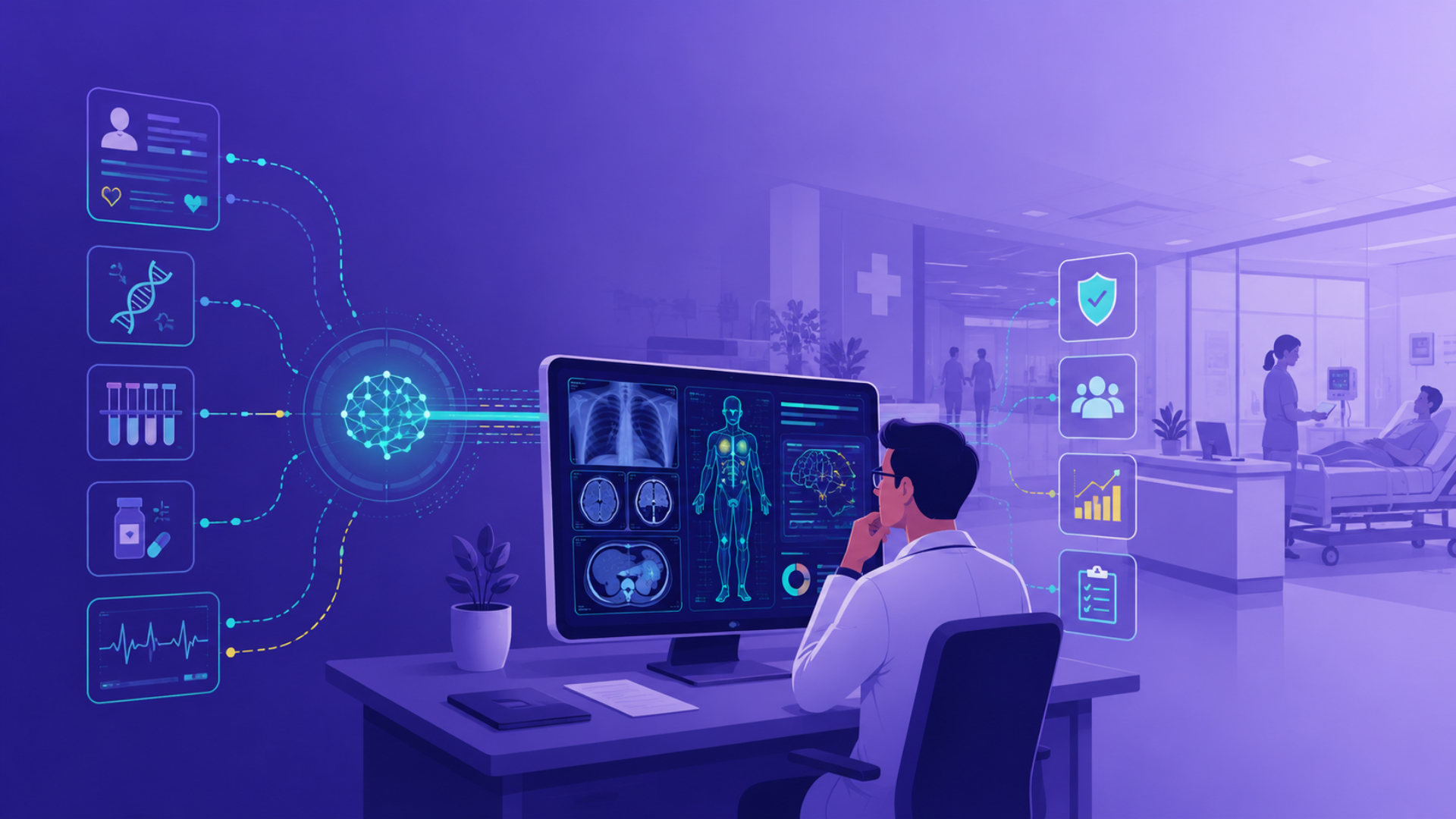
Healthcare is one of the sectors where AI generates the most excitement, the most anxiety, and the most confusion simultaneously. The promises are significant: earlier cancer detection, faster drug discovery, more efficient hospitals, better patient outcomes. The fears are equally significant: misdiagnosis by algorithm, erosion of the doctor-patient relationship, data privacy at unprecedented scale.
In 2026, there is enough real deployment experience across enough healthcare systems to move past the promises and fears and look at what is actually happening. The picture is more specific, more uneven, and more actionable than the headline narrative on either side suggests.
Where AI Is Delivering Measurable Outcomes
The areas where AI is producing clear, reproducible, clinically validated results in 2026 are more limited than the general AI in healthcare narrative implies. But the results in those areas are genuinely significant.
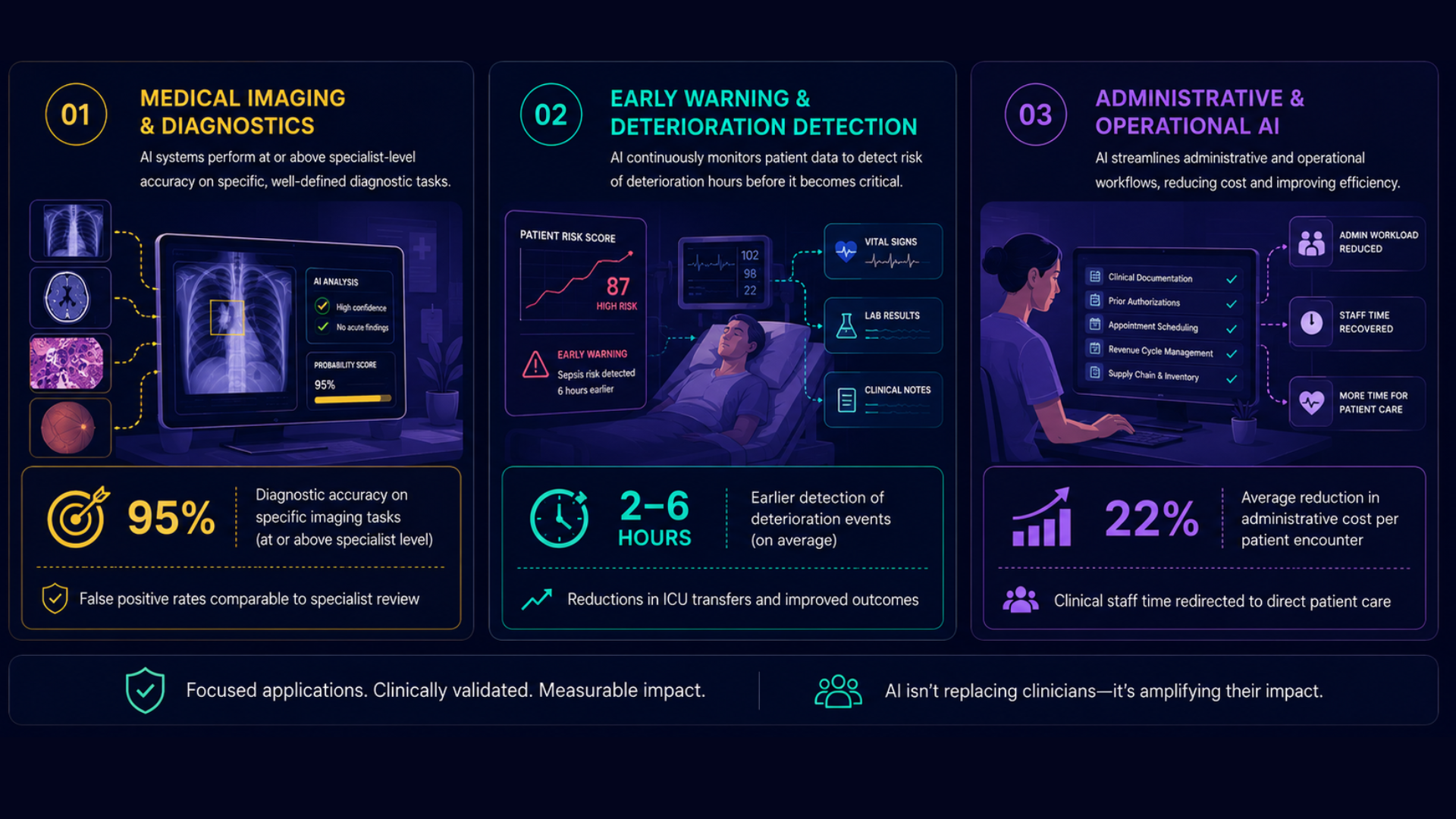
Medical imaging and diagnostics is the most mature application area. AI systems trained on large datasets of annotated medical images, including radiology scans, pathology slides, retinal photographs, and dermatology images, are now performing at or above specialist-level accuracy on specific, well-defined diagnostic tasks. A 2025 study published in Nature Medicine found that AI-assisted screening for diabetic retinopathy in primary care settings detected cases that would have been missed in standard screening, with false positive rates comparable to specialist review.
The important qualification is that performing at specialist level on a specific task is not the same as replacing specialist clinical judgment. The AI systems performing well in imaging diagnostics are doing one well-defined thing: identifying a specific pattern in a specific type of image, and doing it reliably at scale. They are not doing the broader clinical reasoning that a specialist brings to a patient presentation. The clinical value is in extending specialist-level screening to settings and volumes where specialists are not available, not in replacing specialists in settings where they are.
Early warning and deterioration detection in hospital settings is another area with strong real-world evidence. AI systems monitoring continuous streams of patient vital signs, laboratory results, and clinical notes are identifying patients at risk of deterioration, including sepsis, cardiac events, and respiratory failure, hours before clinical teams would typically recognise the pattern manually. Several major health systems report reductions in ICU transfers and improved outcomes in patients flagged by these systems, with the time advantage of early detection being the primary driver of benefit.
Administrative and operational AI is the least discussed but possibly the most immediately impactful category. Clinical documentation, prior authorisation processing, appointment scheduling, revenue cycle management, and supply chain logistics within healthcare organisations are all areas where AI is reducing administrative burden at scale. A 2026 survey by the Healthcare Information and Management Systems Society found that healthcare organisations with mature AI deployments in administrative functions reduced administrative cost per patient encounter by an average of 22 percent. The clinical staff time recovered from administrative tasks is being redirected to direct patient care.
Where AI Is Still Experimental
The gap between what is working reliably and what is still experimental is important to understand, particularly for healthcare enterprise leaders evaluating AI investment decisions.
Clinical decision support at the point of care, meaning AI systems that advise clinicians on treatment decisions in real time, remains largely experimental in most contexts. The technical capability exists. The clinical validation, regulatory approval pathways, liability frameworks, and workflow integration required to deploy these systems reliably at scale do not yet exist in most healthcare jurisdictions. Several high-profile failures, where AI recommendations were followed inappropriately or where systems performed well in controlled conditions and poorly in production, have made clinical communities appropriately cautious.
Generative AI in clinical documentation is being deployed at scale in some health systems and generating significant time savings for clinicians. The risk that these systems hallucinate, generating plausible-sounding but factually incorrect clinical content, remains a serious concern that has not been fully resolved. Health systems deploying generative AI in clinical documentation are implementing review workflows that maintain human accountability for the content generated.
Drug discovery AI is producing genuinely exciting results at the research stage, including identifying candidate molecules, predicting protein interactions, and optimising clinical trial design. But the timelines from AI-assisted discovery to clinical deployment remain long. The impact of AI on drug discovery timelines will be measurable at scale in the late 2020s and 2030s, not today.
The Enterprise Perspective: What Health Systems Are Actually Deploying
For healthcare enterprise leaders, including health system CIOs, hospital network CDOs, and healthcare technology decision-makers, the relevant question is not what AI can do in a research setting but what can be deployed reliably at scale within the regulatory, governance, and operational constraints of a real health system.
The deployments generating the most consistent return in 2026 share several characteristics.
They start with a specific, measurable operational problem. The health systems extracting the most value from AI are not running broad AI transformation programmes. They are deploying AI against named constraints: the sepsis detection rate in a specific unit, the administrative processing time for a specific claim type, the appointment no-show rate in a specific patient population, and measuring against those constraints from the start.
They integrate with existing clinical and operational systems rather than requiring parallel infrastructure. Healthcare organisations run on complex technology estates, including electronic health record systems, laboratory information systems, imaging platforms, and revenue cycle management tools, which have been built over decades and cannot be replaced. The AI deployments that succeed are the ones that layer intelligence on top of existing systems, in the same way that enterprise AI works alongside legacy ERP in manufacturing and supply chain contexts, rather than requiring a technology replacement programme as a precondition.
They build governance into the deployment architecture from the start. Healthcare AI operates in one of the most regulated environments in enterprise technology. Clinical data privacy requirements, algorithmic accountability frameworks, and patient safety obligations mean that governance cannot be an afterthought. Health systems that have moved AI into production successfully have built audit trails, human oversight mechanisms, and performance monitoring into the system design rather than adding them after deployment.
The Data Challenge Specific to Healthcare
Healthcare AI faces a data challenge that is more complex than in most enterprise sectors, and it is worth understanding clearly because it directly affects what is deployable and on what timeline.
Clinical data is extraordinarily valuable for training AI systems and extraordinarily difficult to use appropriately. Patient data is subject to strict privacy regulations that vary by jurisdiction. It is often fragmented across multiple systems within a single health system, with no unified patient record that an AI system can query across the full clinical history. And it is frequently imbalanced, meaning certain conditions, certain demographics, and certain clinical presentations are overrepresented or underrepresented in training datasets in ways that create bias in deployed systems.
Health systems that have made the most progress on AI deployment have typically invested heavily in data infrastructure before deploying AI, building unified data platforms, establishing data governance frameworks, and working through the regulatory and ethical dimensions of clinical data use before reaching for AI capability. This preparatory work is unglamorous and expensive, but it is consistently the factor that separates health systems with deployable AI from health systems with impressive pilots that cannot reach production.
This is the same foundational principle visible in enterprise AI deployment across manufacturing and supply chain: the data and integration foundation is the prerequisite, and skipping it produces systems that work in demonstrations and fail in production.
What Is Coming in the Next 18 to 24 Months
Three developments are likely to significantly expand what is deployable in healthcare AI over the next 18 to 24 months.
Regulatory frameworks are maturing. The EU AI Act, FDA guidance on AI-enabled medical devices, and equivalent frameworks in other major jurisdictions are creating clearer pathways for clinical AI deployment. The uncertainty that has slowed deployment in regulated clinical settings is reducing, and health systems that have been waiting for regulatory clarity are beginning to move.
Multimodal AI is enabling more comprehensive clinical understanding. AI systems that can simultaneously process clinical notes, imaging data, laboratory results, and genomic data, rather than working with a single data type in isolation, are beginning to demonstrate capabilities that single-modality systems cannot match. The clinical applications of multimodal AI in complex disease management and treatment planning are significant.
Ambient clinical intelligence is moving from pilot to production. AI systems that listen to clinical encounters and automatically generate documentation, flag relevant clinical information, and surface decision support in real time, without requiring the clinician to interact with a screen, are beginning to show consistent results in early production deployments. The potential to reduce documentation burden while improving documentation quality and completeness is one of the most significant near-term opportunities in clinical AI.
Healthcare AI in 2026 is neither the transformative revolution that optimistic commentators have been predicting for a decade nor the overhyped disappointment that sceptics have been warning about. It is a maturing technology with clear areas of demonstrated clinical and operational value, significant areas that remain experimental, and a set of deployment challenges, including data infrastructure, governance, regulatory compliance, and clinical workflow integration, that determine whether the technology's potential translates into patient and operational outcomes.
The health systems extracting real value from AI are the ones that have approached it with the same rigour they would apply to any other significant operational investment: clear problem definition, robust data foundations, governance built into the architecture, and accountability for outcomes rather than just delivery.
That approach is not unique to healthcare. It is what effective enterprise AI deployment looks like in every sector.
Vishleshan AI helps enterprises deploy production-grade AI in healthcare operations, building on the same forward deployed engineering model that works across manufacturing, financial services, and supply chain. Book a Consultation