


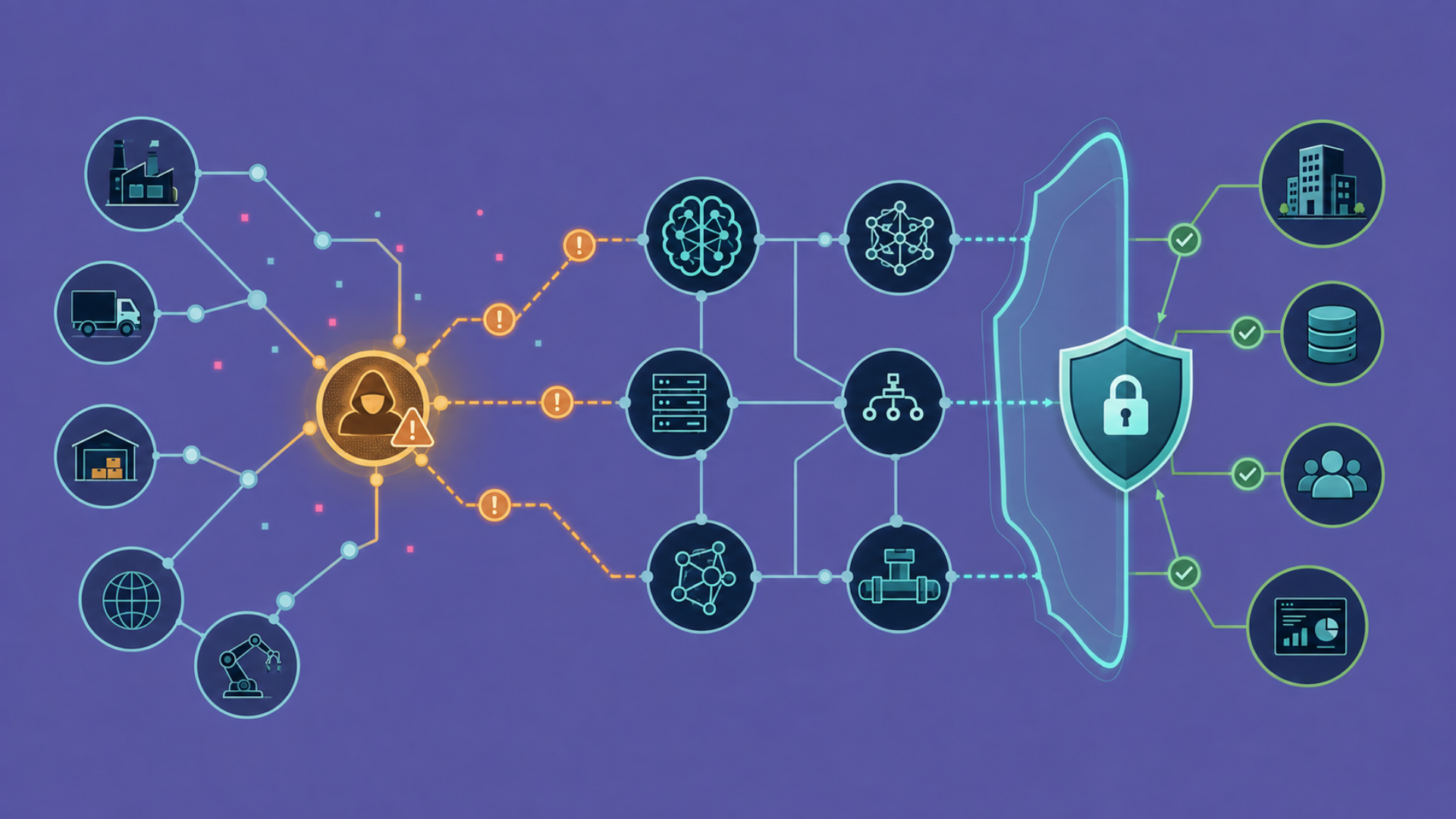
In March 2026, a threat actor group compromised LiteLLM, a widely used open-source AI gateway framework by inserting malicious code into two PyPI package versions. The initial entry point was a security scanner embedded in LiteLLM's own build pipeline. The malicious packages were available for approximately 40 minutes.
The consequences are still unfolding five months later.
More than 2,500 companies and approximately 434,000 CI/CD pipelines were exposed, in what security researchers are calling the largest AI supply chain breach of 2026. The exposed assets are not generic IT credentials. They include model endpoints, AI gateways, vector databases, GPU infrastructure, cloud accounts, and MCP and agentic workflows, the specific infrastructure that enterprises are building their AI programmes on.
The FBI issued a FLASH advisory in July 2026 warning that affiliated actors are likely to weaponise the harvested credentials long after the original intrusion. The breach is not historical. It is active.
The news story here is the breach itself. The enterprise story is what the attack vector reveals about a vulnerability class that most organisations have not yet addressed, and what to do about it before the next attack uses the same approach.
Why This Breach Is Different From Traditional Software Supply Chain Attacks
Software supply chain attacks are not new. The compromise of a widely used open-source component that propagates exposure through dependent organisations has been a documented attack vector for several years.
What makes AI infrastructure supply chain attacks different is the nature of what is exposed.
In a traditional software supply chain attack, the exposed assets are typically credentials to production systems, source code repositories, or internal infrastructure. The exposure is serious. The assets at risk are well-understood by the security teams responsible for protecting them.
In an AI infrastructure supply chain attack, the exposed assets include a category of infrastructure that most enterprise security teams are only beginning to audit: model endpoints, AI gateways, vector databases, and agentic workflows. These are components that sit at the intersection of AI capability and enterprise data, and they carry a specific risk profile that is different from traditional IT infrastructure.
A compromised AI gateway has access to the prompts, context, and outputs of every AI interaction routed through it. A compromised vector database contains the enterprise knowledge that has been embedded for retrieval — which may include sensitive business data, customer records, and proprietary operational information. A compromised agentic workflow can be manipulated to take actions within enterprise systems that are indistinguishable from legitimate AI-initiated actions.
The LiteLLM breach exposed credentials to all of these. High-confidence matches in the exposure dataset include major organisations spanning finance, telecommunications, manufacturing, and defence. The organisations in that list are not organisations that ignored security. They are organisations that had not yet fully extended their security perimeter to cover the AI infrastructure dependencies they were running in production.
The Specific Vulnerability Class the Breach Exploited
Understanding the vulnerability class that enabled this breach is more useful than understanding the specific tools involved, because the same vulnerability class exists in most enterprise AI deployments regardless of which tools they use.
The attack exploited the dependency trust chain in AI infrastructure. Enterprises that deployed LiteLLM trusted it. LiteLLM's build pipeline trusted the Trivy security scanner. Team PCP compromised Trivy within LiteLLM's pipeline. When LiteLLM published the compromised packages, every organisation that updated to those versions pulled the malicious code into their environment, without any action on their part and without any signal that anything had changed.
This is the dependency trust problem at the AI infrastructure layer. Most enterprise AI deployments use open-source frameworks, libraries, and tooling that are themselves dependent on other open-source components. The security of the enterprise AI deployment is, in part, a function of the security of every component in that dependency chain, which the enterprise does not directly control and in many cases is not actively monitoring.
The organisations most exposed in this breach were those whose AI infrastructure had the broadest attack surface in their dependency chain: enterprises running multiple open-source AI frameworks, with ungoverned access between AI infrastructure components and production enterprise systems, without continuous monitoring of the credential exposure that their CI/CD pipelines represented.
This description fits a significant proportion of enterprise AI deployments in 2026, because the speed of AI infrastructure adoption has consistently outpaced the extension of security and governance frameworks to cover it. The same pattern that AI governance research has identified as the primary AI security risk of enterprise AI adoption moving faster than governance, has produced the exposure surface that this breach exploited.
What Your Enterprise Should Do Now
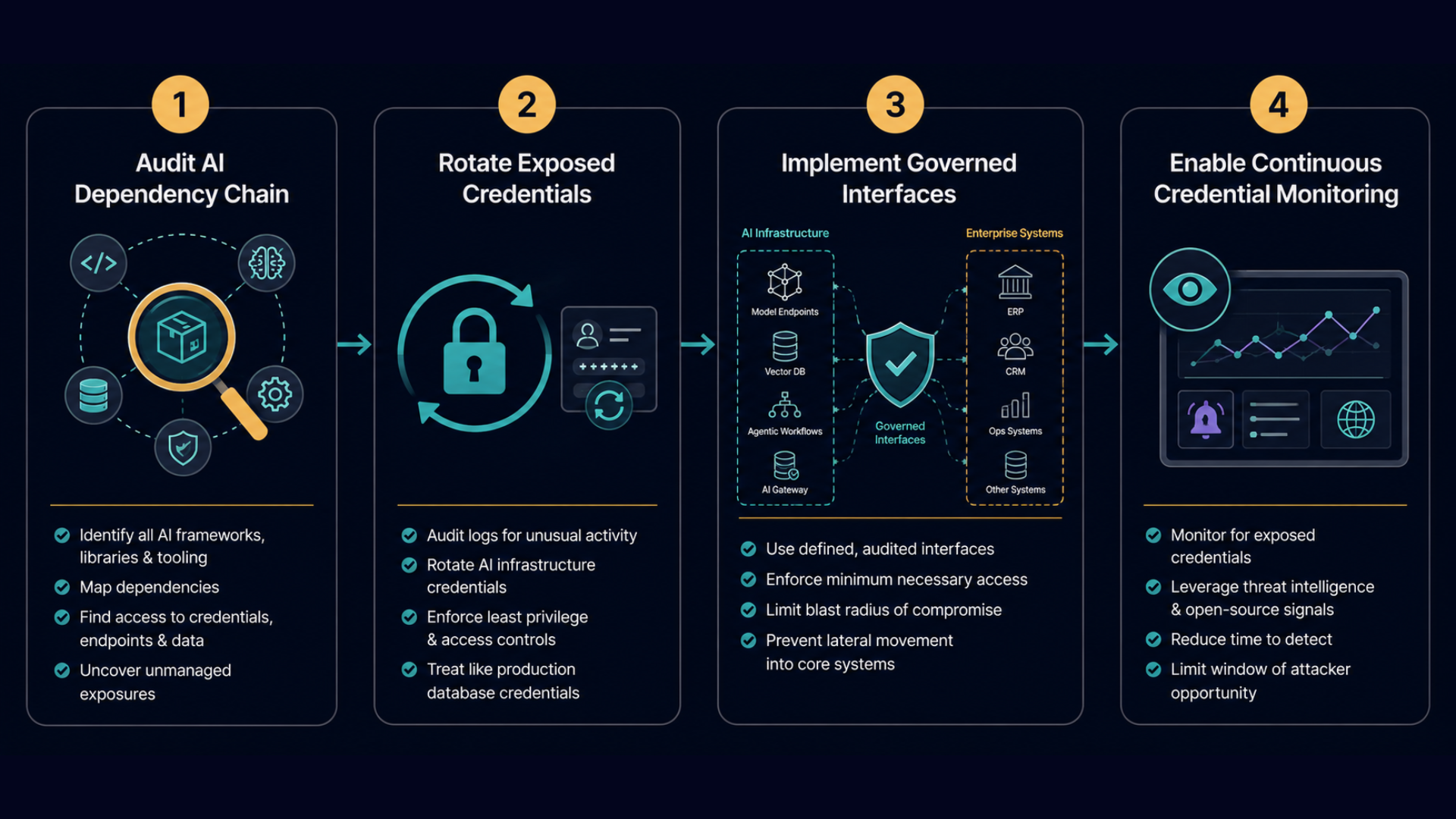
Four actions address the specific vulnerability class that the LiteLLM breach exploited. None of them requires waiting for a security incident to motivate them.
1. Audit your AI infrastructure dependency chain
Most enterprise security teams have well-established processes for auditing production application dependencies. Those processes were built for traditional software stacks. They need to be extended to cover the AI infrastructure layer specifically.
The audit should answer: which open-source AI frameworks, libraries, and tooling are running in your production AI environment? What are the dependencies of those components? Which of those dependencies are actively maintained and monitored for compromise? Which have access to production credentials, model endpoints, or enterprise data?
The answer to this audit will almost certainly reveal dependencies that the security team was not aware of, because AI infrastructure components are frequently introduced by engineering teams building AI applications rather than through the procurement and security review process that traditional software goes through. The audit is the starting point for understanding the actual exposure surface rather than assuming it matches the intended architecture.
2. Rotate credentials associated with AI infrastructure components
If your organisation uses LiteLLM or any component that depends on it, audit AWS CloudTrail and Kubernetes API logs for anomalous activity dating back to March 24, 2026, and rotate any credentials that were accessible to those components. The FBI advisory is explicit that harvested credentials from this breach remain active and are likely to be used in future attacks.
More broadly, the breach is a prompt to audit credential management across AI infrastructure generally. Credentials that provide access to model endpoints, AI gateways, vector databases, and agentic workflow orchestration should be treated as high-sensitivity credentials with the same rotation schedules and access controls as production database credentials. In many organisations, they are not.
3. Separate AI infrastructure from production enterprise systems with governed interfaces
The assets most at risk in the LiteLLM breach are model endpoints, AI gateways, vector databases, and agentic workflows that carry their highest risk when they have ungoverned access to production enterprise systems. An AI gateway that can read from and write to production ERP, CRM, and operational systems without a governed interface is not just an AI infrastructure component. It is a potential pathway into the enterprise's core systems.
The architectural principle that limits this exposure is the same one that governs legitimate enterprise AI deployment: AI systems should interact with production enterprise systems through defined, audited interfaces with minimum necessary access, rather than through direct connections that provide broad access to whatever the AI might need.
This is the AI gateway architecture that well-governed enterprise AI deployments use. It is also the architecture that limits the blast radius of an AI infrastructure compromise, because a compromised AI gateway with governed, minimum-access interfaces to production systems cannot be used to take arbitrary actions in those systems, only the actions that its defined interface permits.
4. Establish continuous monitoring for AI infrastructure credential exposure
The LiteLLM breach was executed in March and reported in August. The five-month gap between compromise and disclosure is not unusual for supply chain attacks. It reflects the challenge of detecting credential exposure in a complex dependency chain rather than detecting an active intrusion.
Continuous monitoring for credential exposure across the AI infrastructure dependency chain, using threat intelligence services that track known compromise indicators across the open-source ecosystem reduces the window between compromise and detection. It does not eliminate the risk of supply chain attacks. It reduces the time that harvested credentials remain active and undetected, which is the metric that determines how much damage an attacker can do with them.
The Governance Architecture That Prevents This Class of Attack
The LiteLLM breach exploited an absence of governance at the AI infrastructure layer. The organisations most exposed were those that had not yet extended their security and governance frameworks to cover the specific components and dependency chains that their AI infrastructure introduced.
This is a solvable problem. The governance architecture that limits exposure to this class of attack has three components.
AI asset inventory as a continuous function, not a point-in-time audit:
The organisations least exposed to supply chain attacks on AI infrastructure are the ones that maintain a continuously updated inventory of every AI component in their environment, including dependencies and the access those components have to enterprise systems. This inventory does not exist in most enterprises, because AI infrastructure is being deployed faster than inventory processes are being updated to cover it.
Security review as a gate for AI infrastructure adoption, not a retrospective:
AI frameworks, libraries, and tooling should go through the same security review process as any other production software dependency before they are deployed, not after they have been running in production for months. This process slows down AI infrastructure adoption at the edges. It significantly reduces the exposure surface that supply chain attacks can exploit.
Governed interfaces between AI infrastructure and production systems as an architectural standard:
The architectural decision to route all AI interactions with production enterprise systems through governed, audited interfaces — rather than allowing AI components direct access to production databases, APIs, and credentials — is the single most effective structural defence against the class of attack the LiteLLM breach represents. A compromised AI component with governed minimum-access interfaces cannot be weaponised to take arbitrary actions in production systems. A compromised AI component with direct production access can.
This is the governance architecture that regulated industry AI deployments have been building around compliance requirements. The LiteLLM breach makes the case that it is the right architecture for any enterprise deploying AI at scale, not just those with explicit regulatory obligations.
What This Means for How Enterprises Deploy AI Going Forward
The LiteLLM breach will not be the last AI infrastructure supply chain attack. The attack surface is expanding as enterprise AI deployment accelerates. The dependency chain complexity is increasing as AI applications stack multiple frameworks, libraries, and tooling. The value of what sits behind AI infrastructure credentials is growing as AI systems gain deeper access to enterprise data and operational systems.
The response that will limit exposure to future attacks of this class is not primarily technical. It is organisational: extending the security and governance frameworks that enterprises already have for traditional IT infrastructure to cover the AI infrastructure layer specifically, before the next attack rather than in response to it.
The forward deployed engineering model that builds governance into AI deployment architecture from day one, rather than retrofitting it after an incident is precisely the model that produces AI deployments with the credential management, access controls, and monitored interfaces that limit exposure to supply chain attacks. Not as a security feature added on top, but as an architectural characteristic built in from the start.
The difference between the organisations that were exposed in the LiteLLM breach and those that were not is, in large part, the difference between AI infrastructure that was deployed with governance and AI infrastructure that was deployed without it.
Vishleshan AI's forward deployed engineers build enterprise AI systems with governed interfaces, minimum-access architectures, and audit trails from day one — across automotive, FMEG, financial services, and supply chain environments where the consequences of ungoverned AI infrastructure are most acute. Book a Consultation