


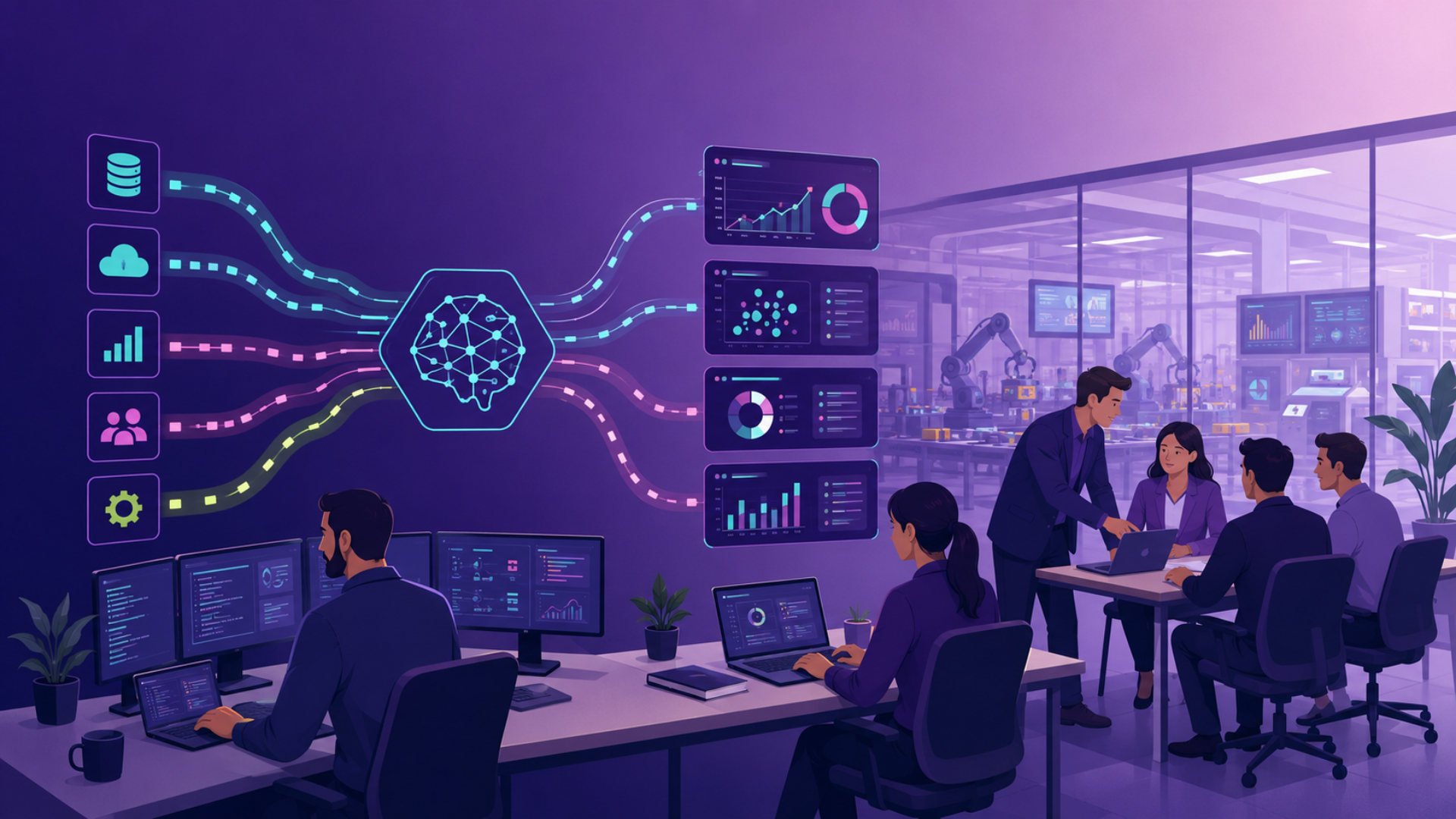
Every major AI company is now building a forward deployed engineering practice. In the past six months alone, major platform vendors, consulting firms, and AI labs have all formally launched FDE organisations, announced significant investments in the model, and published their definitions of what it means to embed engineers inside client environments.
At Vishleshan AI, forward deployed engineering is not a new practice we are launching in response to industry trends. It is the operating model we were built around, engineers embedded inside client environments, working against actual systems and data, accountable to business outcomes rather than delivery milestones.
This piece explains what that means in practice at Vishleshan AI, how we work, what we measure ourselves against, and what enterprises working with us can expect.
Why We Built Around This Model From the Start
Vishleshan AI was founded on a specific belief about enterprise technology delivery: the hard part is never the technology.
The technology is increasingly capable. Models are powerful. Platforms are mature. The gap that consistently separates enterprises that extract value from AI from those that do not is not access to the right tools. It is the ability to make those tools actually work inside a specific organisation's operational environment, with that organisation's specific data, systems, constraints, and people.
That gap cannot be closed from the outside. It cannot be closed through requirements documents, scoping exercises, and handovers. It can only be closed by engineers who are inside the environment where the AI needs to work, who understand how that environment actually operates rather than how it is documented to operate, and who stay accountable until the system is genuinely running in production and generating the business outcome it was designed to produce.
We have seen what happens when this principle is applied consistently across deployments in automotive manufacturing, consumer electricals distribution, financial services, and supply chain operations. The outcomes are measurably better. The timelines are shorter. The adoption rates are higher. And the knowledge accumulated in each deployment makes the next one faster and more capable.
This is why forward deployed engineering is not a practice we are launching. It is the operating model we have always built around.
What Makes Our FDE Model Work
Four things converge to make forward deployed engineering at Vishleshan AI deliver outcomes rather than just deployments.
1. Engineers who work inside your environment from day one.
Our forward deployed engineers are not stationed in a delivery centre building against a specification. They are embedded inside your actual operating environment from the first day of the engagement. Working against your actual ERP. Against your actual production data. Inside your actual compliance framework. Attending the meetings where real business decisions are made.
This is not a methodology. It is a physical and operational commitment. The constraints that derail most enterprise AI deployments, the undocumented ERP customisation, the data quality gap in a specific field, the compliance interpretation that applies in practice but not in policy, are discoverable only from inside the environment. Our engineers discover them early, when they are cheap to address, rather than at integration time, when they require expensive rework.
2. A named business constraint as the starting point, not a capability.
Every Vishleshan AI engagement begins with a specific, measurable business problem. Not "explore how AI can improve our operations." A fill rate that is 12 percent below target. A supplier response time that is costing bookings. A procurement cycle that is adding weeks to a supply chain.
When the constraint is that specific, every architecture decision has a clear answer. Does this component help close the gap on the named metric or not? This discipline keeps deployments focused on production outcomes rather than impressive capabilities that do not connect to revenue.
3. Integration with what exists, not replacement of it.
We layer AI on top of your existing ERP and legacy systems rather than replacing them. This is not a compromise. It is a deliberate design principle. Enterprises that have spent decades building operational infrastructure are not going to replace it to accommodate an AI deployment. And they should not have to.
Our forward deployed engineers build the integration architecture that connects AI to the systems your business already runs on, making them more intelligent and more capable without disrupting the operational foundation they represent. The AI reads from your ERP in real time. It reasons within your business rules and approval hierarchies. It writes actions back into your systems of record through governed interfaces. Your ERP remains the system of record. The AI layer makes it act on what it knows.
4. Accountability that extends through to adoption.
Our engagements do not conclude when a system is technically deployed. They conclude when the system is genuinely being used by the people it was built for and generating the measurable business outcome it was designed to produce.
Technical delivery without adoption is not a success. A system that is live in the environment but ignored in practice has not generated revenue impact. Our forward deployed engineers stay present through the early weeks of production operation, ensuring that the transition from deployment to genuine operational use is complete before accountability transfers.
What You Can Expect From a Vishleshan AI FDE Engagement
A named use case and a production deployment within a defined timeline:
We do not run indefinite pilots. We start with a specific business constraint, build against your actual environment, and deliver a production system within a defined engagement window. That window is set at the start based on the complexity of your environment and the scope of the constraint, not extended indefinitely as new requirements surface.
Engineers, not account managers:
The first conversation about your environment is led by the engineers who will be embedded in it. They evaluate your integration environment, understand your data and systems, and design the engagement based on what they find, not on a generic methodology applied from the outside. The team that scopes the engagement is the team that delivers it.
Outcome-aligned measurement:
We measure engagements against the business metric that justified the initiative, not against delivery milestones. The fill rate, the response time, the procurement cycle. If the metric does not move, the engagement has not succeeded, regardless of what has been built and deployed.
Knowledge that stays with you:
Every engagement is structured to transfer the operational and technical knowledge accumulated during deployment to your internal teams. The data quality discoveries, the integration patterns that work in your environment, the governance mechanisms that satisfy your compliance framework: these are documented and transferred, not retained as dependency-creating information that requires you to come back to us for every subsequent initiative.
Deployment in the sectors we know deeply:
Our forward deployed engineers bring domain expertise accumulated across hundreds of deployments in automotive manufacturing and dealer operations, consumer electricals distribution and channel management, financial services, and supply chain and procurement. That domain expertise is not general familiarity. It is the accumulated knowledge of how AI actually needs to work in these specific operational environments, which reduces the discovery cost in each new engagement and improves the quality of the systems we build.
The Sectors We Deploy In
Automotive and mobility:
We have deployed AI across the full automotive value chain, from supplier performance monitoring and supply chain disruption detection to dealer order intelligence, parts availability optimisation, and field service operations. Our forward deployed engineers understand the IATF quality framework, the ERP configurations typical of automotive manufacturers, and the dealer network dynamics that determine whether channel AI actually gets adopted.
Consumer electricals and consumer durables:
We have deployed AI across consumer electricals distribution networks, from real-time dealer visibility and secondary sales intelligence to field sales productivity and channel scheme optimisation. Our engineers understand how consumer electricals distribution channels actually operate, how data flows from distributor to sub-distributor to retailer, and where the gaps between reported and actual channel performance create opportunities for AI-driven improvement.
Financial services:
We deploy AI in financial services environments under the compliance and governance constraints that make deployment in this sector significantly more complex than in unregulated ones. Audit trails, explainability requirements, model risk management frameworks, and data governance obligations are built into the deployment architecture from day one, not retrofitted before a compliance review.
Supply chain and procurement:
We deploy AI across procurement, supplier management, and supply chain operations, from vendor onboarding automation and purchase order processing to demand forecasting, inventory optimisation, and supply chain disruption detection.
How We Are Different From What You Have Seen Before
Most enterprise AI delivery looks like one of three things: a platform vendor who sells you a product and helps you configure it, a consulting firm that advises on strategy and hands off to an implementation team, or a systems integrator that delivers defined scope from a delivery centre at a distance from your environment.
Each of these models has its place. None of them is structured to close the gap between a working pilot and AI that actually generates revenue impact inside your specific environment.
Vishleshan AI is none of those things. We are a forward deployed engineering practice. Our engineers build inside your environment, against your systems, accountable to your outcomes. We do not sell you a platform and leave you to implement it. We do not produce a strategy and hand off to someone else to execute. We build the production AI system ourselves, inside your environment, and we stay until it is genuinely working.
This is the model the enterprise AI industry is converging on because it is the model that actually works. We have been building this way since Vishleshan AI was founded.
What Comes Next
The enterprises that are pulling ahead in AI are not the ones with the best models or the largest AI budgets. They are the ones that have moved from pilot to production, from workflow improvement to revenue impact, and from isolated AI experiments to AI that is genuinely embedded in how the business operates.
That transition requires the right delivery model. Not a better platform. Not a more detailed strategy. Engineers who are inside your environment, building against your actual constraints, accountable to the business outcome you are trying to achieve.
That is what Vishleshan AI's forward deployed engineers do. Contact us to start your first FDE engagement