



One or more large systems integration firms has almost certainly delivered technology programmes for the organisation over the years. The relationship is established, the procurement process is familiar, and the delivery model is well understood.
Now those same enterprises are hearing about forward deployed engineering (FDE). And a reasonable question is forming in the minds of CIOs and CDOs who are already managing SI relationships: what does an FDE actually do that my SI does not?
It is a fair question. The honest answer is that the two models are not competing for the same work. They are built for different problems, operate on different timelines, and succeed or fail in different ways. Confusing them leads to either underusing what forward deployed engineering can offer, or expecting something from an SI that the model was never designed to deliver.
What Systems Integrators Are Built For
Systems integration is one of the most important capabilities in enterprise technology. At its best, it is what allows large, complex organisations to connect disparate systems, implement platforms at scale, and manage the organisational change that major technology deployments require.
The SI model is built around a specific set of strengths.
Scale. A large SI can mobilise hundreds of people across multiple geographies simultaneously. When an enterprise needs to roll out an ERP across 40 countries in 18 months, that deployment capacity is what makes it possible.
Process. SI firms have developed mature methodologies for managing large, complex programmes, governance frameworks, quality assurance processes, risk management structures, change management playbooks. These exist because large programmes fail without them.
Breadth. A major SI has practice areas spanning every technology domain of cloud, security, data, AI, ERP, CRM and can provide a single commercial relationship covering all of them.
These are genuine strengths. They are also, in many cases, the wrong set of strengths for the specific problem that enterprise AI deployment presents in 2026.
Where the SI Model Struggles With AI
The SI model was designed for a world where requirements could be defined upfront, scoped into a contract, and delivered against a project plan. That world still exists for certain categories of technology work. Enterprise AI deployment is frequently not in that category.
AI initiatives have a specific failure pattern that the SI model is not well-equipped to address. The use case seems clear at the start. A pilot is built, it works technically, it gets signed off. Then the real integration begins and the complexity of connecting AI to live enterprise systems, in a specific organisation's actual data environment, with all the undocumented constraints and workarounds that have accumulated over years of operation, turns out to be significantly larger than the scoping exercise captured.
At that point, a traditional SI engagement has three options. Raise a change request and extend the timeline. Deliver what was scoped and leave the integration gap for the client to manage. Or absorb the cost and margin hit internally.
None of these options produce AI in production. They produce delivered projects, extended timelines, or absorbed losses and an enterprise that is no closer to the operational outcome it needed.
This is not a criticism of SI firms. It is a description of what happens when a delivery model optimised for defined scope meets a problem that is fundamentally about navigating undefined complexity.
What Forward Deployed Engineering Is Built For
Forward deployed engineering is built specifically for the problem the SI model struggles with, getting AI from a working pilot to genuine production inside a complex enterprise environment.
The model operates differently at every level.
Where an SI team works from a specification, a forward deployed engineer works from inside the client's actual environment. Where an SI engagement is scoped upfront, an FDE engagement adjusts continuously as real constraints surface. Where an SI measures success at delivery, a forward deployed engineer measures success at production adoption, the system is genuinely being used, generating the business outcome it was built to produce.
The team size is also different. Forward deployed engineering typically involves a small, senior, technically deep team of engineers who can work across the full stack, understand the business context they are operating in, and make judgment calls without escalating through a governance structure. The SI model, by contrast, requires a larger team to manage the coordination overhead of a defined-scope programme.
That difference in team structure is not incidental. It reflects a fundamental difference in what the two models are trying to do. An SI programme manages complexity through process and governance. An FDE engagement navigates complexity through proximity and judgment.
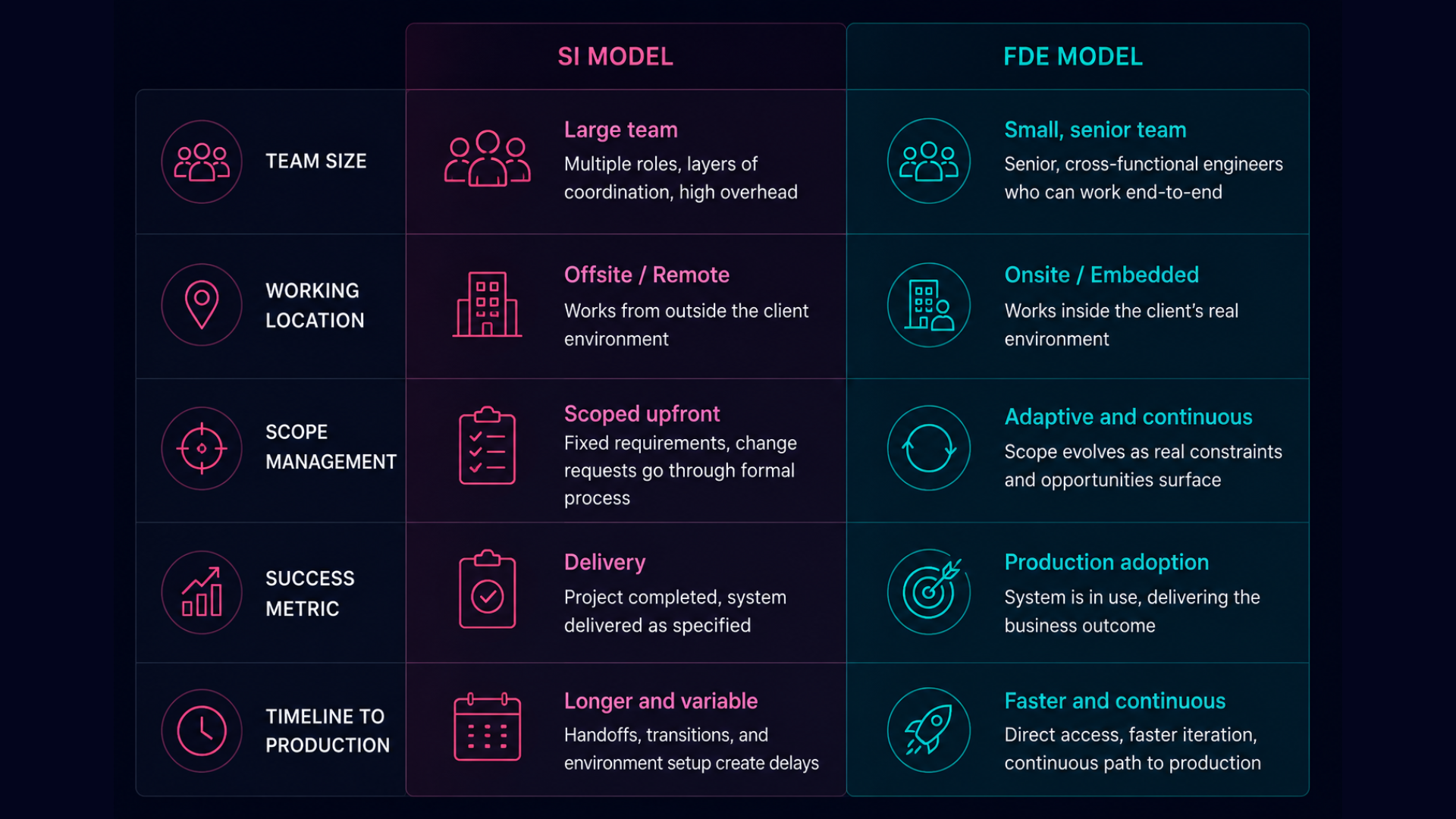
A Direct Comparison
Systems Integrator | Forward Deployed Engineer | |
|---|---|---|
Team size | Large, structured, multi-track | Small, senior, full-stack |
Works from | Defined specification | Inside client environment |
Scope | Fixed at contract | Adjusted continuously |
Success measured at | Delivery and sign-off | Production adoption |
Timeline | Months to years | 90 days to production |
Strength | Scale, process, breadth | Integration depth, speed, outcomes |
Failure mode | Delivers to spec, misses integration | Depends on partner capability |
Best for | Large platform rollouts, ERP implementations | AI deployment in complex environments |
The Specific Problem FDE Solves That SI Cannot
There is one specific capability that forward deployed engineering provides that the SI model structurally cannot, and it is the capability that matters most for enterprise AI in 2026.
Discovery inside the actual environment.
An SI team conducting a discovery phase does so through interviews, workshops, and documentation review from outside the operational environment. The output is a requirements document that captures what the client can articulate about how their systems work.
A forward deployed engineer conducts discovery from inside the environment working in the actual ERP, against actual data, present when the edge cases and undocumented constraints surface in real operations. The output is not a requirements document. It is a direct understanding of how the environment actually works, which is rarely identical to how it is documented.
This distinction is the primary reason that 95 percent of enterprise AI pilots produce no measurable P&L impact, according to research examining 300 public AI deployments. The pilots worked technically. The integration into real production environments did not because the integration environment was never fully understood before the build committed to a direction.
Forward deployed engineering exists to close that gap. It is not a better version of systems integration. It is a different model for a different problem.
When to Use Each Model
The two models are not mutually exclusive. The most effective enterprise technology programmes often use both at different stages, for different purposes.
Use a systems integrator when the requirements are well-defined, the integration environment is well-documented, the delivery needs to scale across multiple locations or business units simultaneously, and the primary risk is programme management and change management rather than integration complexity.
Use forward deployed engineering when the use case involves AI in a complex, partially-understood integration environment, the timeline demands production outcomes in weeks rather than months, the requirements will evolve as the real environment is understood, and accountability needs to extend through to genuine adoption rather than ending at technical delivery.
For automotive manufacturers, consumer electricals enterprises, and financial services organisations deploying AI in 2026, the second set of conditions typically describes the situation accurately. The integration environments are complex, the requirements evolve, and the gap between a working pilot and genuine production adoption is precisely where value disappears.
What to Ask When Evaluating the Right Model
Three questions consistently clarify which model is needed for a specific initiative.
How well understood is the integration environment before the engagement starts? If the answer is "fully documented and stable," an SI engagement is viable. If the answer is "partially documented, with customisations and workarounds we have not fully mapped," forward deployed engineering will close the integration gap faster and at lower overall cost.
What is the timeline for production outcomes? If the business case requires AI running in production within 90 days, the SI model cannot deliver that. Forward deployed engineering is designed specifically for that timeline.
Where does accountability end? An SI engagement ends at delivery. A forward deployed engineering engagement ends at production adoption. If adoption risk is a concern, and for AI initiatives it almost always is the accountability structure of the model matters as much as the technical capability.
Vishleshan AI's forward deployed engineers work inside client environments across automotive, consumer electricals, financial services, and supply chain, taking AI from a named use case to production in 90 days. The model exists specifically to close the gap between a working pilot and AI that actually operates inside the business. Book a Consultation