


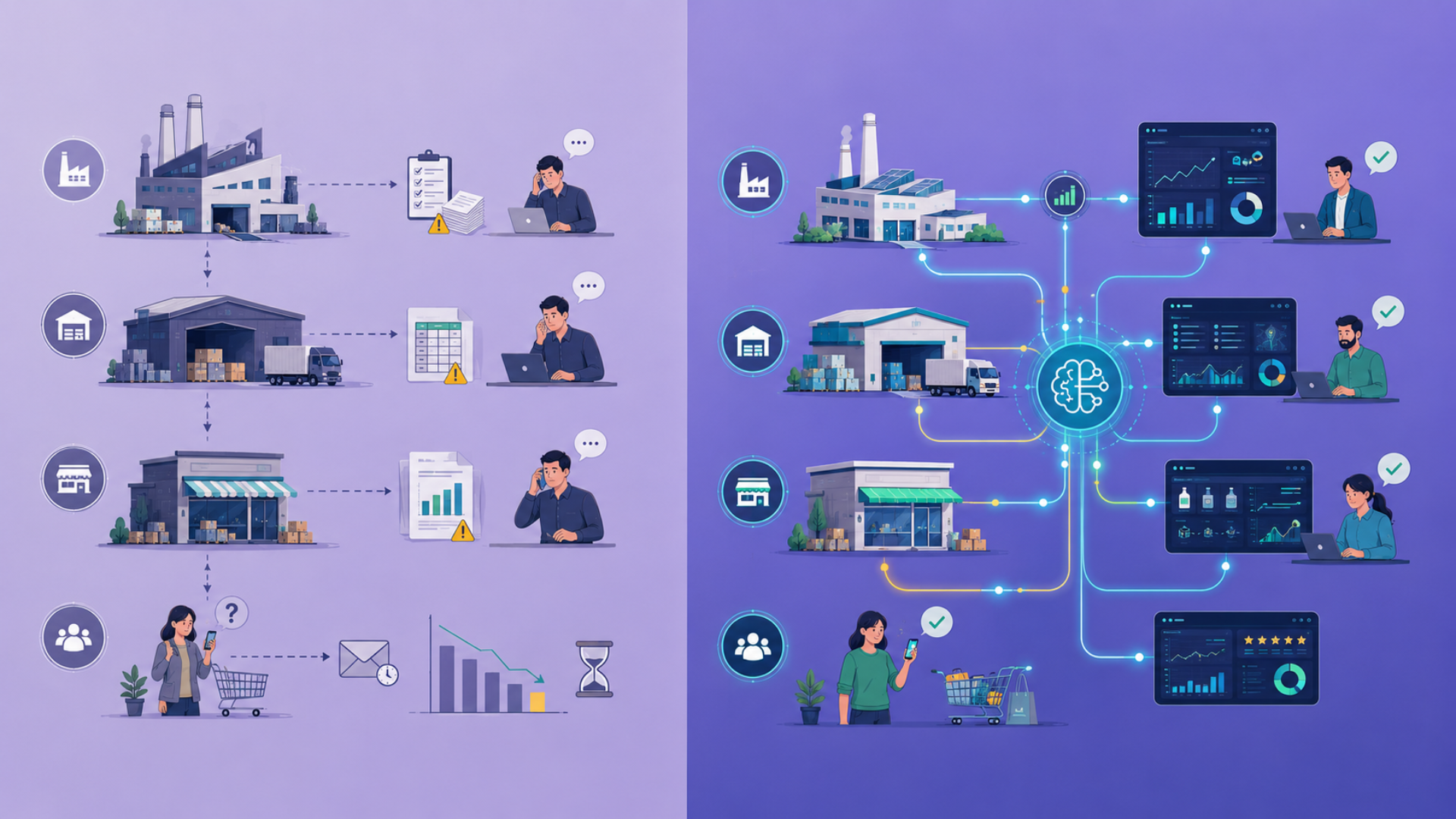
AI adoption in the Consumer Electricals sector has reached near-universal levels at the pilot stage. Almost every large Consumer Electricals company has run AI initiatives across supply chain, channel management, demand forecasting, and field sales productivity. The conference presentations have been made. The proofs of concept have been demonstrated. The press releases have been issued.
Revenue impact has not reached anything like the same level of universality.
The Consumer Electricals companies that are genuinely pulling ahead with AI are not the ones running the most initiatives or investing the most in AI tools. They are the ones that have made a different set of decisions about how AI connects to their operations, how it is measured, and what it is accountable for. Those decisions are not widely discussed, partly because they are less glamorous than technology announcements, and partly because the companies that have made them correctly understand that the advantage they create is worth protecting.
This piece covers what those decisions are and why they produce different outcomes.
The Consumer Electricals AI Gap in Context
The gap between AI adoption and AI revenue impact is visible across enterprise sectors. In Consumer Electricals it is particularly pronounced because the sector's operating complexity, multi-tier distribution channels, highly variable demand at the dealer level, fragmented secondary sales data, and field sales teams operating across hundreds of thousands of touchpoints, creates an environment where AI that works in a demonstration consistently fails to work in production.
The reasons are structural. Consumer Electricals operations generate enormous volumes of data at every level of the channel, but that data is distributed across systems that do not share a common format, updated at different frequencies, and subject to quality variations that reflect the diversity of the dealer network itself. AI deployed into this environment without the data engineering work that makes the data usable will produce confident-looking outputs that experienced field teams quickly learn not to trust.
The Consumer Electricals companies that have closed this gap have done so by making investments that do not look like AI investments from the outside. They are data infrastructure investments, organisational design investments, and delivery model investments. The AI sits on top of those foundations, and it works because the foundations are right.
What Top Performers Are Doing Differently
1. They embedded AI in channel intelligence rather than adding it on top
The most common AI deployment pattern in Consumer Electricals is additive: existing reporting processes are unchanged, and AI-generated insights are made available alongside them. A regional sales manager still receives the same weekly performance report. An AI dashboard is also available if they choose to look at it.
This pattern produces adoption rates that decline over time. When AI generates insights that contradict what experienced field teams believe they know, or when the insights require additional effort to act on within unchanged workflows, the path of least resistance is to stop using the AI and rely on established practices.
Top performing Consumer Electricals companies have made a different design choice. They have embedded AI into the workflows that already determine how the business runs, rather than creating parallel AI-generated workflows that compete with them. The regional sales manager does not receive a weekly report and an AI dashboard. They receive an AI-generated priority list that has replaced the weekly report, structured around the interventions most likely to move performance in their territory this week, with the weekly report data available as supporting context rather than primary input.
This is not a technology change. It is a workflow redesign that makes AI the primary intelligence source rather than an additional one. It requires organisational will to change how decisions are made, not just technical capability to generate AI outputs.
2. They invested in real-time data infrastructure before deploying AI
The second distinguishing investment is one that never appears in AI announcements because it is not AI: real-time data infrastructure that makes secondary sales, inventory, and dealer behaviour data available to AI systems in hours rather than days.
Most Consumer Electricals companies know their primary sales data in near real-time. They know what left the warehouse. Secondary sales data, what actually reached the end customer through the dealer network, arrives with a lag that ranges from days to weeks depending on how dealer reporting is structured. That lag is the gap where competitors move, where inventory imbalances develop, and where dealer performance problems compound before they are visible.
Top performers have made the infrastructure investment that closes this lag. Not by asking dealers to change how they report, which creates friction that undermines adoption, but by connecting to the transaction signals that dealers generate naturally in the course of their operations and aggregating them in near real-time through a unified data layer that sits above the heterogeneous systems the dealer network runs on. The approach mirrors how enterprise AI works alongside legacy ERP in manufacturing: layering intelligence on top of existing systems rather than requiring those systems to change.
The AI that runs on this real-time data produces outputs that field teams can act on immediately. The AI that runs on weekly batch data produces insights that are accurate about a situation that has already changed.
3. They structured accountability for AI outcomes at the business level, not the technology level
The third distinguishing characteristic is organisational rather than technical. Top performing Consumer Electricals companies hold AI outcomes to the same standard as any other business outcome: clear ownership at the function level, clear metrics, and clear accountability for whether the AI is moving those metrics.
In most Consumer Electricals companies, AI is owned by the technology function. Business functions are users of AI tools. The technology function measures success at adoption rates and system performance. Business functions measure success at sales targets, market share, and channel fill rates. Nobody is accountable for the line between the AI's outputs and the business results those outputs are supposed to produce.
Top performers have closed this accountability gap by making AI outcomes a shared metric between the technology team that maintains the AI systems and the business function that acts on them. If the AI is generating dealer intervention recommendations and dealer performance is not improving, both the technology team and the business function need to answer for that gap. That shared accountability changes how both sides engage with the AI: the technology team ensures it is producing actionable outputs rather than impressive analytics, and the business function ensures it is acting on those outputs rather than defaulting to established practices.
This is the same accountability structure that research on enterprise AI revenue impact consistently identifies as a differentiator between the enterprises seeing revenue outcomes and those seeing only workflow changes.
4. They deployed AI with the engineering depth that channel complexity requires
The fourth distinguishing characteristic is in how AI is deployed rather than what AI is deployed.
Consumer Electricals channel operations are genuinely complex. The dealer network is large, heterogeneous, and distributed across geographies with different market dynamics. The data is fragmented across systems that were not designed to interoperate. The business rules that govern pricing, scheme eligibility, credit limits, and approval workflows are numerous, partially documented, and implemented inconsistently across different channel tiers.
AI that works in this environment needs to have been built inside it, against the actual data, with the actual business rules encoded in its architecture, by people who understood the channel complexity before they designed the system. AI that was built against a cleaned and normalised dataset in a development environment and then deployed into the actual channel complexity will produce outputs that reflect the cleaned environment, not the actual one.
Top performing Consumer Electricals companies have consistently deployed AI using forward deployed engineers who work inside the channel operations environment, understand how the dealer network actually works rather than how it is documented to work, and build AI that fits the operational reality rather than requiring the operational reality to be simplified to fit the AI.
This is the deployment model difference that produces the results difference. The same AI capability, deployed by a team working from a specification at a distance from the channel, consistently produces lower adoption and lower impact than the same capability deployed by engineers embedded inside the operational environment.
The Specific Use Cases Where the Performance Gap Is Widest
Across Consumer Electricals operations, the performance gap between top performers and the rest is most visible in three specific use case areas.
Dealer performance intelligence:
Top performers have AI that identifies underperforming dealers three to four weeks before the underperformance appears in formal reporting, using signals from ordering behaviour, scheme activation patterns, and field visit data. The intervention happens when it can still prevent the underperformance rather than after the monthly review has confirmed it. Most Consumer Electricals companies have the data to do this. Top performers have the data infrastructure and deployment model that makes it work reliably.
Inventory rebalancing across the channel:
Top performers have AI that detects developing inventory imbalances across the dealer network in near real-time and recommends rebalancing actions that account for transfer cost, demand forecasts, and seasonal patterns simultaneously. This prevents the margin-destroying combination of stockouts at high-demand dealers and excess inventory at low-demand ones that consistently characterises poorly managed channel operations. The competitive advantage is not in the AI capability itself but in the real-time data infrastructure that makes the AI's recommendations current enough to act on.
Field sales productivity and territory intelligence:
Top performers have AI that gives field sales managers a prioritised intervention list each morning, structured around the dealers in their territory where action this week will have the most impact on targets this month. The field manager's judgment determines how to engage with those dealers. The AI determines which dealers to engage with and in what sequence. This shift from the field manager doing their own territory analysis to the AI doing it and the field manager acting on it produces measurable improvements in call quality and conversion without requiring the field team to change how they sell.
What Makes the Difference Replicable
The performance characteristics of top Consumer Electricals AI performers are not proprietary technology advantages. They are organisational and delivery model advantages that any Consumer Electricals company can replicate with the right sequencing of investments.
The sequence that works consistently is: invest in real-time data infrastructure first, then design the workflow changes that embed AI in existing operations rather than alongside them, then build the accountability structures that make AI outcomes a shared business metric, and deploy AI with the engineering depth that channel complexity requires.
None of these steps is technically exotic. All of them require organisational commitment to change how the business operates rather than just adding AI tools to how it currently operates. That distinction, between AI that augments an unchanged operating model and AI that requires the operating model to change around it, is the deepest characteristic that separates top Consumer Electricals AI performers from the rest.
Vishleshan AI has deployed AI across Consumer Electricals distribution networks and dealer channel operations, building the data infrastructure, workflow integration, and governance architecture that makes channel AI work in production. Our forward deployed engineers work inside client channel environments to build AI that fits the operational reality rather than requiring it to change. Book a Consultation