


Most large enterprises in 2026 are AI-enabled. They have deployed AI tools across functions. They have productivity improvements to show. They have dashboards that report AI adoption rates and use case counts.
Very few are AI-native.
The distinction sounds like a semantic one. It is not. It describes a fundamental difference in how AI relates to the operating model of the business, and it largely determines whether AI delivers the kind of competitive advantage that compounds over time or the kind of efficiency improvement that competitors can replicate in a year.
Understanding the distinction clearly, and knowing where your organisation sits on the spectrum, is the starting point for building an AI programme that actually moves the business forward.
The Definitions That Actually Matter
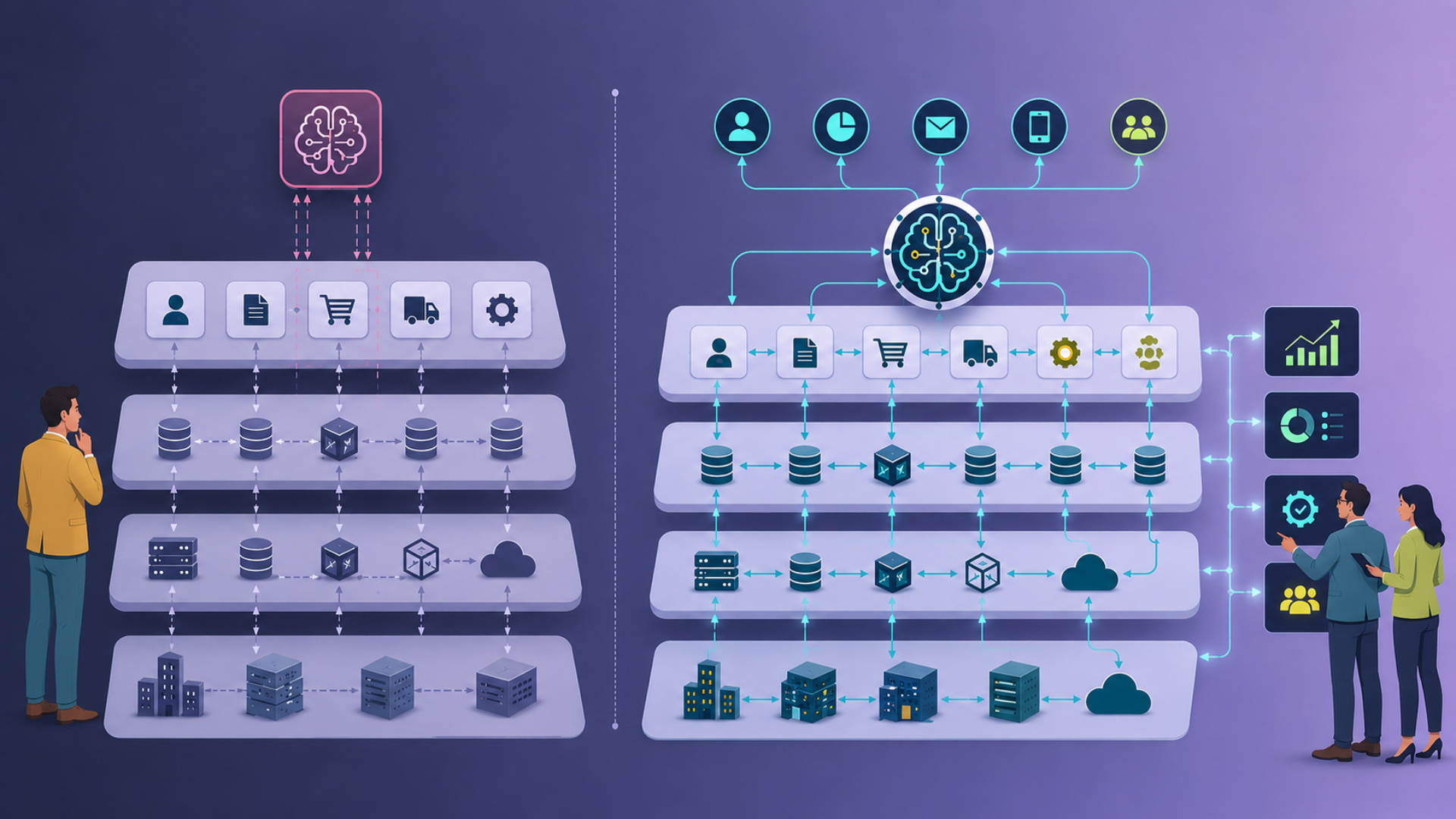
An AI-enabled enterprise has added AI to existing processes. The operating model was built for a world without AI, and AI has been layered on top of it. The procurement team that now uses an AI tool to analyse supplier data is AI-enabled. The customer service organisation that has deployed a chatbot to handle first-tier queries is AI-enabled. The manufacturing plant that runs an AI-powered quality inspection system alongside its existing quality management process is AI-enabled.
These are genuine improvements. They are not transformations.
An AI-native enterprise has redesigned its operating model around AI. The workflows were designed with AI as an architectural component, not added to existing workflows as an enhancement. AI agents are not productivity tools that humans choose to use. They are defined actors in the operational architecture with specific roles, autonomy levels, and constraints. The operating model, the products, and the decision-making processes were designed around intelligence from the ground up rather than retrofitted with intelligence on top of what already existed.
The cleanest way to distinguish the two is to ask what would happen if you removed the AI. In an AI-enabled enterprise, you would lose efficiency. The processes would slow down and the tools would be missed. But the operating model would still function because it was not designed around AI. In an AI-native enterprise, removing AI would not produce a slower version of the existing operating model. It would produce an incoherent one, because the operating model was designed with AI as a structural component.
Why This Distinction Is Getting More Attention Now
The concept of AI-native has been in circulation for several years, but it has moved from a technology discussion to a boardroom-level one in 2026 in a way that it was not before.
At the WAIC 2026 Entrepreneurs' Forum, AI-native organisation was placed squarely at the centre of the agenda, with the forum drawing an explicit line: the era of single-point tool optimisation is giving way to whole-domain organisational reshaping. Deloitte's Tech Trends 2026 report names this shift "The Great Rebuild," where enterprises are not merely adopting AI tools but re-architecting their entire operations to run natively on AI.
The reason it has moved to board level is that the performance gap between AI-native and AI-enabled enterprises is becoming visible in commercial results. Targeted AI deployments are showing 15 to 40 percent efficiency improvements in specific functions, but gains that multiply when successful use cases scale across the enterprise are only visible in organisations that have redesigned their operating model to allow that scaling. AI-enabled enterprises capture the first number. AI-native enterprises capture the second.
What AI-Native Actually Looks Like in an Enterprise Context
For a large manufacturer, an consumer electricals distributor, or a financial services organisation, AI-native does not mean rebuilding from scratch. It does not require replacing existing ERP systems, dismantling existing processes, or starting over. That is the most common misconception and the one that most frequently causes leadership teams to defer the redesign indefinitely.
Existing cloud-native products can evolve into AI-native versions. The distinction is whether the redesign has happened, not when the company was founded.
What AI-native requires is a deliberate redesign decision: which parts of the operating model are we going to rebuild around AI rather than just augmenting with AI tools?
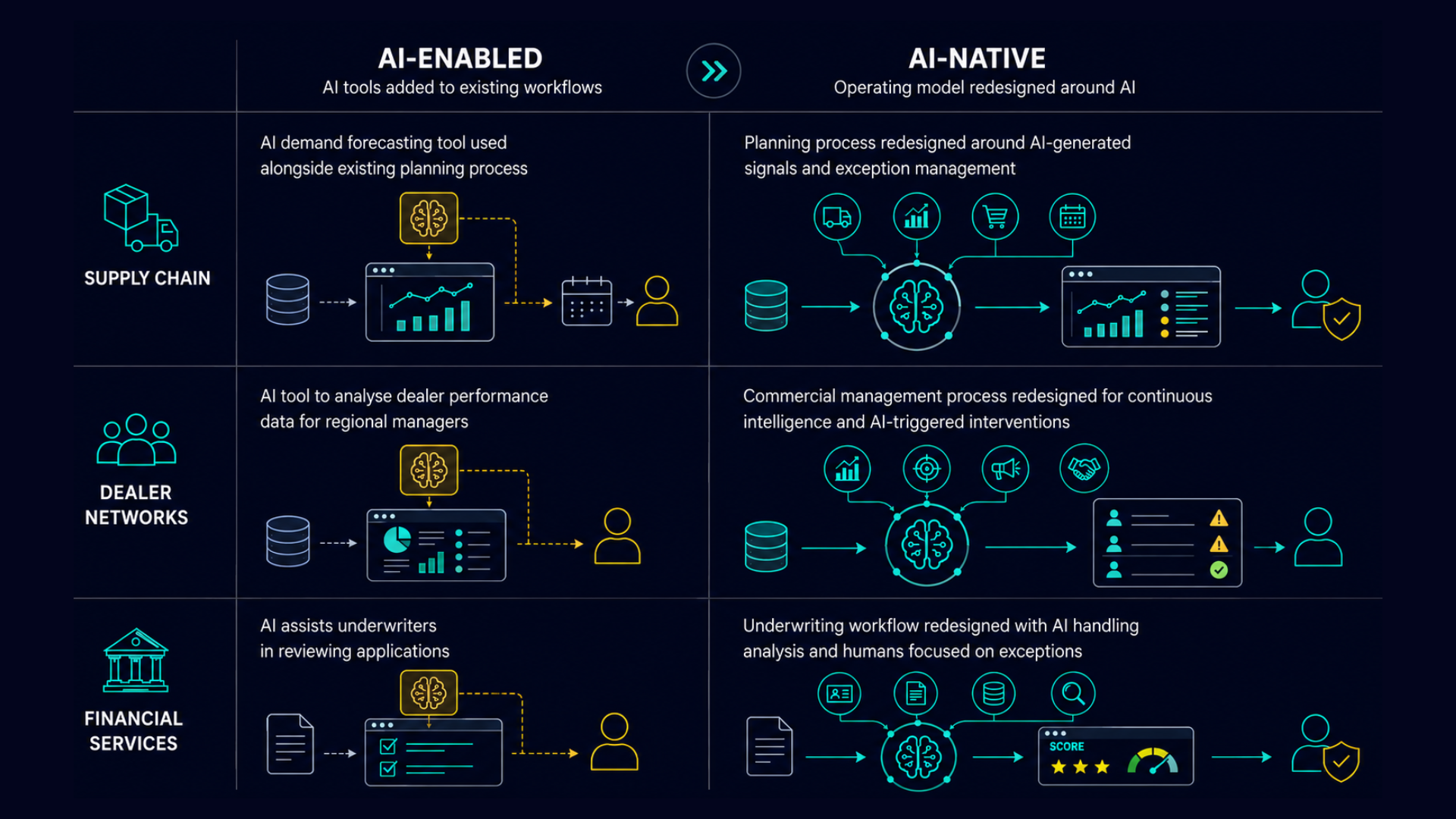
In a supply chain context, an AI-enabled approach deploys a demand forecasting tool that analysts use alongside their existing planning process. An AI-native approach redesigns the planning process itself around AI-generated demand signals, with the human planner's role shifting from producing the forecast to governing the AI's assumptions and managing the exceptions it surfaces.
In a dealer network context, an AI-enabled approach gives regional sales managers an AI tool to analyse dealer performance data. An AI-native approach redesigns the commercial management process so that dealer performance intelligence is continuous rather than periodic, interventions are triggered by AI-detected signals rather than monthly reports, and the regional manager's role shifts from generating analysis to making decisions the AI has prepared.
In a financial services context, an AI-enabled approach deploys AI to assist underwriters in reviewing applications. An AI-native approach redesigns the underwriting workflow so that AI handles the analysis, scoring, and documentation, and the underwriter's role is focused on the subset of cases where judgment and exception handling genuinely require human expertise.
In each case, the difference is not the AI tool. It is whether the operating model was redesigned around what the AI makes possible.
The Three Barriers That Keep Enterprises AI-Enabled
Most large enterprises that want to be AI-native stay AI-enabled. Three barriers explain most of this.
The operating model redesign is harder than the tool deployment:
Deploying an AI tool is a technology project. Redesigning an operating model around AI is an organisational change project of a different order of magnitude. It requires business process redesign, role redefinition, governance framework development, and change management across functions that have operated in a particular way for years. The technology is the easy part. The operating model change is where most initiatives stall.
The data foundation is not ready:
AI-native operating models depend on AI systems that can access, process, and reason over the organisation's actual operational data in real time. Most large enterprises have significant data quality gaps, fragmented data architectures, and limited real-time data availability that make AI-native operation impossible in practice even when the intent is there. The data foundation work that is a prerequisite for AI-native operation is unglamorous, expensive, and rarely given the investment priority it deserves.
Accountability is unclear:
AI-native operation requires someone to own the AI outcomes at the business level, not just the technology level. When AI is a productivity tool, it can be owned by IT. When AI is an architectural component of the operating model, it needs to be owned by the business function it serves, measured against the same business outcomes that function is accountable for. Most organisations have not made this accountability transition, which means the AI-native redesign never gets the business-side sponsorship it requires to be implemented rather than discussed.
What AI-Native Means for How You Evaluate AI Partners
The AI-native aspiration has a direct implication for how enterprises should evaluate AI delivery partners, because the partner who can help you deploy an AI tool is not necessarily the partner who can help you redesign your operating model around AI.
Tool deployment requires technical capability. Operating model redesign around AI requires the combination of technical capability, deep business domain understanding, and the ability to work inside the client's actual operational environment, seeing how things actually work rather than how they are documented to work.
This is precisely what forward deployed engineering is structured to provide. The forward deployed engineer working inside your environment from day one of an engagement is not just connecting an AI tool to your data. They are understanding how your operating model actually functions, identifying where AI can be built into the architecture rather than added on top of it, and building the integration, governance, and workflow redesign that makes AI-native operation possible in practice rather than just in theory.
The build vs buy vs embed decision looks different when the goal is AI-native rather than AI-enabled. AI-enabled goals can often be achieved by buying a platform. AI-native goals require embedding the people who will redesign the operating model alongside the technology that will power it.
Where Most Large Enterprises Are in 2026
Most enterprises in 2026 are stuck between the early signals stage and mid-stage operationalisation on the path to AI-native operation. They have deployed AI in multiple functions. They have seen productivity improvements. They have not yet made the operating model redesign that would move them from AI-enabled to AI-native.
This is not a failure. It is where the journey is, for most organisations, at this point in the adoption curve. The productivity improvements that AI-enabled operation produces are real and valuable. The question is whether those improvements are building toward an AI-native operating model or whether they are being accumulated as a collection of point solutions that will be progressively harder to integrate into a coherent whole.
The organisations that are intentional about the direction of travel, that are making explicit decisions about which parts of their operating model to redesign around AI rather than just augment with AI tools, are the ones that will find the transition to AI-native operation to be a managed progression rather than a disruptive leap.
A Practical Starting Point
The question that helps most leadership teams move from the AI-native concept to a practical starting point is not "how do we become AI-native?" It is more specific: which part of our operating model, if redesigned around AI rather than augmented with AI tools, would produce the most significant and sustainable competitive advantage?
That question produces a specific answer. The specific answer produces a bounded first initiative. The bounded first initiative, delivered with the engineering depth and operating model understanding that genuine production deployment requires, produces the first genuinely AI-native process in the organisation.
And the first genuinely AI-native process is what changes how the rest of the organisation thinks about what is possible.
Vishleshan AI has been helping large enterprises in automotive, consumer electricals, financial services, and supply chain move from AI-enabled to AI-native for over 20 years, layering AI on top of existing systems where that is the right approach and redesigning operating models around AI where that is what the competitive situation demands. Book a Consultation