


Two thirds of customer service organisations now run at least one AI agent. Salesforce's 2026 State of Service research put adoption at 66%, up from 39% a year earlier. 70% of teams deploying AI agents saw measurable value within 60 days. 82% of senior leaders say their teams invested in customer service AI over the last 12 months. 87% plan to invest in 2026.
By those numbers, AI customer service transformation is well underway.
Forrester's 2026 customer service predictions report tells a different story. Customer service quality will get worse before it gets better. Most organisations cannot achieve the efficiencies that vendors promised. They are struggling to scale AI while colliding with operational realities.
Both are true. The gap between them is where most enterprises are right now.
What Changed: From Chatbots to Agentic Resolution
The most significant shift in customer service AI between 2024 and 2026 is the move from deflection to resolution.
Previous-generation chatbots were deflection tools. They intercepted customer queries before they reached a human agent, answered simple questions from a knowledge base, and offered escalation when the query exceeded their capability. Adoption was high. Customer satisfaction was not. Chatbots that could not resolve problems trained customers to skip them entirely and go straight to the phone queue.
Agentic customer service AI is different in a fundamental way. It does not just answer questions. It completes tasks.
A customer who asks for a refund does not receive an explanation of the refund policy. The AI agent processes the refund. A customer who needs to change a delivery address does not receive a link to the account settings page. The AI agent makes the change. A customer reporting a product fault does not receive troubleshooting steps. The AI agent raises a service job, confirms the appointment, and sends confirmation.
This is the shift that Gartner's forecast reflects. By 2029, agentic AI will autonomously resolve 80% of common customer service issues without human intervention, driving a 30% reduction in operational costs. Enterprises that are moving toward that number are the ones that built agentic systems capable of resolution. Those that are not are the ones that deployed chatbots capable of deflection and called it AI customer service.
The Returns That Are Documented
Enterprises that have moved beyond deflection to resolution are reporting returns that justify the investment.
Enterprises in 2026 typically see a return of $3.50 for every $1 invested in AI customer service. Strategic automation can lead to a 30% reduction in operational costs by autonomously resolving up to 80% of common support issues.
Conversational AI is projected to reduce contact centre labour costs by $80 billion in 2026. Only 25% of enterprises have fully integrated these systems into their daily operations. The gap between the return that is possible and the return that is being achieved is largely explained by the 75% that have not reached full integration.
52% of organisations are planning to scale AI beyond customer support in 2026. Customer service teams were among the early adopters of AI because the use case was clear, the feedback loop was fast, and the return was measurable. That early success is now positioning customer service as the transformation engine for broader enterprise AI adoption.
The enterprises seeing the strongest returns are measuring the right things. Not tickets closed per hour. Resolution quality, first-contact resolution rates, and customer sentiment. AI that resolves issues quickly but leaves customers frustrated costs more in churn than it saves in labour. The metric matters as much as the technology.
The Failure Mode That Forrester Is Warning About
Forrester's warning is worth understanding in detail because it describes the failure mode that is producing the customer service quality decline that many enterprises are experiencing.
The failure mode is deploying AI customer service as a cost-cutting measure without redesigning the service architecture that supports it.
Many businesses adopted AI support tools to reduce headcount. They took an existing service operation, added an AI layer to intercept some of the incoming queries, and measured success by how many queries were deflected from human agents. The customer experience was not redesigned. The knowledge base that the AI draws on was not improved. The escalation path from AI to human was not made seamless.
The result is a service experience that is worse than the one it replaced. The AI handles the straightforward queries, which were the ones customers were already satisfied with. The complex queries still go to human agents, but those agents now handle a higher proportion of difficult interactions because the AI has skimmed off the easy ones. Customers who need help with genuinely complex problems encounter an AI that cannot help them and a human escalation path that is harder to reach than it was before.
This is the Forrester scenario: AI adoption driven by cost reduction rather than service improvement. The organisations that avoid it are the ones that defined the customer experience outcome they wanted before they designed the AI implementation to deliver it.
What Good AI Customer Service Architecture Looks Like
The enterprises with the strongest AI customer service outcomes share a consistent architecture. It is not defined by which vendor they use. It is defined by four design decisions.
Task completion rather than query deflection:
The AI agent should be able to complete the most common customer service tasks, not just answer questions about them. This requires integration with the systems where service actions are recorded. A refund requires a connection to the billing system. A delivery change requires a connection to the order management system. A warranty claim requires a connection to the field service system. Without these integrations, the AI can only talk about actions. It cannot take them.
A well-designed knowledge base as the AI's foundation:
AI customer service systems are only as good as the knowledge they draw on. A knowledge base that is incomplete, outdated, or poorly structured produces AI responses that are inaccurate, inconsistent, and erosive of customer trust. Investing in the knowledge base before deploying the AI is not preparation. It is the enabling condition for AI that works.
A seamless human escalation path:
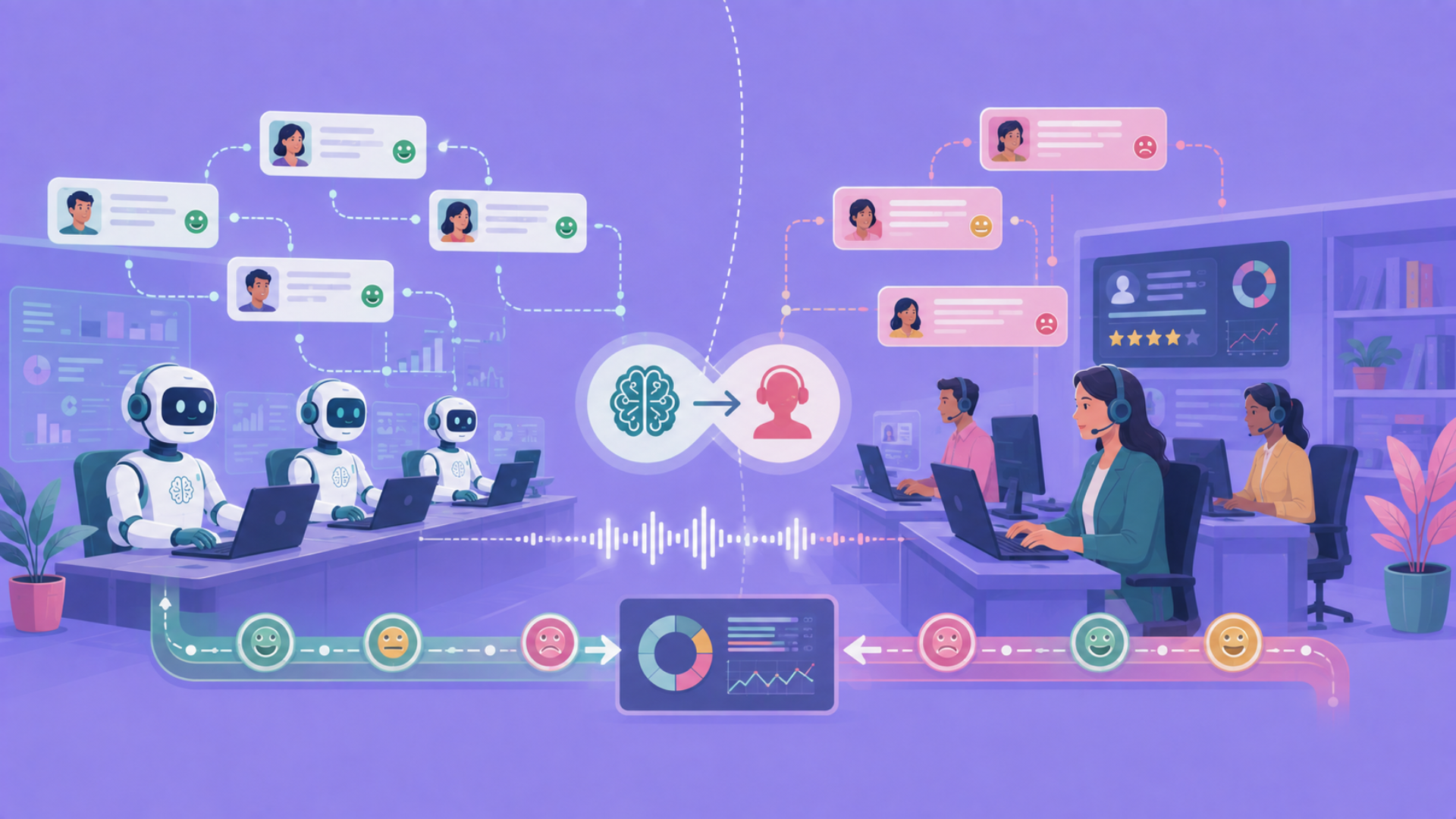
The competitive differentiator that emerged in 2026 is getting the AI-to-human handoff right. Customers accept AI for routine interactions. They do not accept AI for complex, emotionally charged, or high-stakes interactions. The AI needs to recognise when it has reached its boundary and transfer to a human with the full context of the conversation intact. Escalation paths that require the customer to start over with a human agent are worse than not having AI at all.
Measurement against resolution quality, not activity volume:
The governance principle that applies to all enterprise AI applies to customer service AI specifically. Measuring tickets processed, deflection rates, and average handling time tells you how busy the system is. Measuring first-contact resolution rates, customer satisfaction scores, and churn rates tells you whether the system is working. These are different numbers.
What This Means for OEMs and Consumer Goods Companies
For automotive OEMs, consumer electricals manufacturers, and industrial goods companies, AI customer service has a specific application that generic customer service AI discussions rarely address.
The customer service challenge for these organisations is not primarily inbound queries from end consumers. It is the service relationship with dealers, distributors, and channel partners.
A dealer network with 5,000 dealers generates a significant volume of queries to the OEM. Parts availability queries. Warranty claim status. Scheme and incentive eligibility. Technical product support. Many of these queries are routine, repetitive, and solvable with access to the right data.
AI customer service for dealer networks is a high-ROI application that most OEMs have not yet deployed at scale. The dealer who can get an immediate answer to a parts availability question without waiting for a call centre agent is more likely to stay in stock. The dealer who can check warranty claim status without generating an inbound query is more likely to process claims promptly. The dealer who gets immediate technical support is more likely to complete a complex repair correctly the first time.
This connects the customer service AI discussion directly to Loyalty Plus and Technician Plus. The channel relationship and the service relationship are part of the same customer experience. AI that improves the quality and speed of both strengthens the commercial relationship at every point of contact.
The Correction That Is Coming
Forrester's warning that customer service quality will dip before it improves is not a reason to avoid AI customer service investment. It is a reason to invest in the foundations that prevent the dip.
Companies that stripped out human agents too aggressively in 2025 and early 2026 are reintroducing them for high-stakes and emotionally charged interactions. The winning model that is emerging is not AI replacing humans. It is AI handling volume and routine resolution while humans own the trust-building moments that require judgment, empathy, and authority to make exceptions.
Getting that boundary right is the design challenge. Enterprises that define it clearly before deployment avoid the quality dip. Those that discover it after deployment experience it as a customer satisfaction crisis that requires remediation.
The AI deployment principle that applies across every function applies here too. Build for the outcome you want. Measure against the metrics that reflect it. And treat the human-AI boundary as an architectural decision, not a default.
Vishleshan AI works with enterprises across automotive, consumer electricals, financial services, and supply chain to build AI customer service architectures that resolve rather than deflect, using forward deployed engineering (FDE) to connect AI to the systems where service actions actually happen. Book a Consultation