


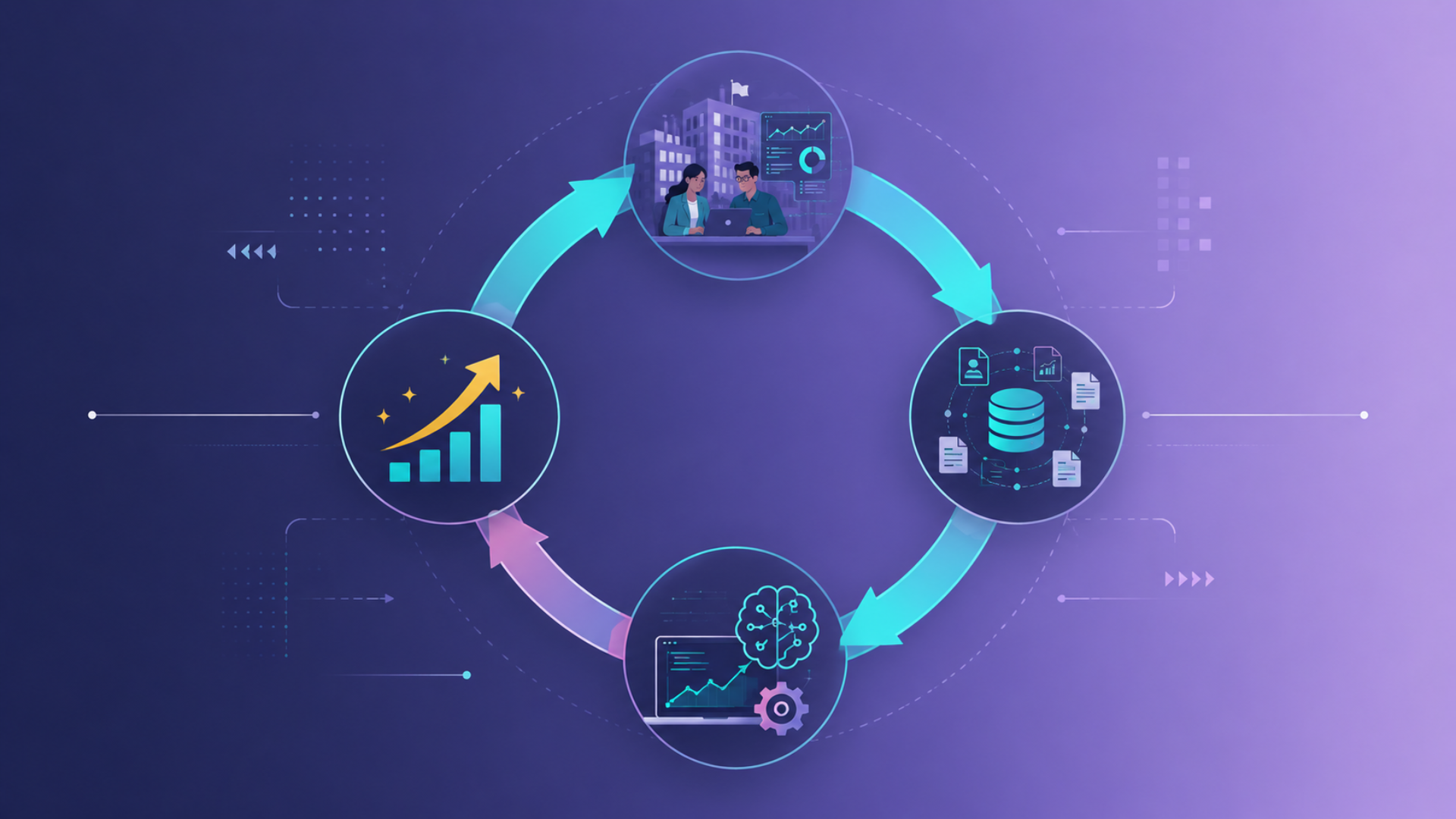
Most discussions of forward deployed engineering (FDE) focus on the first deployment. The engineer goes in, discovers the real constraints, builds against the actual environment, and produces a system that genuinely works in production. That is the core value proposition and it is real.
What gets less attention is what happens after the first deployment. And after the second. And after the third.
Each forward deployed engineering engagement generates two kinds of value. The first is visible: a production AI system that is actually being used and generating measurable outcomes. The second is less visible but ultimately more significant: knowledge. Knowledge about how data actually behaves in this organisation's systems. Knowledge about which integration patterns work and which create problems. Knowledge about the organisational dynamics that determine whether AI gets adopted or quietly ignored. Knowledge about the compliance constraints that need to be built into the architecture from the start.
That knowledge, when captured and applied systematically, is what makes the second deployment faster than the first, the third faster than the second, and the tenth significantly more capable than anything the organisation could have attempted at the start of the journey. It is the compounding mechanism that separates enterprises building a strategic AI capability from enterprises running a series of disconnected AI projects.
This is the FDE feedback loop. It is the part of forward deployed engineering that most enterprises are not thinking about clearly enough when they evaluate AI delivery models.
What Gets Learned in a Forward Deployed Engagement
A forward deployed engineer working inside an enterprise environment for 90 days absorbs a specific kind of knowledge that cannot be fully documented in advance or fully transferred through a handover report at the end.
Data behaviour at production scale:
The data that feeds an AI system in a live enterprise environment behaves differently from the same data in a test environment. Fields that appear clean in sampling have systematic quality issues at scale. Relationships between data entities that appear consistent in documentation are inconsistent in practice. The specific patterns of data quality degradation in this organisation's systems, and the preprocessing approaches that address them reliably, are discovered through production operation, not through documentation review.
Integration behaviour under real conditions:
APIs that behave as documented in testing behave differently under production transaction volumes, under the specific data payloads that real operations generate, and under the edge cases that only appear when real users are running real workflows. The integration patterns that are reliable in this specific environment, and the failure modes that need to be designed around, are knowledge that accumulates through deployment experience and cannot be fully anticipated in advance.
Organisational dynamics that determine adoption:
The technical quality of an AI system is one determinant of adoption. Equally important are the organisational factors: which stakeholders need to be engaged at which points, which concerns need to be addressed before go-live to prevent post-launch resistance, which workflows need to be redesigned rather than just automated, which individuals are change champions and which are blockers. This knowledge is accumulated through being inside the organisation, not through a stakeholder analysis conducted from the outside.
Compliance and governance constraints in practice:
The compliance requirements that apply to AI deployment in a specific regulated environment are documented in policy, but they are applied in practice in ways that policy documents do not fully capture. The specific interpretations that a compliance team applies, the specific audit trail formats that satisfy their requirements, the specific human oversight mechanisms that are acceptable versus those that create regulatory concern: these are learned through operating within the governance framework, not through reading it.
Each of these knowledge types is genuinely useful in the first deployment. Each is significantly more valuable in the second and subsequent deployments, because the learning from the first engagement can be applied from the start rather than discovered mid-build.
The Gravel Road to Paved Highway
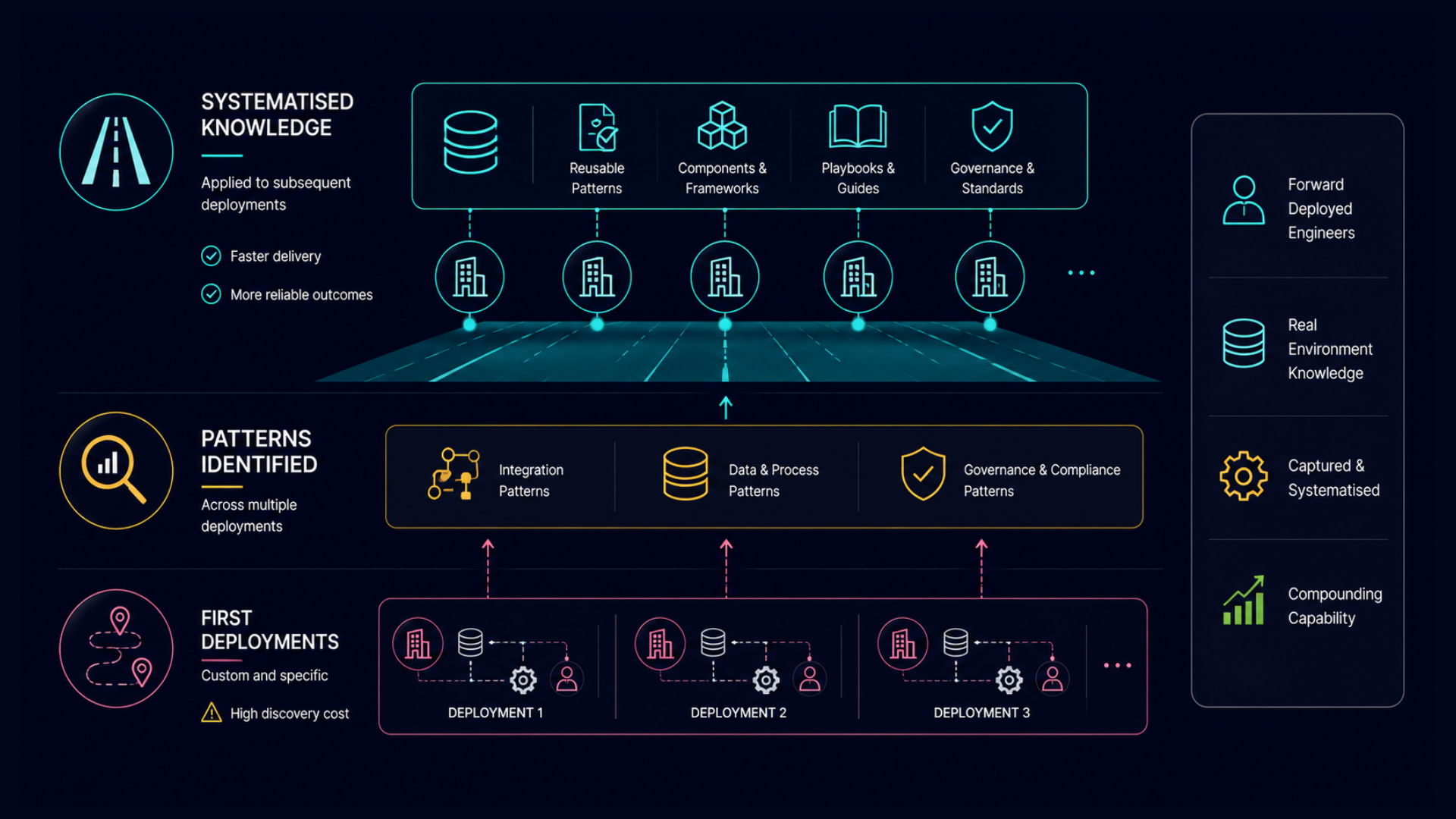
Palantir described the feedback loop in their original forward deployed engineering model as the "gravel road to paved highway" dynamic. Forward deployed engineers would build rough, highly specific solutions for individual clients — the gravel roads. The patterns that emerged across multiple client deployments would be identified, generalised, and built into the core platform as standardised capabilities — the paved highways.
The insight is that the gravel roads are not just delivery work. They are research. Every custom integration, every bespoke data processing pipeline, every organisation-specific compliance mechanism that an FDE builds in the field generates intelligence about what enterprise environments actually need, which is more accurate than any product roadmap process conducted at a distance from real deployments.
This dynamic applies at the enterprise level as well as the vendor level. An enterprise that has run multiple forward deployed engineering engagements is building the equivalent of its own gravel roads: specific, detailed knowledge about how AI actually works inside their operational environment. That knowledge, systematically applied to subsequent deployments, is the paved highway that makes those deployments faster, more reliable, and more capable of handling complexity.
The enterprises that understand this are the ones investing in capturing and systematising the knowledge generated in each FDE engagement, not just in delivering the immediate AI system. The ones that do not are essentially starting from scratch with each new initiative, discovering the same integration constraints and organisational dynamics again each time.
The Three Layers of the FDE Feedback Loop
The feedback loop that makes forward deployed engineering compound over time operates at three distinct levels, each building on the previous.
Layer 1: Technical knowledge about the specific environment:
This is the most tangible layer. The data schemas, the API behaviours, the integration patterns, the infrastructure constraints. This knowledge, documented and maintained after each deployment, directly reduces the discovery time required in subsequent engagements. A second deployment in the same environment that can skip the first four weeks of discovering integration behaviour that was already documented in the first deployment is a materially faster and less expensive deployment.
Layer 2: Domain knowledge about the business and its operations:
This is the layer that is most often undercaptured. The understanding of how the business actually operates, how decisions are made, how approval workflows function in practice, how the operational calendar affects what can be deployed and when: this knowledge is accumulated through time spent inside the organisation and is genuinely valuable in shaping the design of subsequent AI systems. An AI deployment designed by a team that already understands how the business operates will be better designed from the start than one where that understanding needs to be accumulated during the engagement.
Layer 3: Organisational knowledge about how to make AI stick:
This is the most strategically significant layer and the hardest to document explicitly. The knowledge of which change management approaches work in this culture, which stakeholder engagement patterns produce adoption, which training approaches actually change behaviour rather than just creating compliance, and which governance mechanisms are accepted rather than resisted: this is knowledge that compounds most rapidly, because the failure mode it addresses, AI that is technically deployed but not actually adopted, is the failure mode that destroys value most quietly and most consistently.
What This Means for How Enterprises Should Structure AI Programmes
Most enterprises structure their AI programmes as a series of separate initiatives, each scoped and delivered independently, with limited systematic knowledge transfer between them. The forward deployed engineer who worked on the supply chain initiative may not interact with the team working on the procurement initiative. The data quality discoveries from the first deployment may not be applied in the design of the second.
This structure destroys the compounding value that the FDE feedback loop is capable of generating. Each initiative starts with a similar discovery cost. Each encounters similar integration challenges. Each navigates similar organisational dynamics. The learning that could have made each initiative significantly faster and more reliable than the previous one is not being captured and applied.
The enterprises that are capturing the most value from forward deployed engineering are the ones that treat it as a programme, not a series of projects. They maintain a shared knowledge base of what has been learned about their environment across all FDE engagements. They rotate FDEs across initiatives deliberately so that the knowledge accumulated in one deployment enriches the next. They measure not just the outcome of each individual deployment but the trajectory of deployment speed and reliability across the programme, which is the metric that reveals whether the feedback loop is functioning.
This is what building internal FDE capability inside a large enterprise actually means in practice. It is not just hiring engineers with a specific skill set. It is building the knowledge management and programme architecture that allows the learning from each deployment to compound into the next.
The AI Gets Smarter Too
There is a second dimension to the FDE feedback loop that is specific to AI deployments and worth understanding clearly.
AI systems learn from production data. An AI agent deployed in a supply chain environment and operating against real procurement transactions for six months has seen edge cases, unusual patterns, and domain-specific situations that its initial training data did not contain. The feedback from real operation, captured and applied systematically, makes the AI system progressively more accurate and more useful in the specific context it is operating in.
This is the dynamic that agentic AI deployments are particularly designed to take advantage of. An agent that monitors supplier performance and surfaces recommendations will, over time, develop a more accurate model of which signals are meaningful in this specific supply chain and which are noise. An agent that handles dealer queries will become progressively better at understanding the specific terminology, context, and operational patterns that characterise this particular dealer network.
The forward deployed engineer who remains present through the early months of production operation is the person who ensures that this learning is being captured and applied correctly, that the system's improving accuracy is being validated against actual outcomes rather than just measured on internal metrics, and that the AI's evolving behaviour remains within the governance boundaries that were established at deployment.
The Compounding Advantage That Most Enterprises Are Missing
The enterprises that have run three or four forward deployed engineering engagements systematically, capturing the learning from each one and applying it to the next, are operating with a structural advantage over enterprises still running their first or second AI initiative.
Their integration work takes less time because the patterns are already known. Their governance frameworks are already calibrated to their specific regulatory environment. Their change management approaches are already tested against their organisational culture. Their AI systems start from a richer understanding of the domain because previous deployments have generated production data and real-world learning.
This compounding advantage is not visible from the outside. It does not show up in press releases or analyst reports. It shows up in the time from initiative start to production deployment, in the adoption rates of deployed systems, and in the value generated per AI initiative relative to the cost of the engagement.
The enterprises that understand the FDE feedback loop and are investing in capturing it systematically are building a capability that will widen the gap between themselves and competitors who are treating each AI initiative as an independent project.
Vishleshan AI's forward deployed engineers work inside client environments across automotive, consumer electricals, financial services, and supply chain with a deliberate approach to capturing and applying the knowledge generated in each engagement. The feedback loop is not an accidental benefit of the model. It is a designed output of how we structure our engagements and how we build AI systems that get smarter with production experience. Book a Consultation