


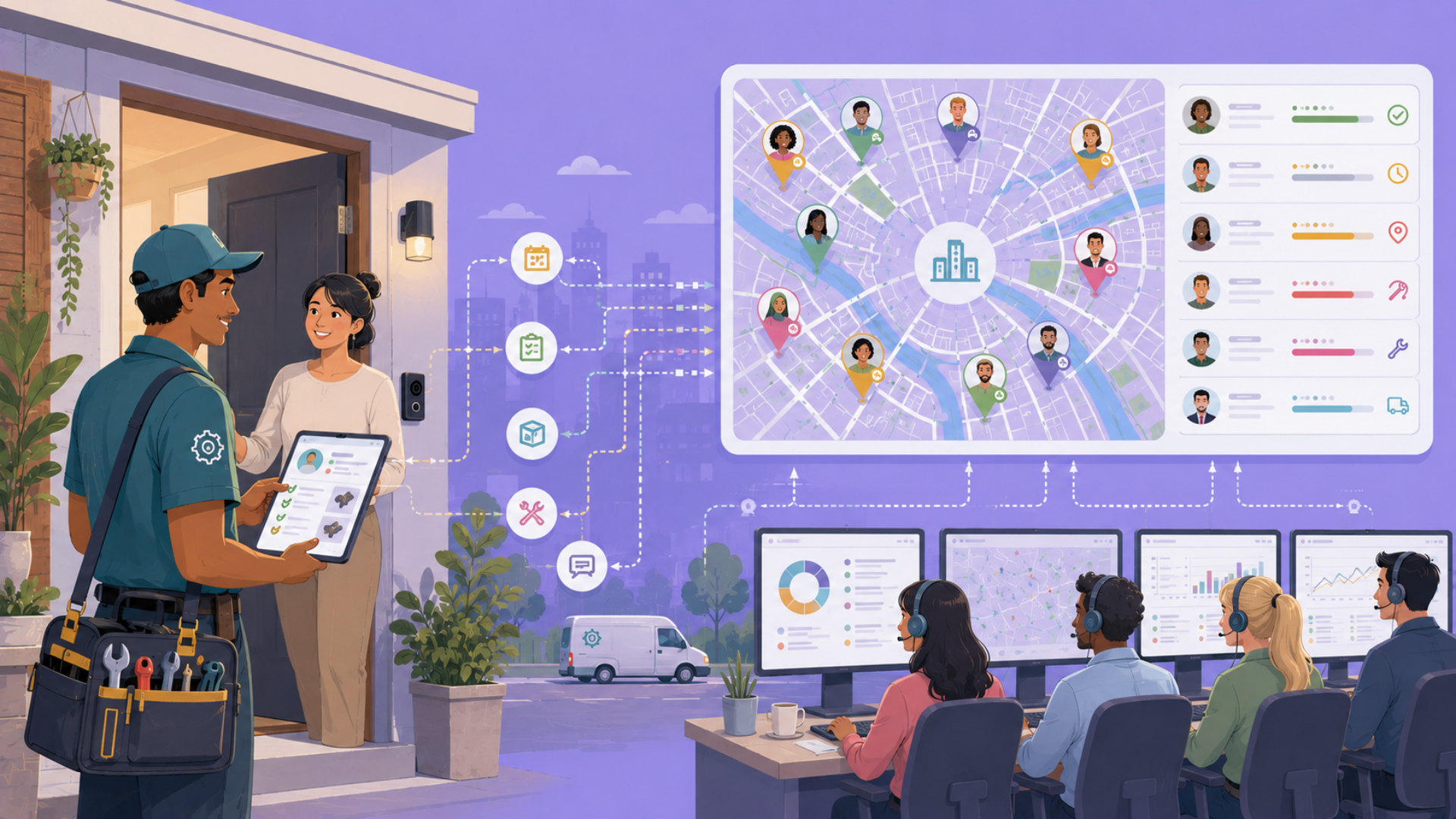
Sending a technician to a customer's home sounds simpler than running a service centre network.
It is not. It is harder.
A service centre has a workshop, a parts store, senior technicians available for consultation, and a manager who can intervene when something goes wrong. A doorstep technician has a vehicle, a toolkit, and a mobile device.
If the diagnosis is wrong, they cannot fix it. If the part is missing, they cannot fix it. If the job type does not match their certification, they cannot fix it. Every failure happens at the customer's front door, in full view of the customer, with no fallback option.
Running this model at scale, across hundreds of thousands of jobs per year, across a national network of mechanics, electricians, or appliance technicians, requires AI that is built specifically for how doorstep service actually works. Not adapted from a service centre model. Built for this one.
What Makes Doorstep Service Operationally Different
In a traditional service centre model, the customer comes to the technician. The technician has access to the full workshop environment. Diagnosis can be iterative. Parts can be ordered after the initial inspection. Colleagues are available for complex jobs.
In a doorstep service model, the technician goes to the customer. Everything needed to complete the job must arrive with the technician. There is no second visit without significant cost and a damaged customer experience.
This creates three operational requirements that service centre models do not face in the same way.
Pre-job preparation must be complete before departure:
The technician needs the right diagnosis, the right parts, and the right job briefing before they leave for the customer's location. Any gap in pre-job preparation becomes a job failure. In a service centre, a missing part is an inconvenience. In doorstep service, it is a failed visit.
Technician matching must be precise, not approximate:
A service centre can assign a job to any available technician and have senior staff assist with complex situations. Doorstep service cannot. The technician dispatched must have the specific certification for the product type, the specific skill level for the repair complexity, and the specific product knowledge to handle the diagnosis independently. Approximate matching produces failed visits.
Job completion must be verifiable without a supervisor present:
A service centre manager can inspect a job before the customer takes delivery. Doorstep service has no equivalent quality gate. Verification must happen through the technician's own documentation of the completed work, captured on mobile at the point of completion.
Each of these requirements places demands on the technology platform that most generic field service management solutions were not designed to meet.
What 5.7 Million Job Cards Looks Like in Practice
A doorstep mechanic platform deployed for a leading automotive OEM handled 5.7 million job cards and generated $35 million in revenue across its network.
That scale is only possible with AI running the operational layer.
At 5.7 million jobs per year, no human dispatcher team can manage job allocation at the required precision. No manual process can verify pre-job preparation consistently across every technician departure. No paper-based system can capture job completion evidence in a form that satisfies the OEM's warranty and quality audit requirements.
The platform made this scale possible by automating the three requirements above. AI allocation matched each job to the right technician based on certification, location, current workload, and parts availability simultaneously. Pre-job preparation was confirmed through the platform before the technician received the job confirmation. Job completion was captured through a structured mobile workflow that generated photographic evidence and a verified audit trail for every job.
The $35 million in revenue was not just volume. It was volume managed efficiently enough that the economics of doorstep service were viable at OEM scale. That economics equation depends entirely on job completion rates. Failed visits are expensive. They consume technician time without generating revenue. They damage the customer relationship. They create a second-visit cost.
AI that prevents failed visits by ensuring pre-job preparation is complete is not just an operational improvement. It is the mechanism that makes the doorstep service model economically viable.
The Four AI Capabilities That Make Doorstep Service Work at Scale
1. Intelligent pre-job preparation
The platform needs to know, before confirming a job assignment, that the technician has what they need to complete it. This requires real-time integration with three data sources.
The customer's product history, pulled from the OEM's warranty and service records, determines what parts are most likely to be needed for the reported fault. The technician's vehicle stock, updated after every job, determines whether those parts are available. The nearest parts location, integrated with dealer inventory, determines whether missing parts can be collected before the job without extending the customer's wait time.
When all three checks pass, the job is confirmed. When they do not, the platform flags the gap and either resolves it automatically or surfaces it for coordinator action before the customer appointment is set.
This is how spare parts delays become a service problem rather than a supply chain problem. The resolution happens before the technician arrives at the door, not after.
2. Precision technician matching
Generic field service allocation matches on availability and proximity. Doorstep service requires matching on certification, product knowledge, repair complexity, and parts availability simultaneously.
AI allocation for a doorstep network evaluates every available technician against every open job continuously. When a job comes in for a specific product type at a specific fault code, the system identifies technicians with the relevant certification, ranks them by proximity and current workload, confirms parts availability for each candidate, and recommends the optimal assignment.
At 5.7 million jobs per year, this matching happens thousands of times per day. It cannot be done manually at this volume with the precision that prevents failed visits.
3. Mobile-first job management for independent technicians
Doorstep technicians are independent operators in a way that service centre technicians are not. They are on the road between jobs. They are at customer locations without colleagues. They need everything the platform can give them in their hands, on their mobile device, at the moment they need it.
The mobile experience for doorstep service needs to cover the full job lifecycle. Job acceptance with all pre-preparation checks confirmed. Job briefing with customer history, product details, and fault diagnosis support. Parts usage recording at the point of use to keep vehicle stock accurate. Job completion with photographic evidence and customer acknowledgment. And the next job assignment ready before the current one is closed.
This mobile experience must work in the connectivity conditions that doorstep technicians actually operate in. Offline capability is not optional. A technician in a basement apartment, an industrial estate, or a semi-rural location cannot wait for connectivity to complete their job documentation.
This is the same multilingual and low-connectivity challenge that large OEM service networks face across all their field operations.
4. AI-verified job closure
Doorstep service requires verification without a supervisor. The platform does this through a structured closure workflow that captures what happened at the job in a verifiable form.
The technician photographs the completed repair. They document the parts used against the parts allocated. The customer provides acknowledgment through the app. The warranty documentation is generated from the captured data. The ERP record updates from the verified closure data.
The result is a verified audit trail for every job that satisfies the OEM's quality, warranty, and compliance requirements. Without this, doorstep service at scale generates a warranty data problem. The OEM cannot verify what was done, what parts were used, or whether the repair met its quality standards.
Why This Model Requires a Different Platform Approach
Most field service management solutions were designed for service centre operations. The data model assumes the technician is based at a location with access to a parts store. The allocation logic assumes a managed workforce with predictable availability. The compliance features assume a supervisor who can review work before it is signed off.
Doorstep service inverts all of these assumptions. The technician's location is their vehicle. The parts store is what they are carrying. The workforce is indirect, certified but not employed. The quality gate is the platform itself.
Building a platform that works for this model requires starting from the doorstep operating model, not adapting a service centre platform to fit it. The data model, the allocation logic, the mobile experience, and the compliance architecture all need to reflect how doorstep service actually works.
This is the platform design principle behind Technician Plus. Built for OEM field service networks including doorstep models, not configured from a generic field service template.
What the Commercial Case Looks Like
Doorstep service is a premium offering. Customers pay for the convenience of not having to bring their product to a service centre. OEMs use it to differentiate on customer experience and to reach customers who would otherwise not access authorised service.
The commercial case depends on the economics of job completion. A doorstep visit that does not result in a completed repair is an expensive failed transaction. The technician's time is consumed. The customer's experience is damaged. A second visit is required at additional cost.
The first-time fix rate is the commercial metric that determines whether doorstep service is viable or expensive. AI that drives first-time fix rate through precise technician matching and complete pre-job preparation is not just an operational improvement. It is the mechanism that makes the commercial model work.
At 5.7 million job cards and $35 million in revenue, the platform demonstrates that doorstep service can be operationally viable at OEM scale. The AI is not incidental to that outcome. It is how the outcome is produced.
Vishleshan AI's Technician Plus is designed for OEM field service networks including doorstep and at-home service models. It is deployed by forward deployed engineers (FDE) who work inside client environments to build the integration, allocation logic, and mobile experience that doorstep service at scale requires. Book a Consultation