


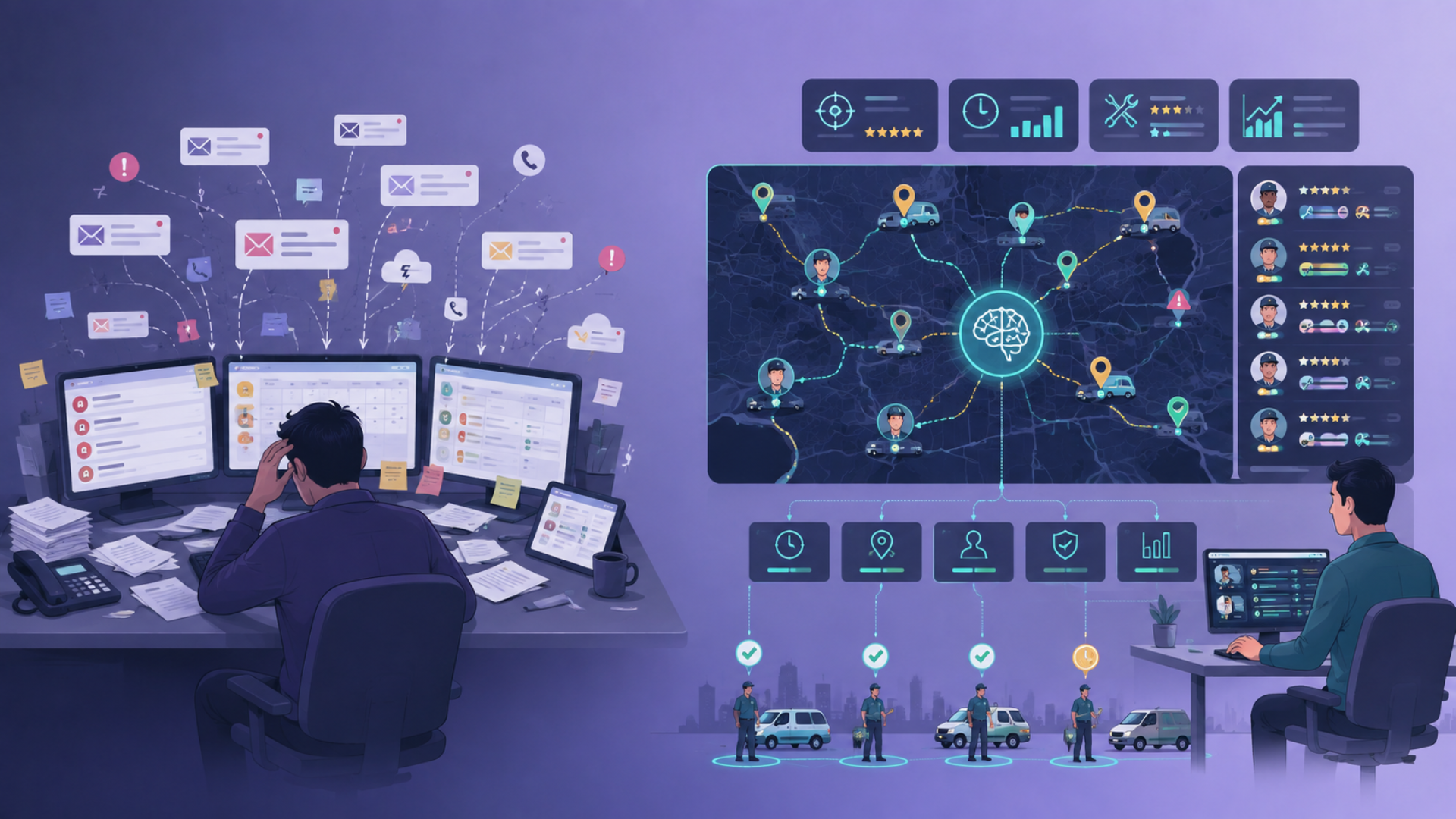
Manual job allocation has a natural ceiling. Below that ceiling, it works. An experienced dispatcher managing 50 technicians can track who has the right certification, who is closest, who has availability, and who has the spare parts needed for the job. They can make reasonably optimal allocation decisions most of the time.
Above that ceiling, manual allocation does not fail suddenly. It fails gradually and quietly. The wrong technician arrives at a job and cannot complete it. A technician with the right certification sits idle in one zone while a job requiring that certification waits in the next. A high-priority customer waits behind a lower-priority one because the dispatcher could not hold the full queue in view at once. A return visit gets scheduled because the parts availability check did not happen before dispatch.
None of these failures is dramatic. Each is a small, recoverable mistake. Across a network of 500, 1,000, or 5,000 technicians, the accumulation of small recoverable mistakes becomes a structural cost that shows up in utilisation rates, first-time fix rates, and customer satisfaction scores before anyone explicitly identifies manual allocation as the cause.
This piece covers what that cost looks like in practice and what changes when AI handles allocation at scale.
Why Manual Allocation Breaks at Scale
The human brain can hold approximately seven items in working memory at once. A skilled dispatcher working at their best can track significantly more than this through experience, systems, and pattern recognition. But there is a limit, and in a large technician network, the number of variables that a good allocation decision requires exceeds that limit by a significant margin.
A good allocation decision at enterprise scale requires knowing simultaneously:
Which technicians are available in what locations,
What certifications and skill levels each holds,
What their current workload looks like and when they will complete current jobs,
What spare parts they have in their vehicle,
What the customer's warranty and service history looks like,
What the SLA requirements for this job category are, and
What the priority ranking of this job is relative to all other open jobs in the queue.
For a network of fifty technicians, an experienced dispatcher holds most of this contextually and makes good decisions most of the time. For a network of five hundred, the matrix is too large. For five thousand, it is not a dispatching problem anymore. It is a combinatorial optimisation problem that requires computational capacity to solve correctly.
What happens in practice is that dispatchers develop heuristics. They allocate based on proximity because it is the most visible variable. They allocate based on availability rather than optimality because availability is easier to see than skill match. They allocate based on the jobs they can see rather than the full queue because the full queue is too large to hold in view. Each heuristic produces allocations that are locally reasonable and globally suboptimal.
Where the Cost Actually Appears
The cost of suboptimal allocation at scale is rarely visible in a single line item. It distributes across several operational metrics that are tracked separately, which is part of why it persists.
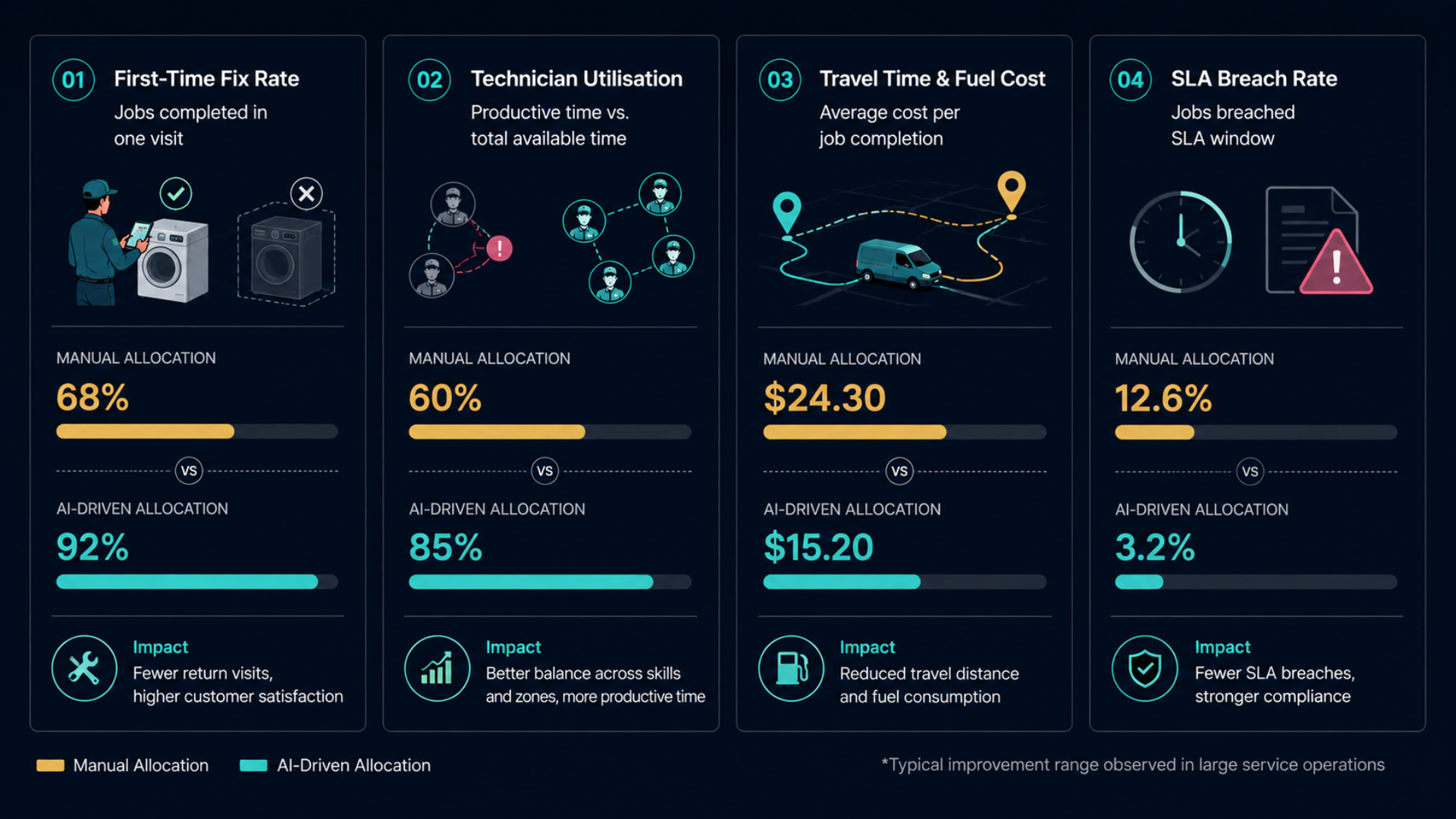
First-time fix rate:
When a technician without the right skill set or without the right spare parts is dispatched to a job, the job does not get completed on the first visit. A return visit is scheduled. The customer experiences a delay. The technician's time is partially wasted. The job takes two visits to accomplish what one should have. First-time fix rate is the metric where wrong allocation shows up most clearly, but it is typically attributed to parts availability or technician training rather than to the allocation decision that sent the wrong technician with the wrong parts.
Technician utilisation:
Suboptimal allocation creates idle time in some zones and overload in others simultaneously. A technician with a specific certification sits idle because the dispatcher did not see the job in the adjacent zone that required it. Another technician takes on more jobs than they can handle because they are the default choice for their area. Utilisation appears in aggregate metrics but the zone-level and skill-level variation that reveals allocation inefficiency is often not tracked.
Travel time and fuel cost:
Proximity-based allocation without optimisation for the full route means technicians travel more than necessary. A technician dispatched from the east side of a city for a job on the west side passes through the area where three other jobs are waiting because the dispatcher did not see the sequence optimisation opportunity. At scale, across hundreds of technicians making multiple trips per day, the travel time and fuel cost of suboptimal routing accumulates into a measurable operational cost.
SLA breach rate:
High-priority jobs that sit in a queue because they were not visible in the allocation decision breach their SLA windows. The breach appears in customer satisfaction scores and potentially in contractual penalties. But the root cause, such as how job priority was weighted in the allocation decision, is rarely identified.
What Changed When a 9,500-Technician Network Moved to AI Allocation
A leading FMEG OEM deployed Technician Plus across a network of 9,500 technicians spanning a national service footprint. Before deployment, job allocation was handled through a combination of regional dispatchers, WhatsApp-based job assignment, and manual tracking systems that gave regional managers limited visibility into what was happening outside their immediate area.
The allocation problems were structural. Wrong technician dispatched to jobs requiring specific certification. Technicians with low utilisation in one region while adjacent regions ran at overcapacity. High-priority jobs being missed in the queue because the queue was managed manually across regional silos rather than as a single prioritised pool.
After deployment, AI allocation evaluated every open job against every available technician simultaneously, weighting skill match, location, current workload, parts availability, and job priority in real time. Allocation decisions that previously required dispatcher judgment and were made with incomplete information were replaced by decisions made with full information across the entire network.
The outcome was AI-verified job closure from technician identity verification at job start through to photographic job completion, with 9,500 technicians on a single platform. The AI did not replace the dispatcher's domain knowledge. It gave that knowledge access to the full context of a 9,500-technician network rather than the partial context of a regional queue.
What AI Allocation Actually Does Differently
AI-driven allocation is not faster manual allocation. It is a different type of decision-making that operates at a different scale.
Manual allocation optimises locally: who is available near this job, and do they roughly have the right skills? AI allocation optimises globally: across all open jobs and all available technicians, what allocation sequence minimises total travel time, maximises first-time fix probability, meets all SLA commitments, and accounts for spare parts availability and technician certification simultaneously?
The difference is not marginal at scale. ISG research projects that by 2028, two-thirds of enterprises will use AI to coordinate field service teams, specifically because the operational advantage of global optimisation versus local heuristics becomes commercially significant above a certain scale threshold.
Three capabilities distinguish AI allocation from enhanced manual dispatching.
Real-time reallocation:
When a job runs over time, a technician calls in sick, or a high-priority emergency job comes in, AI allocation reoptimises the entire open queue in real time rather than leaving the dispatcher to manually cascade the changes through their existing schedule. The queue is always current. The allocations reflect what is actually happening in the field rather than what was planned at the start of the shift.
Skill and certification matching at depth:
Manual dispatchers track certification at a high level because tracking it at depth across hundreds of technicians is cognitively impossible. AI allocation tracks every technician's complete certification profile and matches it precisely to every job's specific requirements. A job requiring a specific product certification, a specific safety accreditation, and a minimum experience level gets dispatched to the technician who has all three, not to the technician who is closest and roughly qualified.
Parts availability integration:
Sending a technician to a job without confirming spare parts availability is a common cause of first-time fix failure. AI allocation can integrate real-time dealer inventory data and check parts availability as part of the allocation decision. This removes the need for a separate check that may be missed.
The Transition From Manual to AI Allocation
The transition from manual to AI-driven allocation in a large technician network is not primarily a technology change. It is an operating model change, and understanding the distinction matters for how it is approached.
Manual allocation concentrates knowledge and decision-making authority in the dispatcher. The dispatcher knows the technicians, understands the territory, and applies their experience to make allocation decisions. When AI takes over allocation decisions, the dispatcher’s role changes. They govern the system, manage exceptions, and apply human judgment when the AI lacks important context.
This role shift is where most AI allocation implementations either succeed or stall. The technology is not the challenge. The change management is. Dispatchers who shift into governance and exception management become more effective after the transition. They can focus their domain knowledge on cases that need human judgment instead of spending most of their time on routine allocation decisions that AI can handle.
The forward deployed engineering model is well-suited to this transition because the change requires working closely with operations. We need to understand how dispatchers work today, what context they use to make decisions, and how that context should shape the AI. We also need to define the new governance role within the operation.
The Number That Matters
The cost of manual allocation at scale does not appear in a single budget line. It appears across first-time fix rates, technician utilisation percentages, travel costs, SLA breach rates, and customer satisfaction scores that are tracked separately and attributed to separate causes.
The number that makes the case for AI allocation is the composite of these: what does a one-percentage-point improvement in first-time fix rate save in return visit cost? What does a five-percentage-point improvement in technician utilisation generate in additional revenue capacity? What does eliminating unnecessary travel time across a 500-technician network save in fuel and labour cost per year?
At enterprise scale, these numbers are significant. The cost of manual allocation is not visible in the budget. It is visible in the gap between what the service operation costs and what it could cost, and in the gap between the first-time fix rate and the technician utilisation rate the operation is capable of and what it is actually achieving.
Vishleshan AI's Technician Plus includes AI-driven job allocation built specifically for OEM and enterprise service networks, integrated with ERP and dealer parts inventory in real time. It has been deployed at 9,500-technician scale with AI-verified job closure from uniform check to job completion. Book a Consultation