


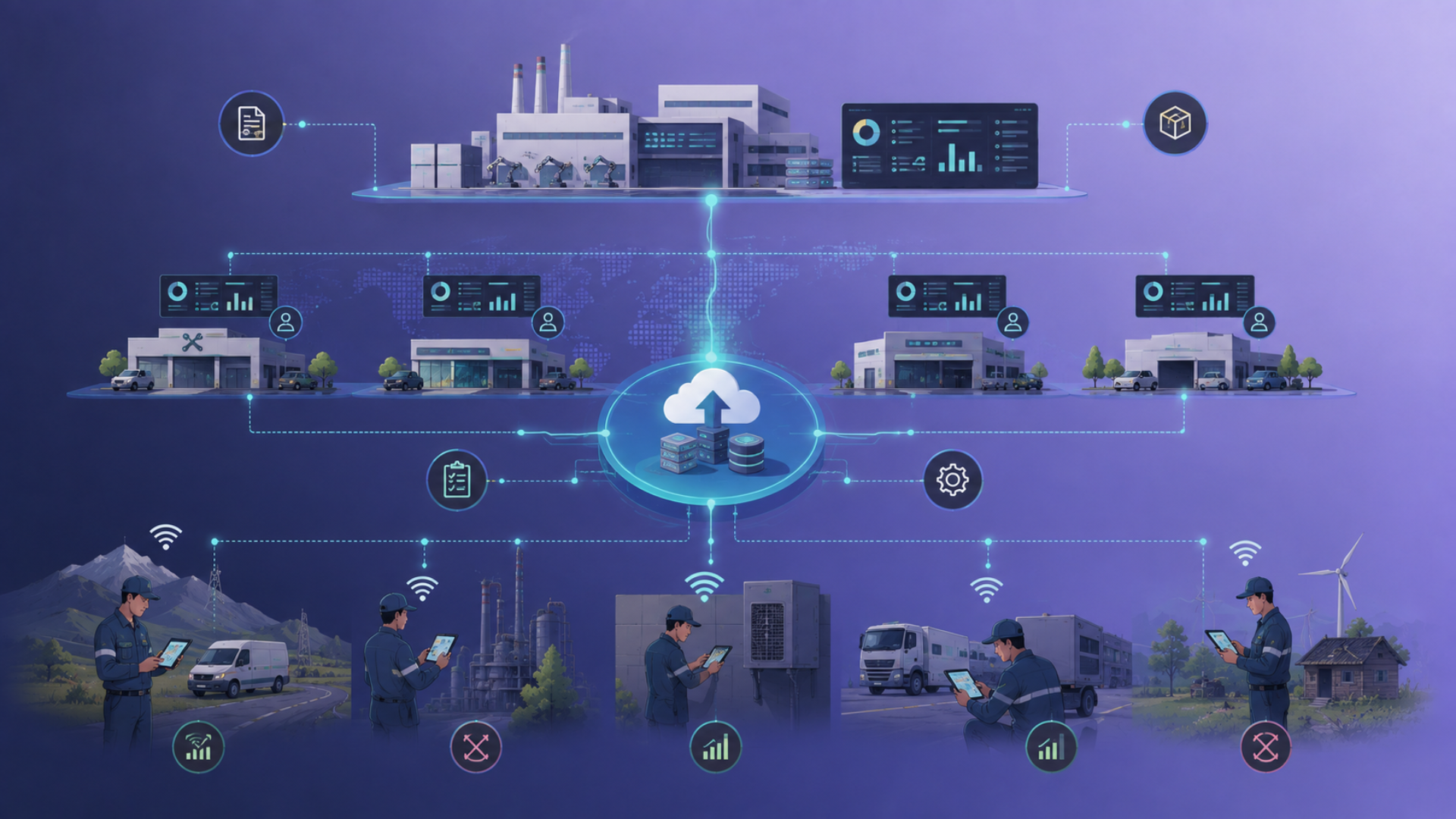
Most field service management software works exactly as advertised — for the customer it was designed for. A mid-sized facilities management company. A regional HVAC service business. A technology hardware company with a few hundred field engineers and a well-structured ticketing system.
That customer is not an OEM managing five thousand technicians across a national dealer network, serving customers in twelve languages, operating in areas with intermittent connectivity, and running every service transaction through an ERP system that has been live for fifteen years and is not being replaced.
The gap between what generic field service software is designed to handle and what OEM service operations actually require is wide. It is also the gap where the most commercially significant field service problems live: job allocation failures that create technician idle time, first-time fix rates that stay stuck below target, AMC revenue that sits uncaptured in service data, and spare parts delays that erode customer satisfaction in ways that register as a service problem but are really a coordination failure between service, parts, and the dealer network.
Understanding why generic tools fail at this scale is the starting point for understanding what a production-grade alternative actually requires.
The Configuration Trap
Generic field service management tools are built around configurability. The proposition is that the same platform can serve a construction company, a medical equipment provider, a consumer electronics brand, and an automotive OEM by allowing each to configure the workflows, fields, and rules that match their specific operations.
Configurability is a genuine feature. It is also the source of the most consistent failure mode at enterprise OEM scale.
An OEM service operation is not a generic field service operation with specific configurations applied. It is a fundamentally different operating model. The job card is not just a work order. It is a document that connects the technician's identity and certification, the customer's warranty status, the spare parts inventory at the dealer location, the payment terms across different service categories, and the manufacturer's quality audit requirement into a single transaction that needs to be resolved correctly the first time.
A generic tool can be configured to capture all of these data points. What it cannot do is enforce the business rules that govern how they interact, because those rules are specific to this OEM's operating model, encoded in this OEM's ERP, and subject to this OEM's compliance and audit requirements. The configuration layer sits on top of a data model that was not designed for this complexity. The workarounds that make it function multiply over time. The gap between how the system is supposed to work and how the field team has learned to make it work becomes institutional knowledge that disappears when people leave.
The ERP Integration Problem
Every large OEM runs field service operations inside an ERP environment that is the system of record for warranties, spare parts inventory, dealer accounts, payment terms, and customer history. Field service software that does not integrate with this ERP is not field service software for this OEM. It is a parallel system that creates data duplication, reconciliation overhead, and the specific category of operational error that comes from two systems with different versions of the same truth.
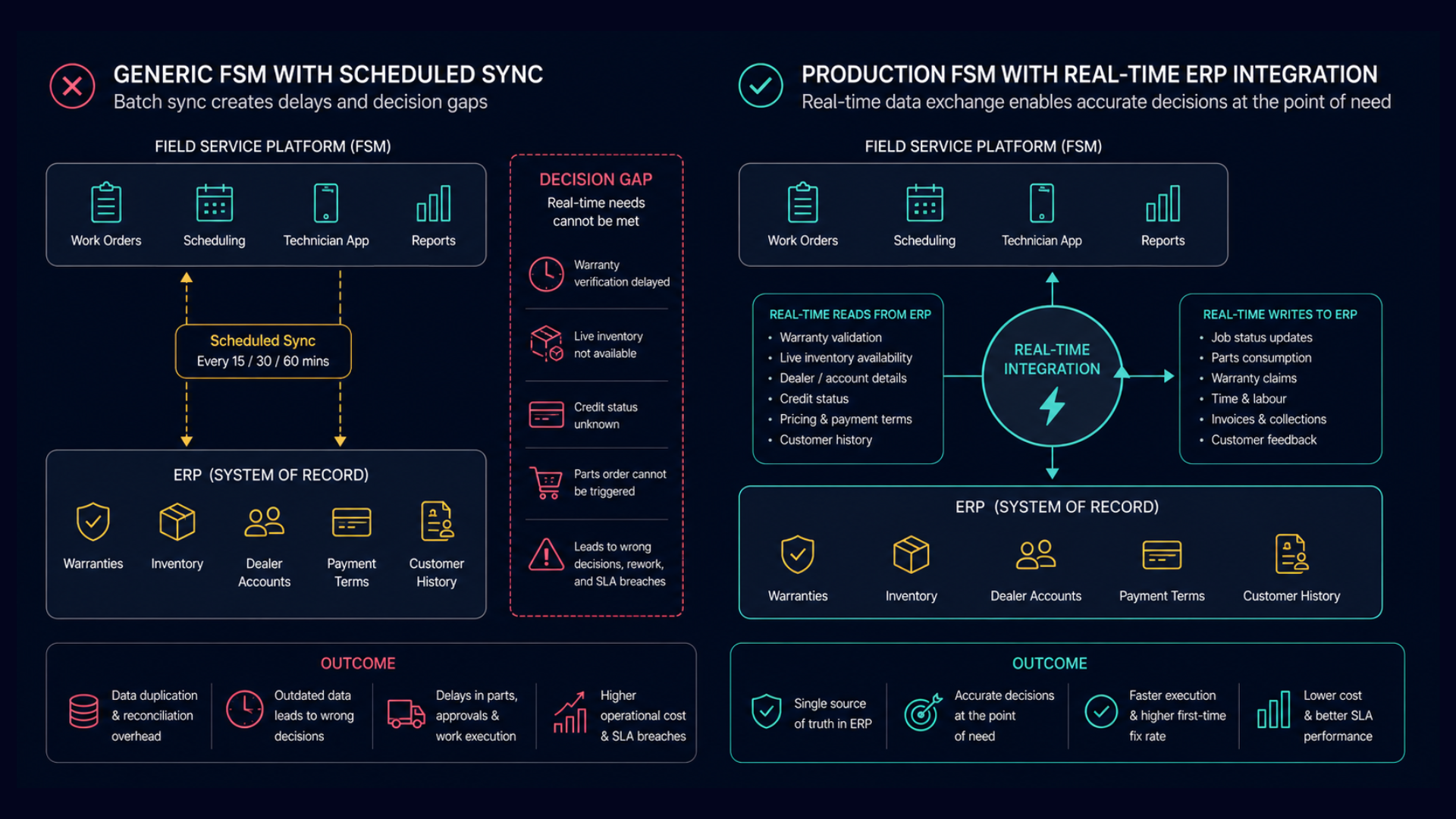
Most generic field service tools offer ERP integration. The integration is typically a scheduled sync between the two systems: job data flows out of the FSM tool into the ERP at defined intervals, and master data flows back. This integration works for use cases where the ERP and the FSM tool are genuinely parallel: the FSM captures field activity, the ERP captures the financial and inventory implications, and the sync keeps them aligned.
It does not work when the field service transaction needs to check ERP data in real time to make a decision. A technician arriving at a customer site who needs to confirm warranty coverage before starting work cannot wait for the next sync cycle. A spare part request that needs to check dealer inventory availability in real time, account for the customer's credit status, and trigger a parts order through the dealer's ERP-connected procurement system is not a sync problem. It is a real-time integration problem that a sync-based architecture cannot solve.
The OEMs that have built field service operations that actually work at scale have solved this by treating ERP integration as an architectural requirement from day one, not a feature to be configured after deployment. The field service platform is not a separate system that syncs with the ERP. It is a system that reads from and writes to the ERP in real time, through governed interfaces that maintain the ERP as the single system of record while making its data available to field operations at the moment it is needed.
This is the same principle that makes enterprise AI work alongside legacy ERP in manufacturing: layering capability on top of existing systems rather than creating parallel architectures that compete with them.
The Technician Network Problem
Generic field service tools are built around the concept of a managed workforce: employees whose identities, certifications, locations, and availability are known and controlled by the organisation deploying the software.
OEM service operations rarely look like this. A large automotive or consumer electricals OEM does not employ most of the technicians who service its products. They work through a dealer network, an authorised service partner network, or an independent mechanic ecosystem where the OEM's relationship is indirect, the technician's identity and certification status needs to be verified rather than assumed, and the quality of the service delivered reflects directly on the OEM's brand regardless of the employment relationship.
Managing a network of this type at scale requires capabilities that are categorically different from managing an employed workforce. Technician onboarding that works across mobile-first interfaces without assuming a desktop or a stable internet connection. Identity verification that can confirm a technician is who they claim to be, is certified for the job type they are accepting, and is physically at the location they are supposed to be at. Job allocation logic that accounts for technician skill, location, current workload, parts availability, and customer priority simultaneously. Quality assurance mechanisms that can verify job completion without a supervisor present at every site.
A leading consumer electricals OEM deployed our field service solution called Technician Plus across its service network and achieved 9,500 technicians on a single platform with AI-verified job closure from uniform check at job start to photographic job completion. That outcome required platform capabilities that no generic FSM tool offered out of the box, because those capabilities were designed specifically for the OEM-dealer-technician network model rather than for a managed employed workforce.
The Scale and Connectivity Problem
Enterprise OEM field service operations have two scale characteristics that generic tools consistently underestimate.
The first is transaction volume. Five million job cards per year across a national service network is not an unusual number for a large OEM. The platform needs to handle this volume reliably, which requires an architecture that was designed for it from the start. A platform that performs well at ten thousand jobs per month and degrades at five hundred thousand is not an enterprise platform that has been configured for a large deployment. It is a mid-market platform that has been pushed beyond its design parameters.
The second is connectivity variability. Field technicians operating in tier-two and tier-three cities, in semi-urban areas, and in industrial environments do not have the reliable high-speed connectivity that urban office workers take for granted. Field service software that requires a stable connection to function is software that fails precisely in the locations where the most technically demanding service work often happens. Offline-capable mobile experiences that sync when connectivity is restored, designed specifically for the connectivity profiles of the markets where the OEM operates, are not a nice-to-have. They are a prerequisite for the software to work where the technicians are.
A platform that delivered over 5.7 million job cards and generated $35 million in revenue across a doorstep mechanic service network was built specifically for this operating context: mobile-first, connectivity-resilient, designed for technicians who are not sitting at a desk and do not have enterprise-grade internet access in the field.
What OEMs That Have Solved This Actually Did
The OEMs that have built field service operations that work at scale share a consistent pattern in how they got there. It is not the pattern that generic software vendors recommend.
They did not deploy a generic platform and configure it to fit their operations. They built or deployed a platform that was designed for their specific operating model from the start. The data model reflects the OEM-dealer-technician relationship. The integration architecture treats ERP as the system of record and connects to it in real time. The mobile experience was designed for the connectivity and device profiles of their technician population.
They did not separate the platform deployment from the operational knowledge required to make it work. The engineers who built the platform understood how the dealer network actually operates, how job allocation decisions are made in practice, what the compliance and quality requirements are, and where the edge cases live. That understanding was not transferred through a requirements document. It was built through working inside the operations, which is the principle behind forward deployed engineering applied to field service.
They measured success at production outcomes, not at deployment milestones. The platform was not considered live when it was technically deployed. It was considered live when technicians were using it, job cards were being closed at the target rate, ERP data was staying clean, and the service metrics that the business cares about — first-time fix rate, parts availability, customer satisfaction, AMC revenue capture — were moving in the right direction.
The Two Questions That Reveal Whether a Platform Is Built for Enterprise Scale
Before evaluating any field service platform for an OEM deployment, two questions reveal more than any feature comparison or demo.
1. How does the platform integrate with ERP in real time, not in batch?
A platform that offers real-time integration and can describe specifically how it reads warranty data, checks parts availability, and writes job completion back to the ERP in real time is a platform built for the right problem. A platform that describes a sync architecture and offers configuration options for sync frequency is a platform built for a different customer.
2. Has the platform been deployed in an OEM-dealer-technician network at the scale you are targeting?
Reference deployments in similar operating contexts, at similar scale, with similar connectivity and language requirements, are the most direct evidence that the platform was built for your problem rather than a simpler version of it.
The answers to these two questions narrow the field quickly.
Vishleshan AI's Technician Plus is built specifically for OEM and enterprise field service operations. It integrates with existing ERP and CRM systems in real time, is deployed by forward deployed engineers who work inside client environments until it is genuinely live, and has been proven at Fortune 500 scale across automotive and consumer electricals service networks. Book a Consultation