


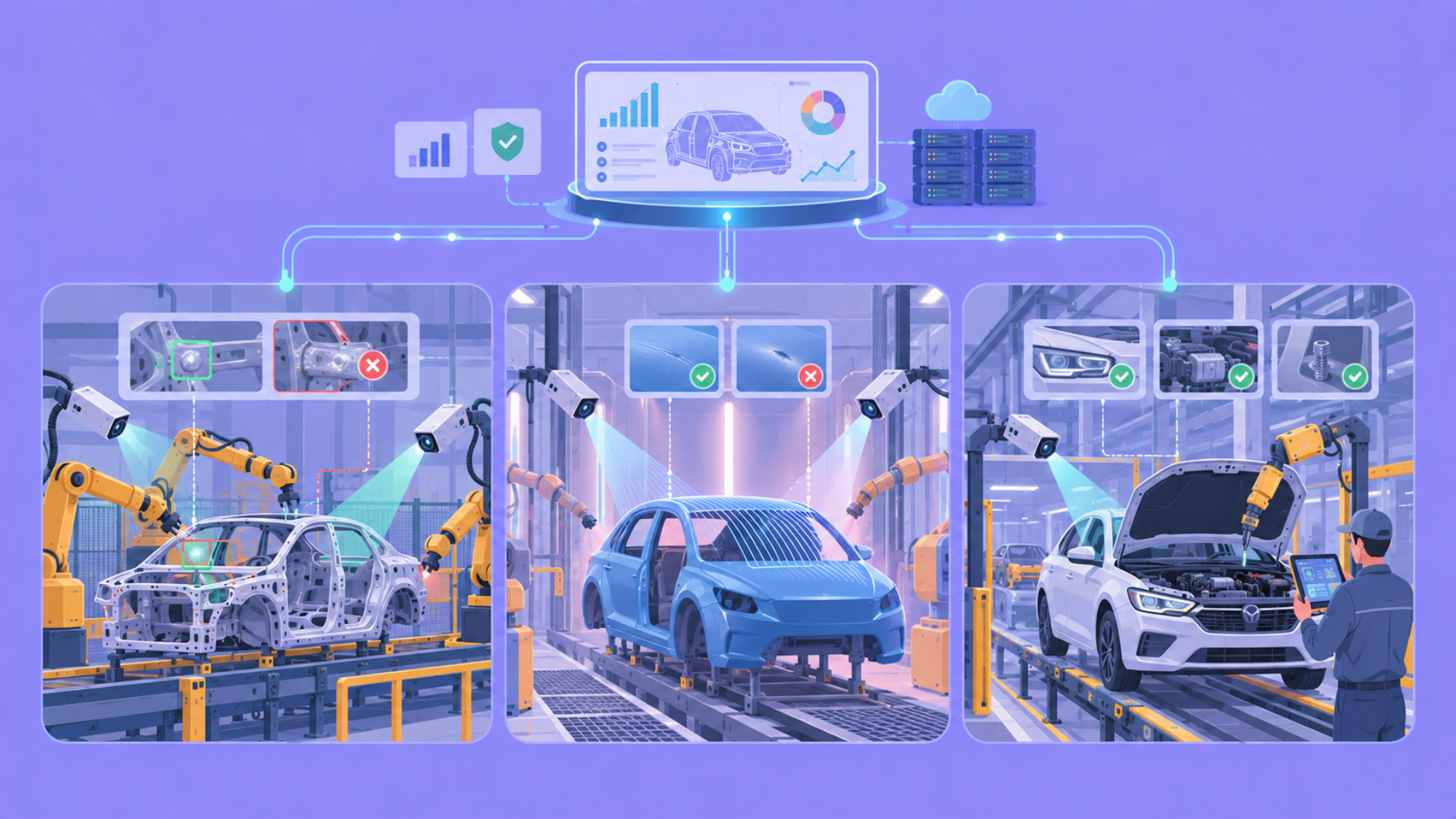
A trained human inspector catches 78 to 84% of surface defects on a good day shift. By hour ten of a night shift, that rate drops below 70%. In an automotive plant running 60 to 90 vehicles per hour with 200-plus quality checkpoints per body, those missed percentages are not an acceptable variable. They are escaped defects, warranty claims, customer complaints, and supplier scorecard damage.
Machine learning vision systems now reach 95 to 100% defect detection accuracy in live automotive production environments, according to a peer-reviewed survey of more than 50 studies published in the journal Sensors in January 2026. AI inspection does not have good days and bad days. It does not have day shifts and night shifts. It applies the same criteria to every unit at line speed, every shift, indefinitely.
The question in 2026 is not whether vision AI works in automotive manufacturing. It does. The question is what good looks like in each specific manufacturing zone, because the vision AI requirements in the body shop are different from those in the paint shop, which are different again from those in the assembly area. Understanding this is the starting point for evaluating whether a vision AI deployment is actually fit for the problem it is supposed to solve.
Body Shop: Welding, Structural Integrity, and Dimensional Accuracy
The body shop produces the vehicle's structural foundation. Every weld, every joint, every dimensional tolerance in this zone carries downstream implications for fit, finish, safety, and NVH performance. A defect that passes through the body shop undetected costs progressively more at every subsequent stage to identify and address.
The primary vision AI applications in the body shop cover three inspection categories.
Weld inspection:
Automotive bodies contain thousands of spot welds. Each needs to meet dimensional and quality specifications. Manual inspection of spot welds at scale is not feasible at production speed. AI vision systems using structured lighting, 3D reconstruction, and deep learning models inspect welds continuously at line speed, detecting weld spatter, incomplete fusion, geometric deviations, and porosity with accuracy that manual inspection cannot match.
Audi's body shop at Neckarsulm runs AI cameras that flag weld spatter in real time and project light directly onto each affected spot, directing grinding robots to the precise location without a human in the loop. This is vision AI working not just as an inspection tool but as a closed-loop quality system. The defect is detected, located, and remediated automatically before the body moves to the next station.
Audi's IRIS system, scaling to ten VW Group locations in 2026, inspects the equivalent of 1.5 million spot welds at scale as part of a broader AI quality architecture that connects body shop, paint shop, and assembly data.
Dimensional measurement and gap analysis:
Panel alignment, door gaps, bonnet flush, and joint geometry all need to meet specifications that determine fit and finish quality. Traditional dimensional measurement relies on coordinate measuring machines at sample rates that cannot catch process drift in real time. AI vision systems using structured light and 3D reconstruction measure dimensions continuously at production speed, detecting process drift before it produces a batch of out-of-tolerance bodies.
Component presence and assembly verification:
The body shop assembles multiple sub-components into the vehicle body. Each attachment point, each clip, each fastener needs to be verified as present and correctly positioned before the body moves forward. Vision AI systems verify component presence at every checkpoint continuously, flagging missing or mispositioned components before they become embedded in the downstream assembly.
Paint Shop: Surface Defects, Process Anomalies, and Environmental Sensitivity
The paint shop is the highest-visibility quality zone in automotive manufacturing. Surface defects that are invisible or acceptable in earlier zones become obvious and commercially damaging after paint. And the paint shop introduces quality variables that other zones do not face: environmental sensitivity, chemistry interactions, film thickness variation, and the sheer surface area of a fully painted body that needs to be inspected.
Human visual inspection at the paint booth exit catches, at best, 78% of surface defects under fixed lighting. The 22% that escape reach final assembly, where each late rejection costs thousands in disassembly, re-paint, and reassembly labour.
Vision AI in the paint shop addresses three specific inspection requirements.
Surface defect detection:
Runs, sags, dry spray, nibs, cratering, and contamination inclusions are all surface defects that are visible at the painted body stage and invisible at earlier stages. AI vision systems using structured lighting, multiple camera angles, and deep learning models trained on paint defect taxonomies detect these consistently at line speed, at sensitivity levels that human inspectors cannot maintain across a full shift.
The specific challenge in paint inspection is the variety of defect types and the sensitivity of the inspection to lighting conditions. AI systems trained on diverse defect libraries, with lighting systems designed to reveal specific defect types, outperform human inspection not just in consistency but in detection sensitivity for specific defect classes that human inspectors consistently under-detect.
Process anomaly detection:
Audi's ProcessGuardAI platform fuses historical process knowledge with live sensor data to catch anomalies as they form rather than after they have propagated. Two paint shop pilots entered series production at Neckarsulm in Q2 2026, covering dosage optimisation in pre-treatment and anomaly detection in cathodic dip coating.
This is a different category of paint shop AI than surface defect detection. It is process intelligence rather than end-of-line inspection. By monitoring the coating process parameters in real time and identifying deviations before they produce visible defects, this approach prevents defects rather than detecting them. The inspection layer catches what the process intelligence misses. The combination drives detection rates that neither approach achieves alone.
Film thickness and coverage consistency:
Paint film thickness variation affects appearance, durability, and adhesion. Vision AI and sensor fusion systems measuring film thickness continuously across the painted body detect coverage inconsistencies at a granularity that manual measurement cannot achieve at production speed.
Assembly: Component Verification, Torque Confirmation, and End-of-Line Inspection
The assembly zone is where the vehicle comes together from its body, powertrain, interior, and electrical systems. It is also the zone with the highest variety of inspection requirements, the largest number of checkpoints, and the most significant consequences for escaped defects. A defect that reaches the customer from final assembly carries the highest remediation cost and the highest impact on customer experience and brand perception.
Vision AI in the assembly zone serves three primary functions.
Component presence and orientation verification.
Modern vehicles contain thousands of components assembled at hundreds of stations. Each component needs to be verified as present, correctly oriented, and correctly positioned. At production speed, manual verification at every checkpoint is not feasible. Vision AI systems at each assembly station verify component presence and orientation automatically, triggering a stop or alert when a missing or incorrectly positioned component is detected before the vehicle moves to the next station.
The commercial case for this is the 1-10-100 rule. A missing component detected at the assembly station costs the time to install it correctly. The same missing component detected at end-of-line costs the time to disassemble, install, and reassemble. Detected at the dealer or by the customer, the cost multiplies further with labour, logistics, goodwill remediation, and warranty claim administration.
Torque and fastener verification.
Critical fasteners in safety-relevant assemblies need torque verification that confirms correct tightening. Vision AI systems using camera-based torque verification, combined with data from smart tooling that records torque values, provide an auditable verification record for every critical fastener in every vehicle. This is not just a quality assurance requirement. It is a regulatory and liability requirement that becomes increasingly important as IATF 16949:2027 standards are applied.
End-of-line inspection.
The final inspection of a completed vehicle before it leaves the assembly area covers the full exterior and interior for defects that have escaped earlier inspection stages. AI vision systems using multi-camera setups, structured lighting, and deep learning models trained on final assembly defect taxonomies inspect the completed vehicle comprehensively in a fraction of the time a manual final inspection requires.
The 99% detection accuracy that AI vision achieves at line speed in controlled conditions in assembly inspection closes the gap that manual inspection leaves. It also generates the complete inspection record that IATF 16949 and customer-specific quality requirements demand.
What Connects the Zones: The Case for End-to-End Vision Intelligence
The three zones described above are typically managed as separate quality processes with separate inspection systems, separate data, and separate improvement cycles. This separation is the source of the most significant missed value in automotive vision AI.
A defect pattern that appears at paint shop inspection may have its root cause in a body shop welding process deviation. A correlation between a specific assembly error and a supplier component batch that also shows up in body shop dimensional data is invisible when each zone's inspection data lives in a separate system.
Modern inline inspection architectures now span the full manufacturing chain, from press lines to paint shops and final assembly, providing continuous, automated evaluation of components and vehicles across zones. As Quality Magazine described it in April 2026, the evolution of automotive quality control is no longer centred on detecting defects. It is about understanding patterns, predicting deviations, and optimising processes before non-conformities occur.
This is the transition from vision AI as an inspection tool to vision AI as strategic infrastructure. Each zone's inspection capability is necessary. The connectivity between them is what makes the intelligence compound.
What IATF 16949 Compliance Requires From Vision AI Systems
IATF 16949, the international quality management standard for automotive production, is the non-negotiable compliance framework for OEMs and Tier-1 suppliers. BYD joined the IATF as a new member in 2026, confirming that even the fastest-growing EV manufacturers are aligning with established automotive quality frameworks.
IATF 16949:2027, the updated standard, now accepts AI-generated traceability as audit-compliant. This is a significant development. Previously, AI inspection systems generated results that needed to be validated against separate documentation for audit purposes. The updated standard recognises AI-generated inspection records directly.
What this means for vision AI deployments is that the system architecture needs to generate compliant traceability records automatically. Every inspection result, timestamped and linked to a specific vehicle and a specific production time, stored in a format that satisfies audit requirements. Statistical process control data. Measurement system analysis. Defect Pareto charts. These are not reports generated separately from the inspection system. They are outputs of the inspection architecture itself.
Vision AI systems that generate IATF-compliant records automatically remove the manual documentation burden that quality teams carry during surveillance and re-certification audits. Systems that require manual documentation of AI inspection results do not.
Vishleshan AI's forward deployed engineering (FDE) approach builds vision AI systems inside automotive manufacturing environments. We understand the specific inspection requirements of each manufacturing zone, the IATF compliance architecture that the deployment needs to satisfy, and the integration with MES and ERP systems that connects inspection intelligence to production decisions. Our manufacturing AI experience spans body shop, paint shop, and assembly applications across automotive and industrial manufacturing.Book a Consultation