


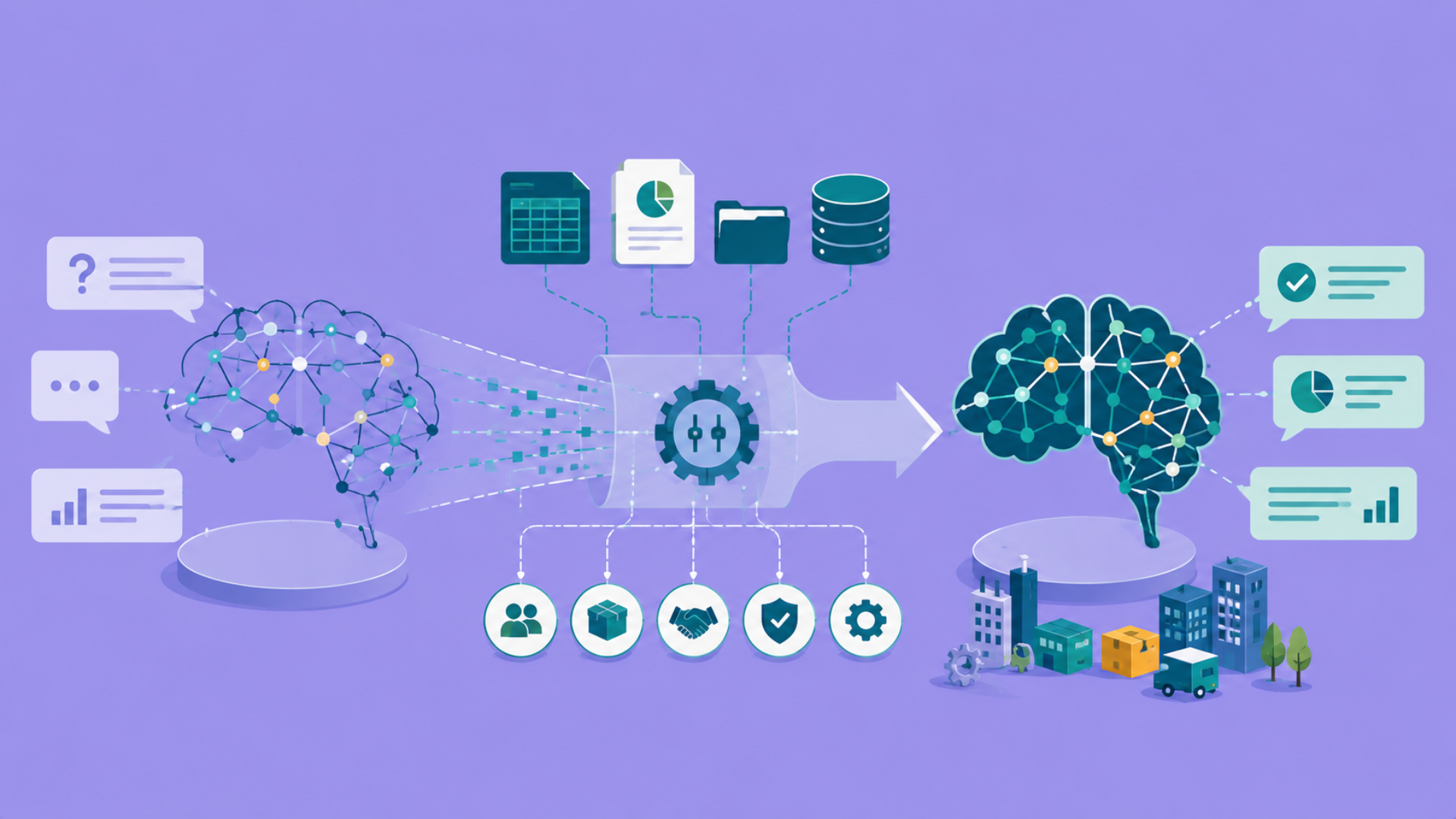
"Should we use RAG or fine-tuning?" is the most-searched question in enterprise AI right now.
It is also a question that many teams answer wrong. They reach for fine-tuning when RAG would do the job. Or they stick with RAG when fine-tuning would fix a problem they have been struggling with for months.
This piece explains the difference in plain terms. What fine-tuning is. What it is good for. When you actually need it. And when you do not.
What Fine-Tuning Actually Is
A general-purpose AI model is trained on a huge amount of text from the internet. It learns language, reasoning, and a broad base of knowledge.
Fine-tuning takes that model and trains it further on your specific data. Your documents. Your terminology. Your preferred format and tone.
The result is a model that behaves differently from the general one. It uses your language. It responds in your format. It understands your domain.
A simple analogy: a new hire joins your company knowing how to write and reason well. Fine-tuning is the onboarding process that teaches them how your company works, how you communicate, and what good output looks like in your context.
What Fine-Tuning Is Good For
Fine-tuning changes how a model behaves. It is not for giving a model new information. It is for shaping how it responds.
Here is where it genuinely helps.
Consistent tone and format:
If you need the AI to always respond in a specific format, such as a structured service report, a legal clause, or a clinical note, fine-tuning is the most reliable way to achieve that consistency. Prompt instructions can achieve some of this. Fine-tuning does it more reliably at scale.
Domain vocabulary:
If your business uses terminology that general models get wrong or interpret loosely, fine-tuning on your documents teaches the model your language. A manufacturing OEM, a financial services firm, and a pharmaceutical company all use terms that have precise meanings in their context. Fine-tuning embeds those meanings.
Reducing hallucination in a specific domain:
A model fine-tuned on your verified internal content is less likely to hallucinate in that domain. It has learned what correct answers look like in your context and is more likely to stay within that boundary.
Cost and speed at scale:
A smaller model fine-tuned on your data can outperform a large general model on your specific task, at a fraction of the running cost. If you are processing millions of queries, this matters.
What Fine-Tuning Is Not Good For
Fine-tuning does not update the model's knowledge.
If you fine-tune a model on your product documentation from last quarter and then update the documentation, the model still knows the old version. It does not automatically learn the new one.
For keeping AI up to date with new information, you need RAG. RAG retrieves relevant content from your current documents at query time and gives it to the model as context. The model answers using the retrieved content. When the documents change, the answers change.
Fine-tuning changes behaviour. RAG changes knowledge. Most enterprise AI systems need both.
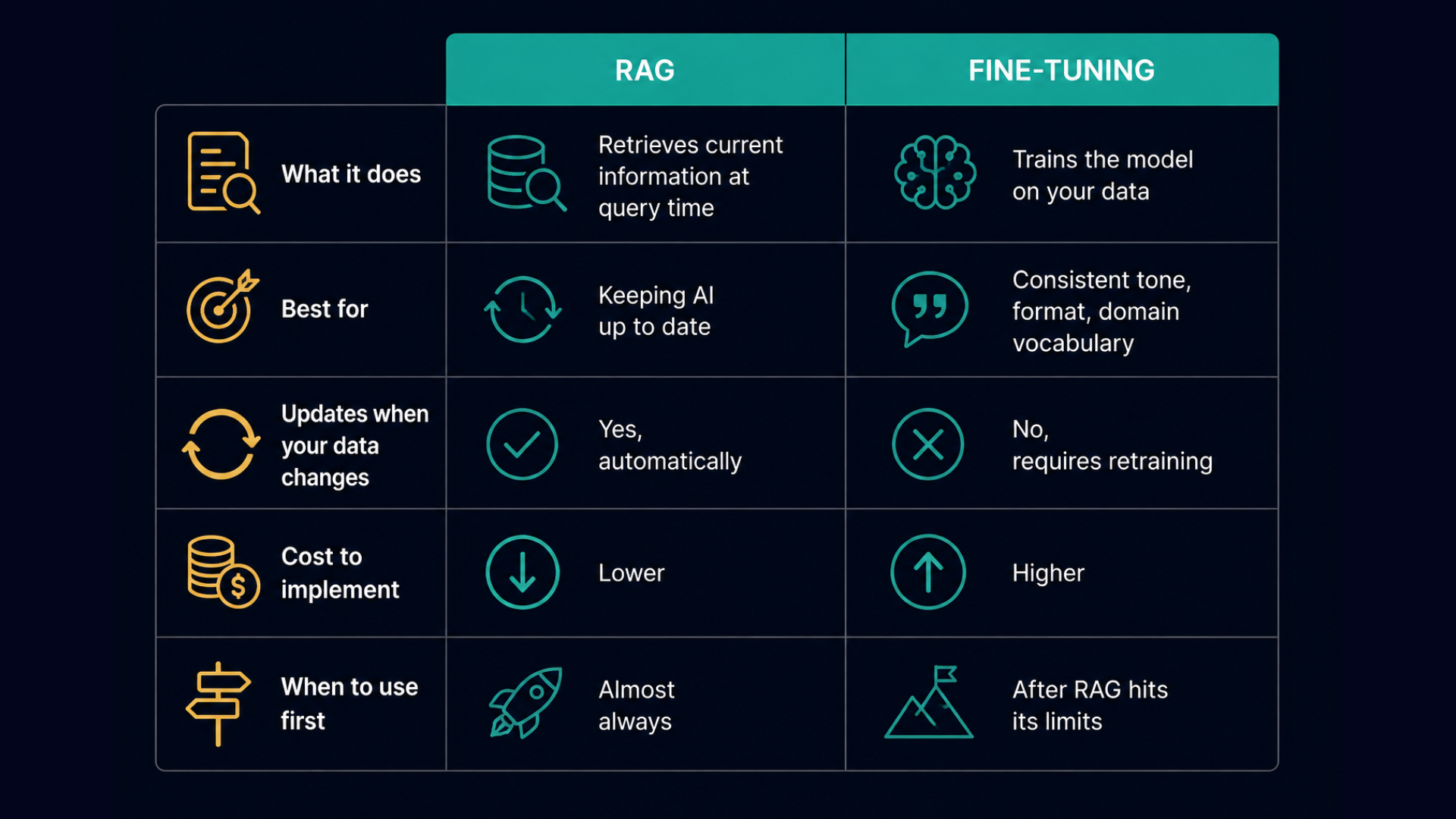
RAG vs Fine-Tuning: A Plain Comparison
RAG | Fine-Tuning | |
|---|---|---|
What it does | Retrieves current information at query time | Trains the model on your data |
Best for | Keeping AI up to date | Consistent tone, format, domain vocabulary |
Updates when your data changes | Yes, automatically | No, requires retraining |
Cost to implement | Lower | Higher |
When to use first | Almost always | After RAG hits its limits |
The practical advice from most enterprise AI teams in 2026 is: start with RAG. Add fine-tuning when RAG alone is not producing the consistency or quality you need.
When Does an Enterprise Actually Need Fine-Tuning?
Here is the honest answer: most enterprises do not need fine-tuning to start. They need it when specific problems appear.
Fine-tune when you hit these situations.
Prompt engineering is not working:
You have tried writing better prompts to get consistent output. The model still drifts in tone, format, or terminology. Fine-tuning fixes this more reliably than any prompt can.
You have enough good examples:
Fine-tuning needs quality training data. A minimum of 500 high-quality, verified examples is a reasonable starting point for most tasks. Fewer than that and the results will be unreliable.
Latency or cost is a problem:
A fine-tuned smaller model is faster and cheaper to run than querying a large frontier model via API. At high query volumes, this becomes significant.
You need the model to know your domain deeply:
Technical support for complex industrial equipment. Compliance responses in a specific regulatory framework. Clinical documentation in a specific specialty. These require depth that general models lack and fine-tuning can provide.
Data privacy matters:
A fine-tuned model deployed on your own infrastructure means your data does not leave your environment. This matters in regulated industries.
What Fine-Tuning Requires
Fine-tuning is not a small undertaking. Before committing to it, understand what it needs.
Good training data:
The quality of the fine-tuned model depends entirely on the quality of the data you train it on. Bad data produces a model that is consistently wrong in your specific style. Data curation takes more time than the training itself.
A clear evaluation framework:
You need to know before training what good output looks like. Set up your test cases before you start. Projects that do this are significantly more likely to reach production.
Ongoing maintenance:
A fine-tuned model is not set and forget. As your business changes, your training data needs to change. Build this into your plan from the start.
Technical capability:
Fine-tuning requires machine learning expertise. If your team does not have it, you need a partner who does.
The Question to Ask Before You Fine-Tune
Before investing in fine-tuning, ask this: is the problem I am trying to solve a knowledge problem or a behaviour problem?
If the AI is giving wrong information because it does not have access to your current data, that is a knowledge problem. Solve it with RAG.
If the AI is giving information in the wrong format, the wrong tone, or using the wrong terminology, that is a behaviour problem. Solve it with fine-tuning.
Most enterprise AI problems are a combination of both. Start with RAG. Add fine-tuning when the behaviour problems persist.
Vishleshan AI's forward deployed engineers design the right architecture for each enterprise deployment, including when RAG alone is sufficient, when fine-tuning adds value, and how to combine both for use cases that require consistency and current knowledge simultaneously. Book a Consultation