


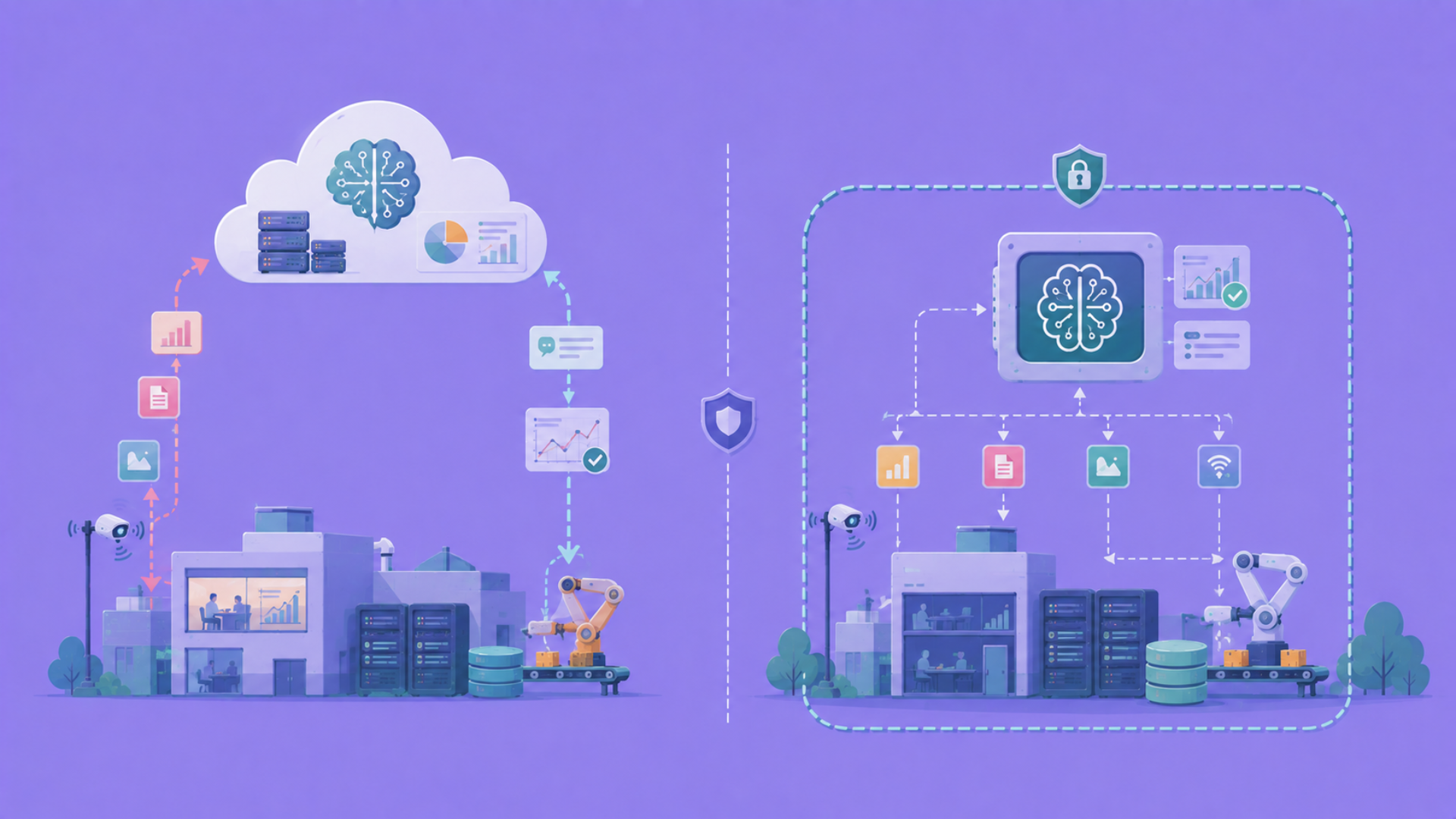
55% of enterprise AI inference now runs on-premise. That is up from 12% in 2023.
The shift is not driven by performance. Cloud AI models are still more capable at the frontier. It is driven by something more fundamental: data governance, regulatory compliance, and the growing recognition that sending sensitive enterprise data to external APIs creates risks that many organisations are no longer comfortable accepting.
NTT DATA released research in May 2026 describing enterprise AI as outgrowing the architecture and infrastructure beneath it. Data jurisdiction has become a core design parameter. Organisations that redesign early are gaining a measurable edge in AI readiness and scale.
On-device AI is how enterprises are responding. Here is what it is and when it matters.
What On-Device AI Actually Is
On-device AI means running the AI model on infrastructure that the organisation controls, rather than accessing it through an external API.
When you use a cloud AI API, this is what happens. Your data leaves your infrastructure. It travels to the vendor's servers. The model processes it there. The result comes back. The vendor may log the query, use it for model improvement, or store it in a data centre subject to laws in a jurisdiction you did not choose.
When you run AI on-device or on-premise, none of that happens. The model sits on your own servers, your own devices, or your own cloud environment. Your data never leaves your infrastructure. The model processes it locally. The result stays local.
The term covers a spectrum. At one end, AI running on an individual device, a smartphone, a laptop, or an edge computing device. At the other end, AI running on the organisation's own data centre or private cloud environment. What they share is the principle: the model runs where the data is, rather than the data travelling to where the model is.
Why This Matters More in 2026 Than It Did Two Years Ago
Three converging forces have made on-device AI a serious enterprise topic rather than a technical curiosity.
Data sovereignty law is tightening:
The EU AI Act, GDPR, CCPA, Brazil's LGPD, and Canada's Law 25 all impose requirements on how data is handled, where it is processed, and who has access to it. The sovereign cloud market reached $80 billion in 2026, growing 35.6% year on year, as enterprises move AI workloads away from global hyperscalers to infrastructure they control.
There is a specific legal issue that most enterprise technology teams do not fully understand. Using an American cloud provider's European data centre does not give you data sovereignty under EU law. The US CLOUD Act allows US authorities to compel any US-incorporated cloud provider to hand over data stored anywhere in the world, including EU data centres. Amazon, Microsoft, Google, IBM, and Oracle are all US-incorporated. AWS Frankfurt, Azure West Europe, and Google Cloud Belgium are all subject to CLOUD Act demands.
If your organisation needs genuine data sovereignty, the data cannot be on infrastructure controlled by a US-incorporated company, regardless of where that infrastructure is physically located.
On-device models have become capable enough:
In 2024, the quality gap between self-hosted open source models and frontier cloud APIs was significant. That gap has narrowed substantially. On-premise deployment of capable open source models now handles 85 to 90% of enterprise AI use cases at quality levels that are difficult to distinguish from cloud APIs for most business applications.
This changes the trade-off calculation. Previously, choosing on-device AI meant accepting significantly lower model quality. Now, for the majority of enterprise use cases, it means accepting a modest quality difference in exchange for meaningful cost, privacy, and compliance advantages.
The cost economics have shifted:
Local inference is approximately 18 times cheaper per token than cloud APIs for sustained workloads, with hardware payback periods of six to ten weeks at typical enterprise volumes. For organisations running millions of inference calls per month, this is a material cost difference.
The Three Types of On-Device AI Worth Understanding
Not all on-device AI is the same. The right choice depends on the use case, the data sensitivity, and the quality requirement.
On-device at the endpoint level.
AI running on individual devices, smartphones, laptops, or tablets, without requiring connectivity. This is what Apple Intelligence, Google's Gemini Nano, and Qualcomm's optimised models provide for consumer devices. For enterprise use cases, this means AI that works in the field, in low-connectivity environments, on the technician's or field engineer's device. The quality is good for simple, well-defined tasks. It is limited for complex reasoning. And the data sovereignty benefits are real: queries never leave the device.
This is directly relevant to field service operations in automotive and consumer electricals networks, where technicians need AI support in locations without reliable connectivity, and where queries about customer data and product information need to stay within controlled infrastructure.
On-premise at the organisational level.
AI running on the organisation's own data centre infrastructure or private cloud environment. This provides the full capability of capable open source models with complete control over the data. Suitable for the high-sensitivity enterprise workloads where data cannot leave the organisation's environment under any circumstances.
Financial services organisations processing loan applications, insurance underwriting data, and customer financial records. Automotive manufacturers processing proprietary production data and supplier contracts. Healthcare providers processing patient records. These are the use cases where on-premise deployment is not a preference. It is a requirement.
Private cloud deployment:
AI running on cloud infrastructure that is dedicated to the organisation and isolated from shared infrastructure, typically operated by the cloud provider in a specific geographic region under specific governance terms. This provides more capability and scalability than on-premise while offering better data isolation than standard cloud APIs. The data sovereignty advantages depend entirely on the specific terms and the jurisdiction of the infrastructure.
What On-Device AI Costs
On-device AI is not free. It is cheaper than cloud APIs at scale. But it has real costs that need to be understood before committing to this architecture.
Hardware. Running capable AI models requires GPU infrastructure. For edge devices, this means hardware with on-device AI processing capability. For on-premise deployments, this means GPU servers that are expensive to acquire, power-intensive to run, and require maintenance over their operational life.
Engineering. Deploying and maintaining an AI model on your own infrastructure requires engineering capability. Someone needs to manage the deployment, monitor performance, handle model updates, and maintain the system over time. This is an ongoing operational commitment, not a one-time project.
Latency advantage. This is a cost benefit rather than a cost. On-device inference typically delivers results in 40 milliseconds versus 1.5 seconds for cloud API calls. For real-time applications, for voice AI interfaces, for field service tools that need to respond immediately, this latency difference determines whether the AI gets used or gets abandoned.
When On-Device AI Is and Is Not the Right Choice
On-device AI makes sense when:
Data cannot leave the organisation's environment under any circumstances. Sensitive financial data, patient records, proprietary product information, classified content. If the governance requirement is absolute, the architecture must be on-device.
Query volume is high enough that the infrastructure cost is lower than the API cost. The crossover point varies but for most large enterprises running sustained high-volume workloads, on-device infrastructure pays back within weeks.
Latency matters for the user experience. Real-time voice interaction, instant search, live document processing. Cloud API latency of one second or more creates friction that reduces adoption.
The use case is within the quality range of capable open source models. Document classification, named entity extraction, summarisation, sentiment analysis, domain-specific question answering. These work well with on-premise open source models.
Cloud AI is still the right choice when:
The task requires frontier reasoning capability. Complex legal analysis, sophisticated synthesis, high-stakes judgment calls where the quality difference between frontier models and on-premise alternatives is significant.
The organisation lacks the engineering capacity to operate AI infrastructure. Running on-premise AI is an operational commitment. Without that capacity, cloud APIs are the practical option.
Query volume is low enough that cloud API costs are manageable. At low volumes, the infrastructure investment in on-device deployment exceeds the API savings.
What the Regulatory Direction Tells Enterprises
The regulatory direction is consistent across every major jurisdiction. Data governance requirements are tightening. Enforcement is increasing. The window for enterprises to deploy AI without a clear data governance architecture is closing.
The EU AI Act's enforcement provisions for systems handling sensitive data are in effect. GDPR enforcement on AI systems is active. Financial services regulators in the UK, EU, and Singapore have all published guidance on AI governance that includes data handling requirements.
Enterprises that build data sovereignty into their AI architecture now, choosing on-device deployment where it is required, will face compliance reviews with an architecture that already satisfies the requirements. Those that defer the decision will face it at a moment of their regulator's choosing.
Data jurisdiction is a design parameter, as NTT DATA's research described it. It needs to be decided at the architecture stage, before production deployment, not resolved after a regulatory inquiry.
Vishleshan AI's forward deployed engineering (FDE) approach designs AI architectures that account for data sovereignty requirements from day one. For clients in financial services, automotive, and consumer electricals, we make explicit decisions about which workloads require on-device deployment, which can run on managed cloud infrastructure, and how to structure the governance framework that satisfies both the regulatory requirement and the operational need. Book a Consultation