


At CES in January 2026, NVIDIA's Jensen Huang declared it the "ChatGPT moment for physical AI."
Georgetown's Center for Security and Emerging Technology ranked the development alongside ImageNet in 2012 and ChatGPT in 2022 as a genuine industry inflection point. Deloitte and BCG both published major research reports on the topic within weeks of each other. TCS published its Physical AI Readiness Report 2026 based on research with manufacturing executives across multiple countries.
When analysts, hardware manufacturers, and consulting firms all converge on the same concept at the same time, one of two things is happening. A genuine structural shift is underway. Or a marketing cycle has begun.
In 2026, it appears to be both. Understanding the difference between what is real and what is still promised is the starting point for making good decisions about physical AI investment.
What Physical AI Actually Is
Most AI runs on a screen. You give it an input. It gives you an output. Text in, text out. Data in, prediction out. The AI lives in software. It interacts with the world through interfaces.
Physical AI is different. It perceives the real world through sensors and cameras. It reasons about what it perceives. And it acts directly in the physical environment through robots, autonomous machines, and connected hardware.
Physical AI is AI with a body.
The simplest definition comes from the industry itself: physical AI is AI that can perceive, reason, and act in the real world. Not AI that advises humans who then act. AI that acts directly, in the physical environment, on the physical objects and processes it is monitoring.
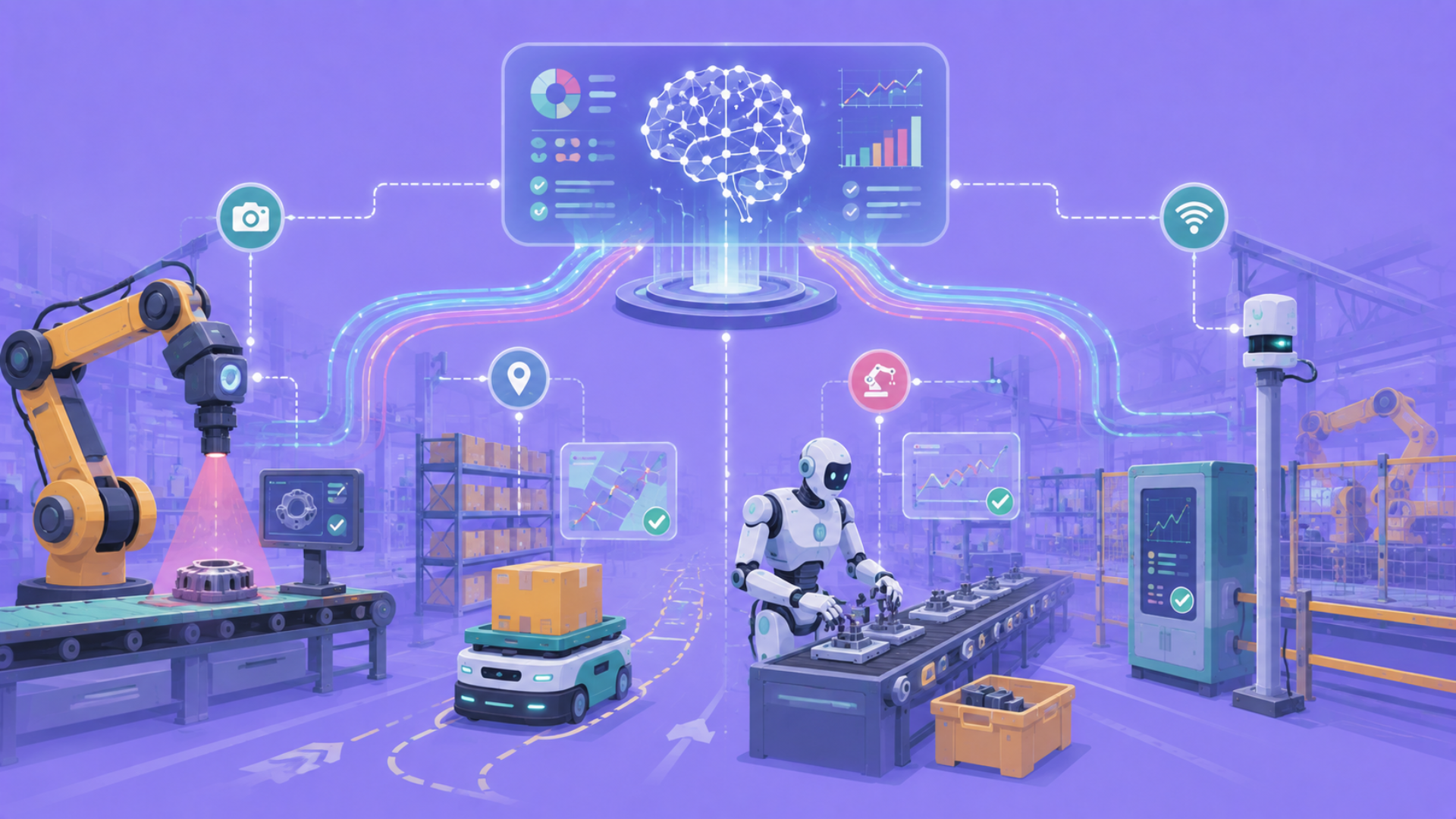
A quality inspection camera that detects a defect and stops the production line before the defective unit moves to the next station is physical AI. An autonomous mobile robot that navigates a warehouse, identifies the right shelf location, and retrieves the correct item without human direction is physical AI. A robotic arm that adjusts its grip in real time based on the shape and weight of the object it is handling is physical AI.
What distinguishes physical AI from earlier automation is the intelligence layer. Traditional industrial robots follow programmed instructions precisely. They are powerful but inflexible. Change the task and you need to reprogram the robot.
Physical AI systems learn. They adapt to variation. They handle situations they were not explicitly programmed for, because they are reasoning about what they perceive rather than executing a fixed sequence of steps.
Why 2026 Is Different From Previous Automation Waves
Manufacturing has been through several automation waves. Industrial robots in the 1970s and 1980s. Computer numerical control in the 1990s. Collaborative robots and IoT in the 2010s. Each wave was real. Each was also over-hyped relative to how quickly it actually changed shop floor operations.
Three things make 2026 genuinely different from previous waves.
Foundation models have reached physical AI:
The same approach that made large language models capable of general reasoning is now being applied to physical systems. Robotics foundation models trained on vast datasets of physical interactions are enabling robots to handle novel situations rather than only performing the specific tasks they were trained for. This is a qualitative change in what robots can do without reprogramming.
Major industrial vendors moved from research to product:
ABB unveiled industry-ready physical AI systems at Automate 2026 in June. Figure AI is testing humanoid robots at BMW's South Carolina factory. Amazon's Sequoia system improved inventory identification and storage speeds by 75% over previous methods. These are not research projects. They are production deployments.
22% of manufacturers now plan to deploy some form of physical AI by 2027:
That figure comes from TCS's Physical AI Readiness Report 2026. That is not early-adopter territory. It is a meaningful share of the market already committing capital.
Where Physical AI Is Working in Production Right Now
The honest answer about physical AI deployment in 2026 is that it works well in constrained, high-value environments where reliability is achievable and the economics justify the cost.
Warehouse and logistics automation is the clearest example. The global warehouse automation sector is projected at between $9.5 billion and $14.2 billion in 2026, growing at 15 to 20% annually. AI orchestration platforms now manage mixed fleets of robots and human workers within the same operational space. Autonomous mobile robots navigate dynamically, avoiding obstacles and adapting to changing warehouse layouts without requiring fixed paths or infrastructure modifications.
Manufacturing quality inspection is one of the most rapidly growing physical AI applications. Computer vision systems inspect every unit passing through a production line. They detect defects at a granularity human inspectors cannot match. They run continuously without fatigue. And they generate quality data that feeds back into process improvement. For automotive and consumer goods manufacturers, this is one of the fastest paths to measurable quality improvement.
Precision assembly and handling is where humanoid robots are beginning to make their first production appearances. BMW's testing of Figure AI robots at its South Carolina factory covers tasks requiring dexterity that traditional industrial robots cannot handle. Precision manipulation, complex gripping, and two-handed coordination. These are tasks that have resisted automation for decades because they required human judgment and physical adaptability. Physical AI is beginning to close this gap.
Field inspection and maintenance is an emerging application with significant potential for asset-intensive industries. Autonomous drones and ground robots inspect infrastructure, identify maintenance needs, and in some cases perform repairs, in environments that are hazardous or difficult for humans to access consistently.
What Physical AI Is Not Ready for Yet
Being honest about limitations matters as much as being clear about capabilities.
Physical AI is not ready for fully unstructured environments at industrial scale. Robots that work excellently in a controlled warehouse struggle in environments where the layout, the objects, and the task vary unpredictably. General-purpose physical AI that can handle any task in any environment remains a research challenge, not a production reality.
Humanoid robots are genuinely impressive in demonstrations. In production environments, they are in early testing at a small number of facilities. The combination of reliability, safety, and cost-effectiveness required for broad industrial deployment is not yet consistent across the available systems.
The economics are still challenging for many applications. Physical AI systems require significant upfront investment. The return on that investment depends on the volume of the task, the labour cost being displaced or augmented, the reliability of the system in production, and the total cost of ownership including maintenance. For high-volume, repetitive tasks in controlled environments, the economics work. For lower-volume or highly variable tasks, they often do not yet.
What This Means for Enterprise Leaders
77% of manufacturers expect physical AI to significantly transform warehouse operations according to TCS's 2026 report. None plan to reduce investment in the technology.
For enterprise leaders in automotive manufacturing, consumer goods, logistics, and industrial operations, physical AI is not a distant future technology to monitor. It is a current capital allocation question.
The enterprises that will extract the most value from physical AI are the ones that start with specific high-value problems rather than broad technology adoption goals. Which tasks in your operations are high-volume, repetitive, and require physical precision? Which environments are consistent enough that a physical AI system can operate reliably? Which operational bottlenecks, if resolved, would generate the clearest and most measurable return?
These questions produce a specific starting point. A starting point leads to a bounded pilot. A bounded pilot in the right use case produces the evidence base and the organisational experience to scale.
The physical AI market is projected to grow from $1.5 billion in 2026 to $15.24 billion by 2032 at 47.2% annual growth. The enterprises investing in the right use cases now are the ones that will have the operational experience, the vendor relationships, and the implementation knowledge to scale efficiently as the technology matures and the economics improve.
The Connection to Enterprise AI More Broadly
Physical AI does not operate independently of the enterprise AI stack. It is an extension of it.
Physical AI systems generate enormous volumes of data from sensors, cameras, and operational interactions. That data feeds into the same data and integration architecture that underpins enterprise AI across supply chain, manufacturing, and field service. Physical AI decisions need to connect to ERP systems, quality management systems, and maintenance platforms. The agentic AI governance that applies to software agents applies equally to physical agents that take real-world actions.
The enterprises that will integrate physical AI most effectively are the ones that have already built strong data foundations, integration architectures, and AI governance frameworks. Physical AI is not a separate technology strategy. It is the next layer of the same enterprise AI strategy.
Vishleshan AI's forward deployed engineering (FDE) approach builds AI systems that connect to the physical operations of our clients across automotive manufacturing, consumer electricals distribution, financial services, and supply chain. As physical AI moves from pilot to production across these industries, the integration and governance work that makes it reliable is the same work we have been doing since before the term existed. Book a Consultation