


Top-performing field service organisations achieve an 87% first-time fix rate. Bottom performers achieve 59%. The 28-point gap between them represents a significant difference in operational cost, customer satisfaction, and technician productivity. It persists not because the bottom performers lack access to capable field service management (FSM) technology but because they have not connected that technology to the three upstream conditions that determine whether a first-time fix happens.
Those three conditions are: the right technician with the right skill for the specific job type, confirmation that the required parts are available before dispatch, and a job completion process that verifies closure in a way that the solution and the ERP both trust.
A leading Consumer Electricals OEM, operating a national service network, was achieving job closure rates significantly below target. The solution it was running was capable in isolation. The problem was not the solution. It was that the solution was operating without real-time connection to the ERP warranty data, without live integration to dealer parts inventory, and without a job completion process that could verify closure at the required level of certainty for warranty and audit purposes.
Within six months of deploying Technician Plus, the organisation achieved 95% app-based job closure across its service network. This is what changed.
Why First-Time Fix Rate Is Determined Upstream, Not at the Job Site
The most common misconception about first-time fix rate is that it is determined at the customer site, by the technician's skill and the quality of their diagnosis. That is the visible part of the problem. The determinants are invisible by the time the technician arrives.
First-time fix rate is determined at three earlier points in the service workflow.
At technician selection:
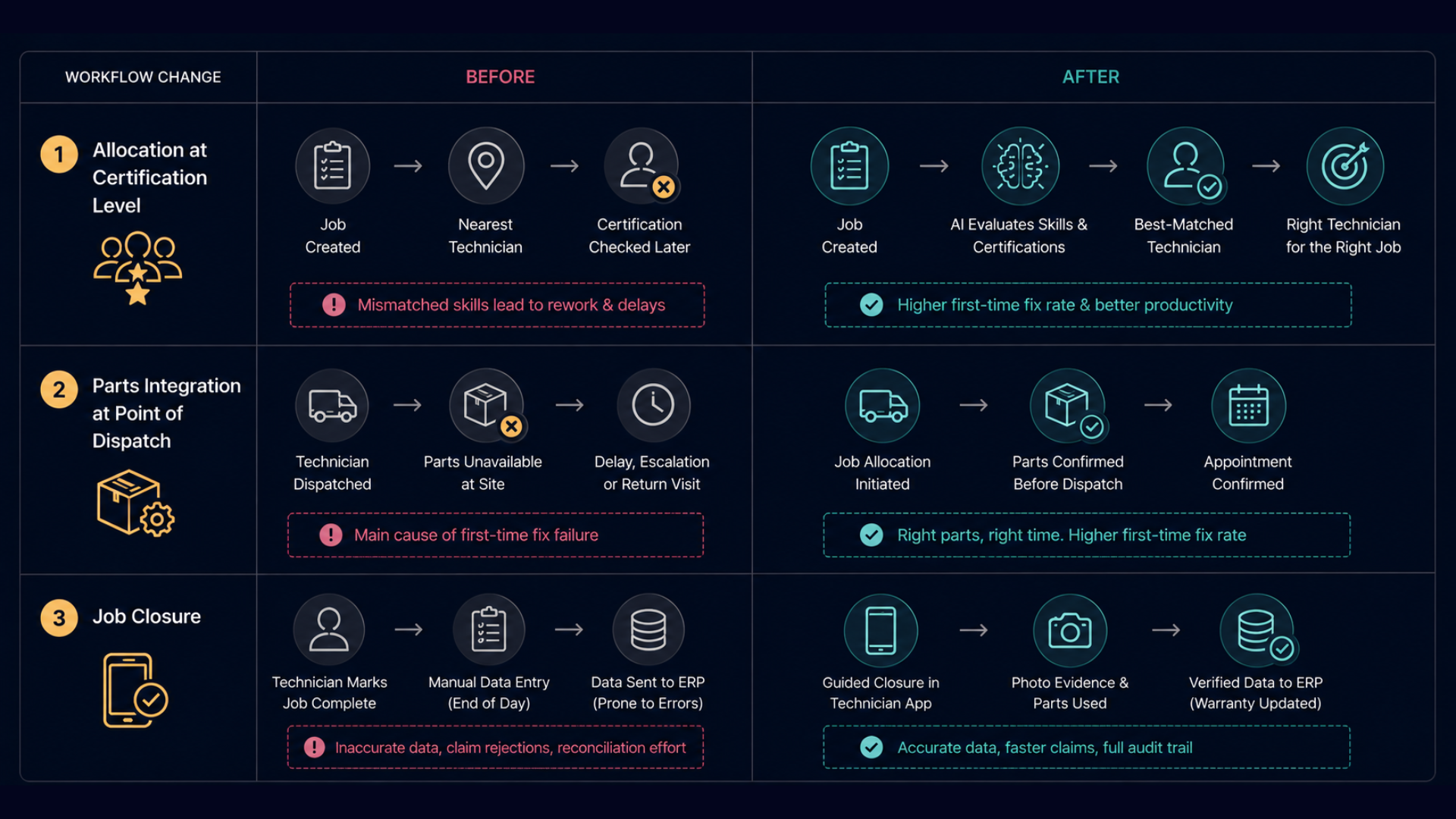
The allocation decision determines whether the technician who arrives at the site has the specific certification, the specific product training, and the specific experience level required for this job type. A technician who is broadly qualified but not specifically certified for this product category will complete the job at a lower rate than one who is precisely matched. At 500-plus technicians across a dealer network, precise skill matching requires AI allocation that evaluates every available technician against every job's specific requirements simultaneously. Human dispatchers working from regional queues cannot do this reliably at scale.
At parts confirmation:
The parts decision determines whether the technician who arrives at the site has the components required to complete the job. In a large OEM service network where technicians work from vehicle stock replenished through dealer inventory, parts confirmation before dispatch is the difference between a job that is completed on the first visit and one that requires a return visit after parts are sourced. If parts confirmation is not integrated into the dispatch decision, it either happens manually and inconsistently or it does not happen at all.
At job completion verification:
The verification process determines whether job closure in the solution matches actual job completion in the field. In service networks where technicians self-report job completion without verification, the closure rate in the solution does not reflect the actual completion rate. Jobs get marked closed that are not complete, or completed jobs do not get marked closed because the technician's mobile experience is too friction-heavy to use reliably in the field. Neither situation gives the solution or the ERP accurate data to work with.
Improving first-time fix rate requires addressing all three upstream conditions. Improving only one while leaving the others unchanged produces partial improvement at best.
What the Consumer Electricals OEM Was Dealing With Before Deployment
The service network in question comprised thousands of technicians working through a combination of authorised service centres and dealer-employed service staff. Before deployment, three structural problems were suppressing job closure rates.
Allocation without skill depth:
Job assignment was handled through a combination of regional dispatchers and direct mobile communication between service coordinators and technicians. Dispatchers had high-level visibility of technician availability but limited visibility of specific certification and skill levels at the individual technician level across the full network. Jobs were assigned based on availability and rough geography rather than precise skill match. Technicians arrived at jobs they were not optimally qualified for more often than the organisation knew, because the data to track this was not being collected systematically.
Parts confirmation without integration:
Spare parts availability was checked through a separate process from dispatch. A phone call to the dealer or a manual inventory lookup that happened after the technician was already assigned and the customer appointment was already set. When parts were unavailable at the dispatch point, the resolution was either to send the technician and reschedule after the visit confirmed the parts gap, or to delay the appointment while parts were sourced. Both outcomes had the same result: a customer interaction that required more touches than it should have.
Job completion without verification:
The job closure process required technicians to update a system on their mobile device after completing the job. Adoption of this step was inconsistent. Some technicians completed it reliably. Others completed it at the end of the day from memory. Others did not complete it at all, leaving jobs in an open state in the solution until a coordinator chased. The closure rate that the solution reported did not reflect actual field performance.
What Changed After Deployment
AI-matched allocation at certification level
Technician Plus maintains a live profile for every technician in the network including product certifications, skill assessments, job type history, and performance metrics by job category. When a job is created, the allocation engine evaluates available technicians against the job's specific requirements. Criteria like product type, service category, warranty tier, and customer SLA and recommends the best-matched technician rather than the nearest available one.
For the Consumer Electricals OEM, this meant that jobs requiring specific product certifications were routed to technicians with those certifications as a first filter rather than as an afterthought. The quality of the allocation decision improved immediately, without requiring any change in how regional managers or dispatchers operated, because the recommendation surfaced the right answer before they had to make the call.
Real-time parts integration at point of dispatch
The solution integrated with dealer inventory systems in real time, checking spare parts availability for the specific job type at the point of dispatch rather than as a separate step. When required parts were not available in the technician's vehicle stock, the allocation engine checked availability at the nearest dealer location and either confirmed that parts could be collected before the customer appointment or flagged the gap for coordinator action before the appointment was confirmed.
This single integration eliminated the most common cause of first-time fix failure in the network: technicians arriving at jobs without the parts required to complete them. The change did not require any new process from the service coordinator. The parts check happened automatically as part of the allocation decision.
AI-verified job closure
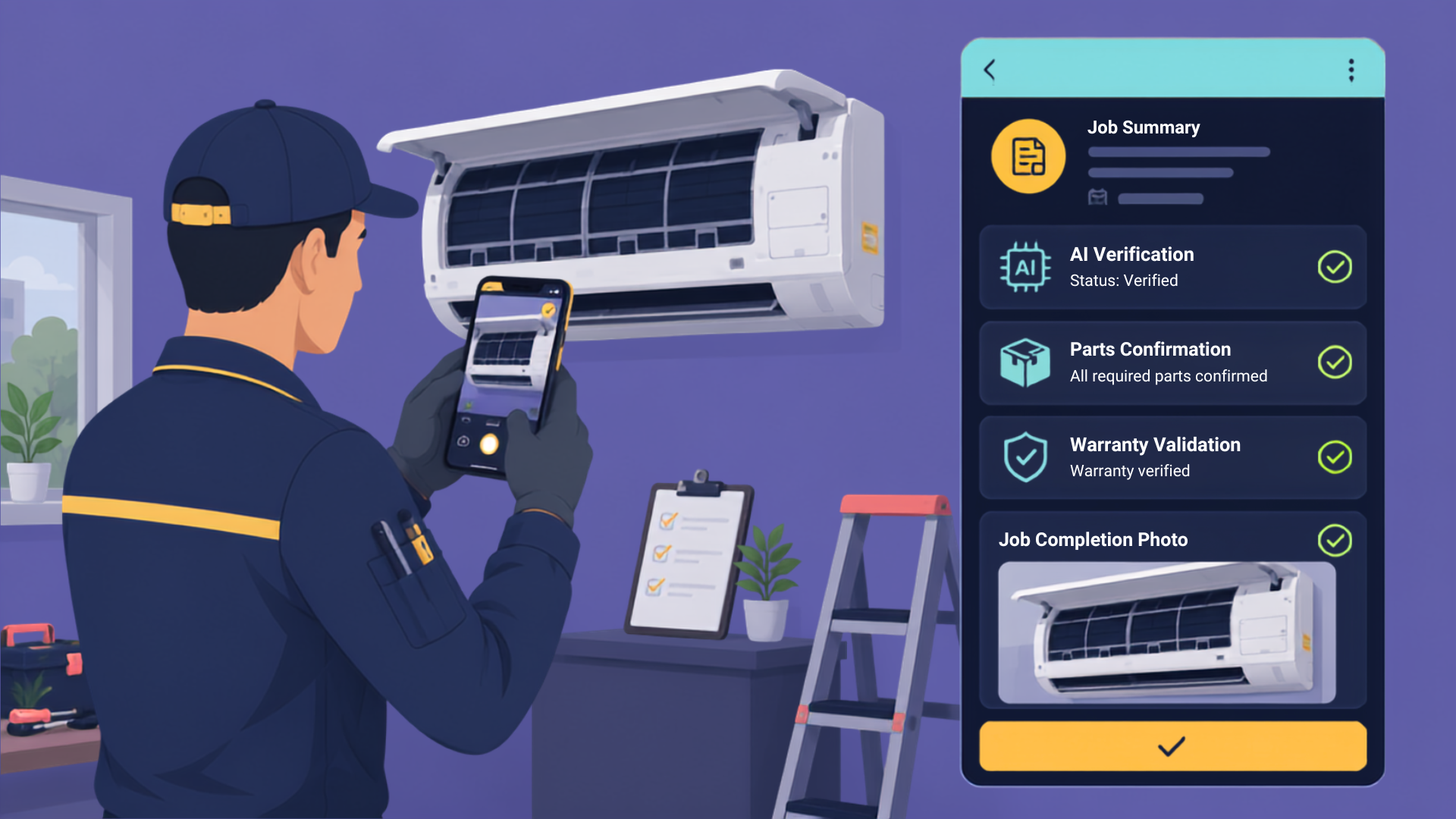
Job completion in Technician Plus is verified rather than self-reported. The technician's mobile app guides them through a structured job closure sequence that includes photographic evidence of completed work, confirmation of parts used, customer acknowledgment, and warranty documentation upload where required. The sequence is designed for the connectivity conditions the network operates in, working offline where necessary and syncing when connectivity is restored.
The closure data that reaches the ERP is verified data. Not a technician's end-of-day recollection of what they completed, but a timestamped, photographically evidenced record of job completion at the point it occurred. The ERP's warranty records update from this data, which means the warranty claim process and the job closure process are driven by the same underlying data rather than from two separate inputs that need to be reconciled.
The 95% Figure in Context
The 95% app-based job closure rate achieved within six months of deployment is a verified closure rate. Jobs closed through the app with AI-verified completion, not a self-reported completion rate. The distinction matters because it reflects actual field performance rather than system reporting.
The industry benchmark for first-time fix rate in complex OEM service networks sits around 70 to 75% as a starting point for organisations that are measuring it accurately. Top performers reach 85 to 87%. The Consumer Electricals OEM moved from a position where accurate measurement was not possible to 95% verified closure within six months of deployment. This was because earlier the closure data was self-reported and inconsistent.
Three things explain why the improvement happened as fast as it did.
The solution was deployed by working closely with the client's service operations teams, which meant the allocation logic, parts integration, and verification workflow were tuned to the specific operating conditions of this network before go-live rather than being configured generically and adjusted post-launch.
The mobile experience was designed for the connectivity and device profile of the technician population, which meant adoption happened at a much higher rate than previous solution deployments had achieved. Technicians used the app because it worked in the conditions they were actually working in.
The three upstream conditions of allocation, parts, verification were addressed simultaneously rather than sequentially. Addressing only one while the others remained unresolved would have produced partial improvement. Addressing all three together produced the compound effect visible in the closure rate.
What This Means for OEMs Evaluating FSM solutions
The 28-point gap between top and bottom performers in first-time fix rate is not closed by selecting a more capable FSM solution. It is closed by ensuring that the solution is connected to the three upstream conditions that determine whether first-time fix happens: precise skill matching at allocation, confirmed parts availability before dispatch, and verified rather than self-reported job closure.
The questions that reveal whether a solution is positioned to close this gap are specific.
How does the solution match technicians to jobs?
By availability and broad skill category, or by specific certification and performance history at the job type level?
How does parts availability integrate with the dispatch decision?
Aas a separate manual check, as a scheduled sync with inventory systems, or as a real-time query at the point of allocation?
How does job closure work in the field?
As self-reporting through a mobile app, or as a verified process that collects photographic evidence and warranty documentation at the point of completion?
The answers to these three questions predict whether a solution will move first-time fix rate or simply track it.
Vishleshan AI's Technician Plus addresses all three upstream conditions in its core architecture: AI-matched allocation at certification level, real-time parts integration with dealer inventory, and AI-verified job closure with photographic evidence. It has been deployed across a 9,500-technician Consumer Electricals service network with 95% app-based job closure achieved within six months of go-live. Book a Consultation