


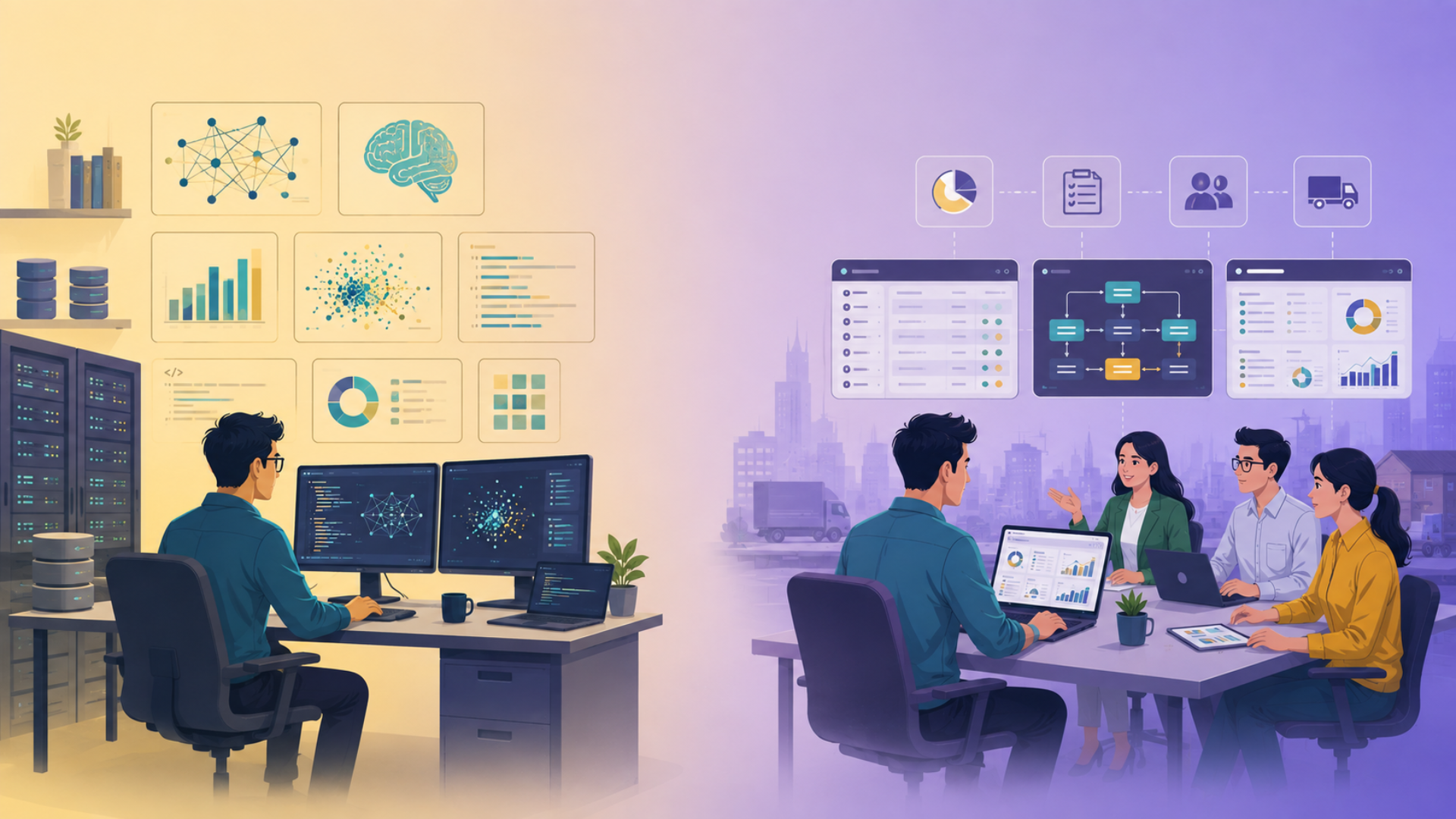
Between January and July 2026, forward deployed engineer job postings grew at four times the rate of overall AI engineering postings. The overall AI engineering market doubled in six months. FDE postings nearly quadrupled.
That divergence tells you something about where the enterprise AI bottleneck actually sits. Building AI capability is getting easier and faster. Getting AI to work inside a specific enterprise environment remains the hard part, and the market is pricing that difficulty accordingly.
For enterprise leaders evaluating how to resource an AI programme, the forward deployed engineer versus AI engineer distinction is not an academic one. It is a practical resourcing decision that determines whether your AI initiative gets to production or stalls in the gap between a working proof of concept and a system that actually operates inside your business.
This piece covers what each role actually does, where they differ, and what that means for how you structure your AI programme.
What AI Engineers Actually Do
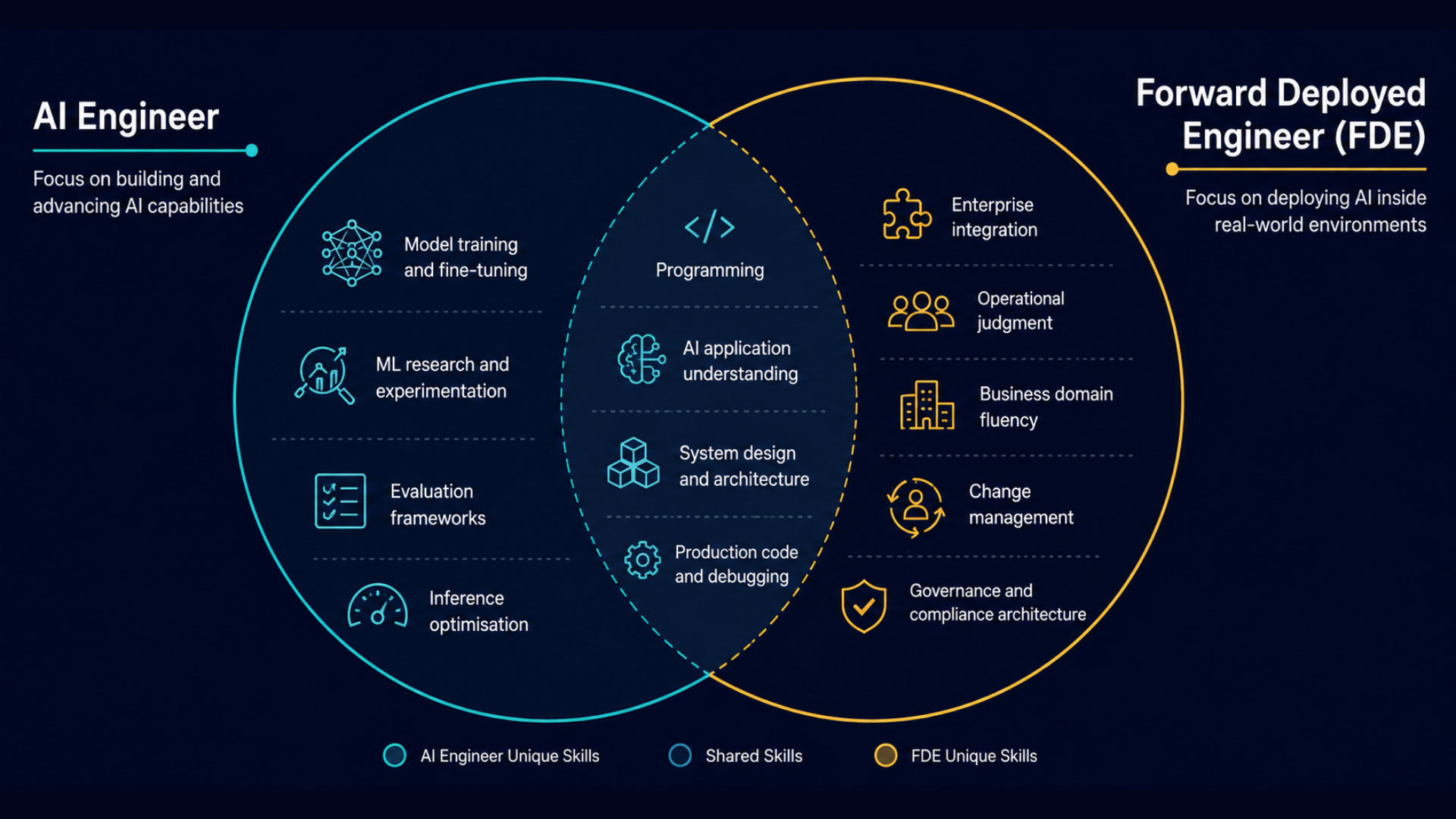
An AI engineer's primary focus is on building, training, fine-tuning, and optimising AI models and the infrastructure that runs them. Their work is centred on the AI system itself: the model architecture, the training data and methodology, the evaluation framework that measures model performance, and the inference infrastructure that serves the model at scale.
In an enterprise context, AI engineers are typically responsible for selecting or building the models that power AI applications, fine-tuning foundation models on domain-specific data, designing the evaluation systems that measure whether the AI is performing as intended, building the model serving infrastructure that handles production inference, and monitoring model performance and managing model drift over time.
The outputs of an AI engineer's work are AI systems with defined capability profiles: models that can perform specific tasks at defined accuracy levels, under defined conditions, within defined cost and latency parameters.
What AI engineers are typically not optimised for is the integration and deployment work that takes a capable AI system and makes it actually function inside a specific organisation's operational environment, against that organisation's specific data, within that organisation's specific compliance constraints, connected to that organisation's specific ERP and legacy systems.
That is a different problem. And it requires a different kind of engineer.
What Forward Deployed Engineers Actually Do
A forward deployed engineer's primary focus is on making AI work inside a specific environment. Not building the AI capability, but deploying it: integrating it with the systems the enterprise actually runs on, ensuring it operates correctly on the enterprise's actual data, building it within the compliance and governance constraints the enterprise actually faces, and staying accountable until it is genuinely adopted and generating the business outcome it was designed to produce.
The work of a forward deployed engineer in an enterprise AI deployment typically covers integration architecture between AI systems and ERP, CRM, MES, and operational platforms; data pipeline engineering that takes the enterprise's actual messy production data and makes it usable by AI systems; governance architecture including audit trails, explainability mechanisms, and human oversight structures; change management and adoption work that ensures the people the system was built for actually use it; and the continuous adjustment of scope and approach that is required when the real production environment turns out to be more complex than any specification captured.
The outputs of a forward deployed engineer's work are production AI systems that are integrated with the enterprise's actual operational infrastructure and being used by the people they were built for.
The Core Distinction
The simplest way to describe the difference is this.
An AI engineer asks: how do we make the AI more capable?
A forward deployed engineer asks: how do we make the AI work inside this specific environment?
These are not competing questions. They are sequential ones. The AI engineer's work creates a capable AI system. The forward deployed engineer's work takes that capable AI system and deploys it inside the real operational complexity of a specific large enterprise.
The reason both roles exist, and the reason FDE postings are growing four times faster than overall AI engineering postings, is that making AI capable and making AI work inside an enterprise are genuinely different problems. Making AI more capable is primarily a research and product development challenge. Making AI work inside a specific enterprise is primarily an integration, contextualisation, and change management challenge.
Most enterprises that have stalled between pilot and production have not stalled because their AI was not capable enough. They have stalled because the integration and deployment challenge was not addressed with the right people and the right operating model.
A Direct Comparison
AI Engineer | Forward Deployed Engineer | |
|---|---|---|
Primary focus | AI model capability and infrastructure | AI deployment inside a specific environment |
Works on | Models, training, evaluation, inference | Integration, data pipelines, governance, adoption |
Success measured | Model performance metrics | Production adoption and business outcome |
Works primarily | In a product or platform environment | Inside the client's operational environment |
Skill emphasis | Deep AI and ML expertise | Full-stack generalism, domain fluency, operational judgment |
Outputs | Capable AI systems | Deployed AI systems in production |
Relationship to enterprise | Builds capability available to the enterprise | Works inside the enterprise to make capability usable |
Failure mode | Capability that does not fit the deployment environment | Depends on partner capability and domain understanding |
The Overlap and Why It Creates Confusion
The reason the FDE versus AI engineer distinction creates confusion is that there is genuine overlap in technical skills.
Both roles require strong engineering capability. Both need to understand AI systems deeply enough to work with them effectively. Both write production code. And in 2026, as the distinction between the roles has become more important commercially, many AI engineers have developed FDE-relevant skills, and many FDEs have deepened their AI technical capability.
The confusion is compounded by naming conventions that vary across organisations. Anthropic calls the equivalent of an FDE an Applied AI Engineer. Some organisations use AI Deployment Engineer. Others use Customer-Embedded Engineer or Technical Implementation Engineer. The title landscape is inconsistent enough that a job title alone does not reliably tell you which problem a person is positioned to solve.
What reliably distinguishes the two, regardless of title, is the primary orientation of their work: toward AI capability development or toward AI deployment inside specific environments. That orientation shapes everything about how someone approaches a problem, where they spend their time, and what kind of experience makes them better at their job.
An AI engineer who has spent five years improving model accuracy and scaling inference infrastructure has developed expertise that makes them significantly better at the AI capability problem. A forward deployed engineer who has spent five years deploying AI inside complex enterprise environments has developed expertise that makes them significantly better at the deployment problem. The technical skills overlap. The expertise does not.
When Your AI Programme Needs an AI Engineer
AI engineers are the right resource when you are building or significantly customising AI capability: training or fine-tuning models on your domain-specific data, building the evaluation infrastructure that measures whether AI is performing correctly for your use case, developing the inference and serving infrastructure that handles production scale, or building reusable AI components that will power multiple applications across the enterprise.
Most large enterprises do not need to build foundation model capability from scratch. That is the province of AI labs. But many do need to fine-tune models on their specific data, build domain-specific evaluation frameworks, and develop the AI infrastructure that will serve as the foundation for multiple deployment initiatives. That is AI engineering work.
AI engineers working on internal capability are most effective when the deployment environment is well-defined and stable, when the integration requirements are clear, and when the primary challenge is making the AI system more capable rather than making it work inside a complex operational environment. When those conditions are met, AI engineering capability can be deployed effectively without forward deployed engineering support.
When Your AI Programme Needs a Forward Deployed Engineer
Forward deployed engineers are the right resource when the primary challenge is deployment and integration rather than capability: connecting AI to the specific ERP and operational systems the enterprise runs on, making AI work correctly on the enterprise's specific messy production data, building the governance and compliance architecture that allows AI to operate within the enterprise's regulatory constraints, and driving the adoption of deployed AI systems across the operational teams they are built for.
For the majority of enterprise AI initiatives in automotive, consumer electricals, financial services, and supply chain, the primary challenge is not AI capability. Foundation models and application-layer AI are capable enough for most enterprise use cases. The primary challenge is integration and deployment: getting AI to work reliably inside the specific, complex, partially-undocumented operational environment of a specific large enterprise.
That is a forward deployed engineering problem. Resourcing it with AI engineers optimised for capability development rather than deployment will produce sophisticated AI that does not work in production.
The Right Combination for Most Enterprise AI Programmes
Most enterprise AI programmes need both, sequenced correctly and with clear accountability for each.
AI engineers build or select and customise the AI capability that the enterprise needs. Forward deployed engineers take that capability and deploy it inside the enterprise's specific operational environment. The AI engineer's work creates the foundation. The forward deployed engineer's work makes it actually function in production.
The most common mistake is treating these as interchangeable: expecting AI engineers to handle deployment work they are not optimised for, or expecting forward deployed engineers to handle deep capability development work they are not positioned to do. Each role has a clearly defined problem space. The enterprise AI programmes that consistently reach production are the ones that match the right people to the right problem rather than expecting one profile to cover the full spectrum.
This is why the build vs buy vs embed decision in enterprise AI programmes is not just a commercial decision. It is a capability decision. Buying a platform addresses the AI capability question. Embedding forward deployed engineers addresses the deployment question. Enterprises that have answered only the first question and not the second are the ones producing impressive pilots that never reach production.
Vishleshan AI's forward deployed engineers work inside client environments across automotive, consumer electricals, financial services, and supply chain, taking AI capability and making it work in production. The AI capability is increasingly available. The deployment capability is what determines whether that capability generates business outcomes. Book a Consultation