



In June 2026, AWS committed $1 billion to a new forward deployed engineering unit, seeding it with thousands of engineers to be placed directly inside enterprise customer environments. This followed OpenAI's Deployment Company, Anthropic's enterprise services venture, and formal FDE programme launches from Google, Databricks, and ServiceNow — all in the same 12-month window.
The signal is unambiguous. The model that gets AI from working concept to production deployment is forward deployed engineering. And the race to own that capability is now a top-tier strategic priority for every major player in enterprise technology.
For large enterprises on the receiving end of this, the question that follows is practical: should we rely entirely on external FDE partners to deploy AI in our environment, or should we build some version of this capability internally? And if we build it internally, how?
The honest answer is that most large enterprises should do both, and the sequencing matters.
Why Internal FDE Capability Is Worth Building
The case for building internal FDE capability is not primarily about cost. External FDE partners will typically be faster, more experienced, and more capable for the first several deployments than an internal team that is still developing the model.
The case is about compounding.
Every AI deployment generates knowledge: about how your data actually behaves in production, which integration patterns work in your specific ERP configuration, which organisational dynamics affect adoption in your specific culture, which governance mechanisms satisfy your compliance framework without creating operational friction. That knowledge, when captured and applied to subsequent deployments, makes each one faster and more effective than the previous one.
External FDE partners accumulate some of this knowledge on your behalf. But they also take significant portions of it with them when the engagement concludes. An internal FDE capability retains everything.
Over a three to five year horizon, enterprises that have built genuine internal FDE capability accumulate an institutional knowledge base about AI deployment in their specific environment that becomes a structural competitive advantage. Deployments that took four months initially now take six weeks. Use cases that required significant external support now run with minimal external involvement. The AI programme compounds in a way that purely externally-delivered AI does not.
This is why TechTarget's analysis of the FDE landscape recommends that for most enterprises, the most realistic approach is using vendor FDEs to kickstart complex deployments while building internal capability in parallel, with knowledge transfer treated as a formal requirement rather than an assumption.
What Internal FDE Capability Actually Requires
Building internal FDE capability is not the same as building an AI team or a data science team. The capability profile is different, the operating model is different, and the failure modes of doing it wrong are different.
Four things need to be in place for internal FDE capability to function effectively.
Engineers with the right profile, not just the right credentials.
The skills that make a great forward deployed engineer are not the skills that make a great AI researcher or a great data scientist. They are full-stack technical generalism at production depth, business domain fluency, and operational judgment under ambiguity.
The engineers most likely to be effective in internal FDE roles are often not the ones with the most impressive pure AI credentials. They are the ones who have demonstrated the ability to work effectively across the full technical stack, who have developed genuine understanding of how the business operates alongside their technical capability, and who have shown the judgment to make good decisions when requirements are unclear and information is incomplete.
Most large enterprises have engineers who fit this profile. They are often underutilised in roles that do not use their full capability, or siloed in technical functions that do not give them the business exposure that makes the FDE profile develop. Identifying and repositioning these people is typically faster than hiring the profile from scratch in a market where FDE demand significantly exceeds supply.
A mandate that puts engineers inside business units, not in a central IT function.
The most common mistake in building internal FDE capability is structuring it as a centralised AI delivery team that business units submit requests to. This replicates the organisational dynamic of traditional IT delivery, where the people doing the technical work are separated from the operational environment where it needs to work.
Internal forward deployed engineers need to be embedded inside the business units they serve, for the duration of the deployment they are working on. Not in a matrix structure where they report to IT but are assigned to a business unit. Actually embedded: in the meetings, in the operations, absorbing the context that makes it possible to build AI that fits the environment rather than requiring the environment to adapt to the AI.
This is an organisational design decision that requires business leadership buy-in, not just IT leadership buy-in. The business unit head needs to be willing to have engineers working inside their operation. The accountability for AI outcomes needs to be shared between the embedded engineers and the business function, not owned entirely by a central AI team.
Knowledge management infrastructure that captures what is learned.
The compounding value of internal FDE capability comes from captured learning. Without deliberate knowledge management, the knowledge accumulated in each deployment lives in the heads of the engineers who did the work and disperses when they move to the next project.
The infrastructure required is not complex. A structured documentation practice that captures the technical discoveries from each deployment: the integration patterns that worked, the data quality issues that were encountered, the governance mechanisms that satisfied compliance requirements. A shared library of reusable components: integration code, data processing pipelines, governance frameworks, that can be adapted for subsequent deployments rather than rebuilt from scratch. And a rotation practice that moves engineers across deployments deliberately, so that the knowledge accumulated in one context enriches the approach taken in the next.
The organisations building internal FDE capability most effectively treat this documentation and knowledge transfer as a formal output of each engagement, not as an administrative afterthought. The knowledge base is the asset that makes the third deployment significantly faster than the first.
A clear transition model from external to internal delivery.
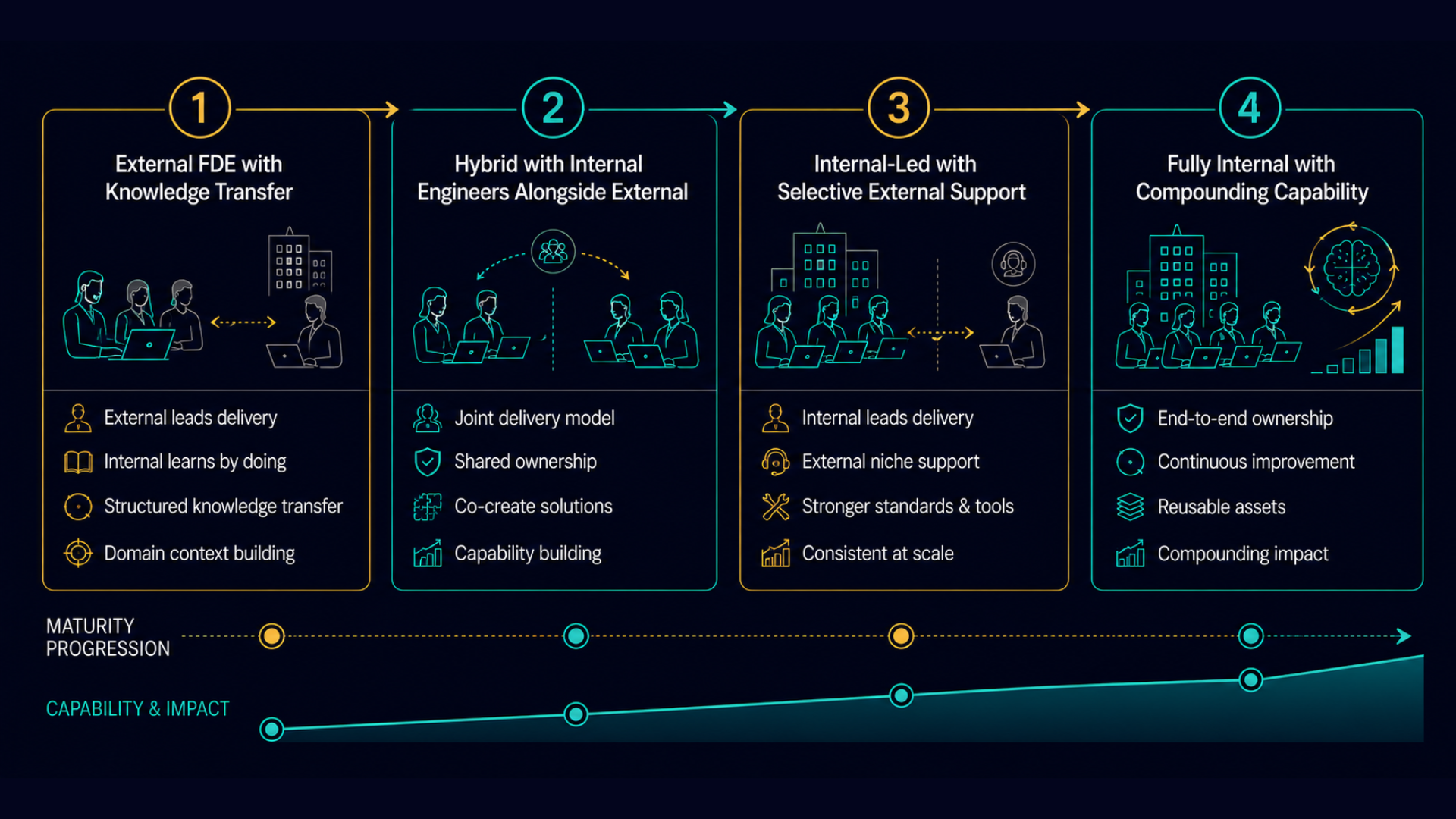
For most large enterprises, the realistic path to internal FDE capability runs through an external FDE partner rather than starting from scratch independently. The first several deployments develop the organisation's understanding of what internal FDE capability needs to look like in their specific environment: what profiles to hire, what the operating model should be, what knowledge management infrastructure is required.
This transition works best when the initial external FDE engagements are explicitly structured to build internal capability as a formal output, not just to deliver a production AI system. The external engineers should be working alongside internal engineers from day one, transferring the contextual knowledge and operating patterns that will allow the internal team to run subsequent deployments with progressively less external support.
The enterprises that get this wrong treat external and internal FDE as separate phases. The ones that get it right treat them as parallel tracks from the start.
The Hiring and Talent Strategy
Building internal FDE capability requires a talent strategy that is different from standard technical hiring.
Prioritise profile over credentials:
The FDE profile is a combination of technical generalism, business domain understanding, and operational judgment that does not map cleanly to standard engineering job descriptions or standard hiring criteria. Engineers who can demonstrate that they have worked effectively inside complex, ambiguous, client-facing environments are more predictive of FDE success than engineers with strong AI or ML credentials who have worked primarily in controlled product environments.
Look inside before looking outside:
The engineers who fit the FDE profile often already exist inside large enterprises. They are the ones who have built integrations across multiple systems, who have worked directly with business stakeholders to translate requirements into technical solutions, and who have navigated the organisational complexity of making technology work inside a real operational environment. Identifying and repositioning these people is faster and less expensive than competing for external FDE talent in a market where demand has grown over 1,000 percent year-on-year.
Build a rotation programme, not a fixed team:
An internal FDE function that becomes a fixed team quickly develops the same siloed characteristics as a central IT delivery function. The engineers stop being embedded and start becoming a delivery team that business units submit requests to. A rotation programme that moves engineers between business unit deployments deliberately, with knowledge transfer built into each rotation, maintains the embedded, cross-functional characteristic that makes FDE effective.
Invest in domain expertise development:
The technical skills that FDE requires can be developed through practice and deliberate training. The domain expertise that makes FDE effective in a specific industry context takes longer to develop and is harder to replicate through training alone. Pairing technically strong engineers with experienced domain experts during early deployments, and building the domain knowledge transfer into the rotation programme, accelerates the development of the full FDE profile faster than technical hiring and training alone.
What to Measure to Know It Is Working
Internal FDE capability is an investment with a compounding return profile. The metrics that reveal whether it is working are different from the metrics that reveal whether a traditional AI project is delivering.
Deployment velocity across the programme:
The clearest signal that internal FDE capability is compounding is that each subsequent deployment is faster than the previous one. If the third deployment takes the same time as the first, the knowledge is not being captured and applied. If it takes significantly less time, the compounding is working.
Proportion of deployment work handled internally:
In the early stages of building internal capability, most of the technical work will be done by external partners with internal engineers learning alongside. Over time, the proportion handled internally should increase. Tracking this progression gives a clear picture of whether the capability build is on track.
Adoption rates of deployed systems:
The operational judgment dimension of FDE capability is the hardest to develop and the most important for adoption outcomes. If the AI systems deployed by the internal team are achieving high adoption rates, the team has developed the capability to understand and navigate the organisational dynamics that determine whether AI gets used. If adoption rates are poor despite technically sound deployments, the organisational and contextual dimension of FDE capability needs more development.
Reuse of components and patterns:
The knowledge management infrastructure is working when components and patterns developed in one deployment are being reused and adapted in subsequent ones. Tracking the proportion of each new deployment that reuses existing components rather than building from scratch is a direct measure of whether the knowledge base is being captured and applied.
The Strategic Case for Making the Investment
Building internal FDE capability requires a three to five year investment horizon before the compounding returns are fully visible. That timeline makes it easy to defer in favour of external partnerships that deliver results faster in the near term.
The strategic case for making the investment anyway is that the enterprises building internal FDE capability now are creating an AI deployment advantage that will be progressively harder for competitors to close. The knowledge of how to deploy AI effectively inside your specific operational environment, accumulated across multiple deployments and embedded in an internal team that stays with the organisation, is an asset that cannot be replicated quickly through external partnerships or new hiring.
The FDE feedback loop means that each deployment makes the next one more effective. After three years of consistent investment, an enterprise with a mature internal FDE capability will be deploying AI initiatives in weeks that their competitors are deploying in months, at significantly lower cost, with significantly higher adoption rates. That compounding advantage, accumulated over a decade, is the strategic case for making the investment today rather than when the competitive pressure is already visible.
The question is not whether to build internal FDE capability. For large enterprises with ambitions to scale AI across their operations, it is one of the highest-return investments available. The question is how to structure the build so that the compounding starts as early as possible and the investment delivers returns before the full capability is mature.
Vishleshan AI works with large enterprises to build their internal FDE capability alongside the immediate production AI deployments our forward deployed engineers deliver. Knowledge transfer is a formal output of every engagement, not an assumption. The goal is enterprises that can run AI deployments independently, faster and more effectively with each one. Book a Consultation