


Most writing about the forward deployed engineer versus software engineer question is aimed at engineers deciding which career path to take. That is a legitimate question with a clear answer for the person weighing their options.
For enterprise leaders resourcing an AI programme, the question is different. It is not about career paths. It is about delivery models: when does your initiative need a software engineer, and when does it need a forward deployed engineer? Getting this wrong is one of the most consistent reasons that enterprise AI initiatives produce impressive pilots that never reach production.
This piece is written for the enterprise buyer, not the job seeker.
The Core Distinction in Plain Terms
A software engineer builds for all users. Their job is to create software that works reliably at scale, for a broad and diverse user base, across environments they cannot fully control or anticipate. The craft is in abstraction, in designing systems that generalise, in writing code that handles the cases you did not think of because you cannot know who will use it or how.
A forward deployed engineer builds for one enterprise. Their job is to make AI work inside a specific organisation's actual environment, against that organisation's specific data, within that organisation's specific constraints, connected to that organisation's specific systems. The craft is in specificity, in understanding one environment deeply enough to build something that actually fits it, rather than something that fits a generalised version of it.
Both are production engineers. Both write code that needs to work reliably under real conditions. The difference is the direction they are optimising in.
What Software Engineers Are Built to Do
Software engineers are optimised for scale and reusability. The code they write is designed to serve many users across many environments. The abstractions they build are designed to accommodate variation, because the engineer cannot know in advance all the ways the software will be used.
This is exactly what you need when you are building a product. It is also exactly what you do not need when you are deploying AI into a specific enterprise environment, because the abstractions that make software work for everyone make it fit no specific environment particularly well.
Consider an enterprise ERP integration. A software engineer building a general-purpose ERP integration would design it to handle the documented API, the standard data structures, and the typical configuration patterns. A forward deployed engineer integrating with a specific organisation's ERP would discover that the documented API behaves differently under production load than in the sandbox, that the data structure in one field has been customised in a way that is not in the documentation, and that there is an undocumented approval workflow that needs to be accounted for before any write operation completes correctly.
These are not edge cases. They are standard discoveries in enterprise AI deployment. And they are discoveries that only happen when someone is working inside the actual environment, against actual data, under actual conditions.
What Forward Deployed Engineers Are Built to Do
Most AI projects fail not because the model is bad, but because it cannot talk to the customer's legacy databases, handle their authentication requirements, or meet their data residency obligations. Getting a demo working in a sandbox is roughly 20% of the job. The other 80% is navigating enterprise infrastructure, regulatory constraints, and the operational reality of getting production credentials from a security team.
Forward deployed engineers are built for that 80%.
They are technically capable across the full stack, which is necessary because enterprise AI deployment requires working across data engineering, cloud infrastructure, AI application development, and system integration simultaneously. But their primary differentiator is not technical breadth alone. It is the ability to work effectively inside a client's environment, absorbing the contextual knowledge that no specification document captures, and making the judgment calls that arise when the real environment turns out to be more complex than the documented one.
As covered in what skills make a great forward deployed engineer, the combination of technical generalism, business domain fluency, and operational judgment that the role requires is genuinely unusual. It does not develop naturally in engineering careers built around product development, where the environment is controlled, requirements are specified, and the engineer rarely encounters the operational complexity of a live enterprise deployment.
A Direct Comparison
Software Engineer | Forward Deployed Engineer | |
|---|---|---|
Builds for | Many users across many environments | One enterprise, one environment |
Optimises for | Scale, reusability, abstraction | Fit, integration, production within specific constraints |
Works from | Product requirements, user research, specifications | Inside the client's actual environment |
Discovers constraints | Through testing and user feedback | By being present in the operational environment |
Success measured by | Feature delivery, system reliability, performance at scale | Production adoption within the specific enterprise |
Failure mode | Builds something that works but does not fit the specific environment | Depends on partner capability and domain understanding |
Best suited for | Building the AI platform or product | Deploying AI inside a specific enterprise environment |
The Specific Failure Mode That Happens When You Use the Wrong One
The most common and most expensive mistake in enterprise AI resourcing is bringing in software engineers to solve a forward deployed problem.
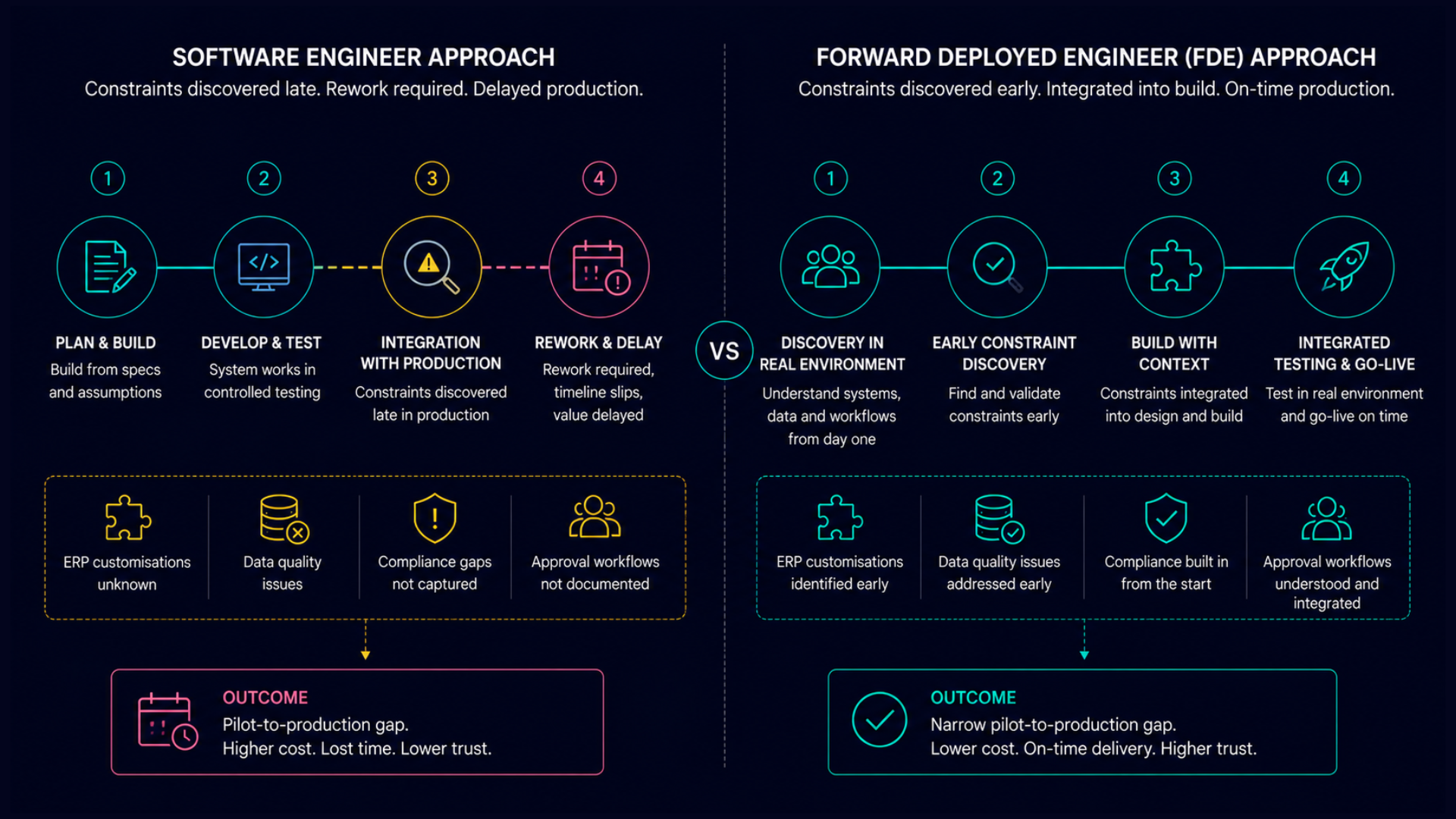
The pattern is predictable. An enterprise decides to build an AI capability internally or bring in a technical team to deploy a platform. The engineers are excellent. They understand AI, they can build reliably, and they produce a system that works in testing. Then the integration with the production environment begins.
The ERP customisation that was not in the documentation. The data quality issue in a specific field that produces unreliable AI outputs. The compliance requirement that was not captured in the requirements document because nobody on the team knew enough about the organisation's regulatory obligations to ask the right questions. The approval workflow that exists in practice but not on paper.
Each of these is a discoverable constraint. A forward deployed engineer working inside the environment from day one finds them early, when they are cheap to address. A software engineer working from a specification finds them late, when they require rework that is expensive and disruptive to the delivery timeline.
This is the pilot-to-production gap that characterises the majority of enterprise AI failures. It is not a technology problem. It is a deployment model problem. And it is almost always caused by applying a product engineering approach to an enterprise deployment problem.
When Your AI Programme Needs a Software Engineer
Software engineers are the right resource when you are building a reusable AI capability that will be deployed across many environments, or when you are developing the core AI platform that forward deployed engineers will later deploy into specific client environments, or when the integration environment is well-documented, stable, and behaves as specified.
Most AI product companies are primarily hiring software engineers, because they are building products. The major AI labs that have built forward deployed engineering functions have done so alongside their software engineering capability, not instead of it. The software engineers build the models and the platforms. The forward deployed engineers deploy them into specific enterprise environments.
For an enterprise building its own internal AI capability, software engineers are the right resource for building reusable infrastructure, shared data platforms, and internal AI tools that serve a broad internal user base. They are not the right resource for the integration work that connects AI to the specific operational systems the enterprise runs on.
When Your AI Programme Needs a Forward Deployed Engineer
Forward deployed engineers are the right resource when you are deploying AI into a specific enterprise environment with complex integration requirements, when the integration environment is partially undocumented or behaves differently in production than in testing, when the requirements will evolve as real constraints surface during the deployment, and when the accountability needs to extend through to genuine production adoption rather than technical delivery.
For most enterprise AI deployments in automotive manufacturing, FMEG operations, financial services, and supply chain, the integration environment is complex, partially undocumented, and behaves differently in production than in a test environment. These are forward deployed engineering problems, not software engineering problems.
The build vs buy vs embed framework addresses this directly. Enterprises that are trying to deploy AI into their existing operational environment need the embed option, which is forward deployed engineering, not the build option, which is software engineering applied to a different type of problem.
The Hybrid Reality in Most Enterprise AI Programmes
In practice, most well-structured enterprise AI programmes use both roles at different stages.
Software engineers build the foundational data infrastructure, shared AI components, and internal platforms that will be used across multiple deployments. Forward deployed engineers take those components and deploy them into specific operational environments, handling the integration complexity, the compliance requirements, and the adoption challenges that the production environment presents.
The sequencing matters. Enterprises that try to use software engineers for the deployment work typically discover that they need forward deployed engineers after the pilot has stalled. Enterprises that bring in forward deployed engineers without a strong software engineering foundation for the core AI components find that the FDEs are spending time building infrastructure that should have been built once and reused.
The right answer is not either-or. It is understanding clearly which problem each role is designed to solve and structuring the programme accordingly.
Vishleshan AI's forward deployed engineers work inside client environments across automotive, FMEG, financial services, and supply chain, specifically to solve the deployment and integration challenges that software engineers are not positioned to address from the outside. They take AI from a named use case to production in 90 days, accountable to the business outcome rather than to the technical delivery. Book a Consultation