


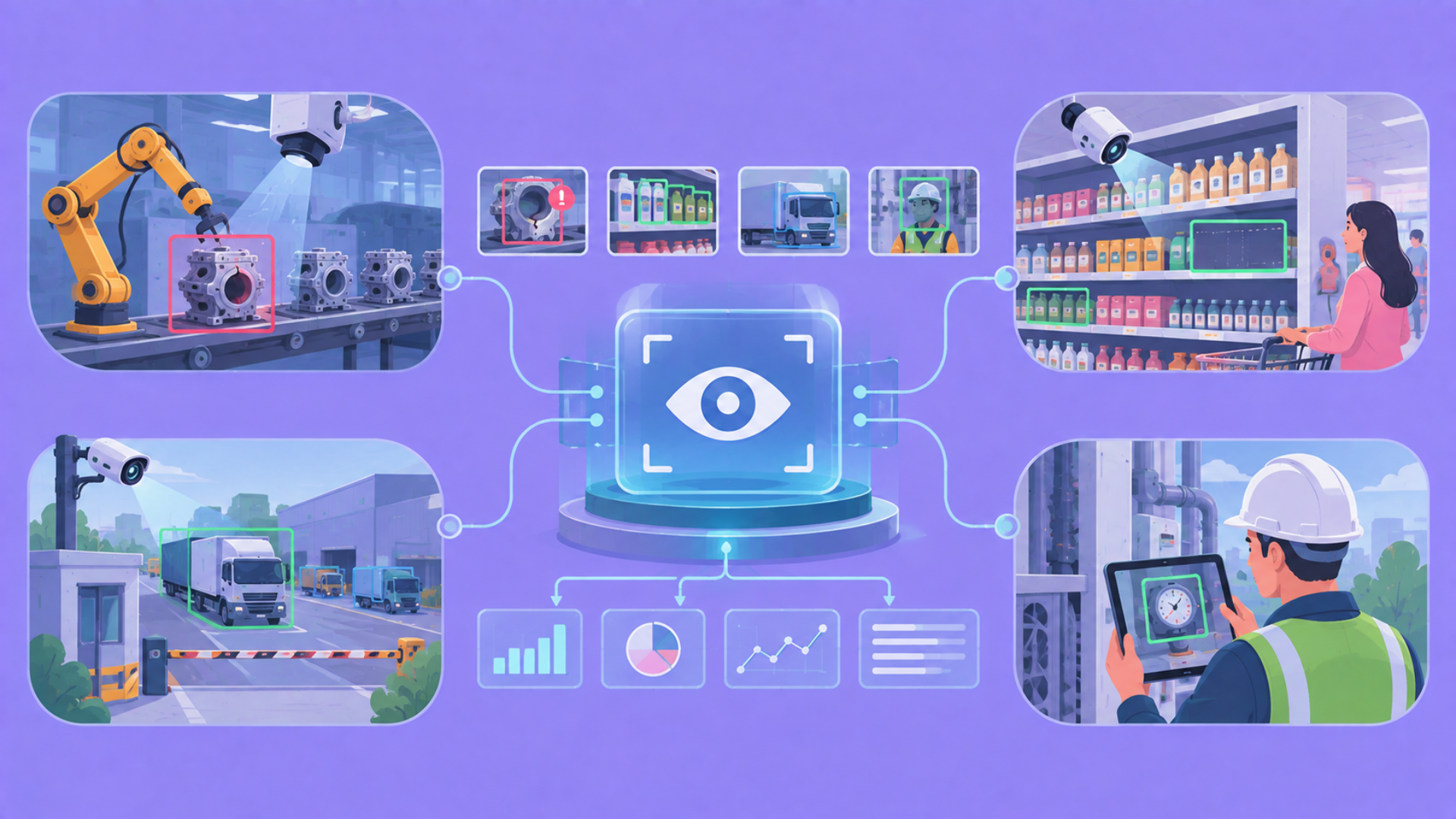
Twenty years ago, machines that could see and understand the physical world existed only in research laboratories and science fiction. In 2026, they are on factory floors, in retail stores, in logistics yards, and in the hands of field technicians across every major industry.
Vision AI is the technology that made this possible. It gives machines the ability to see, interpret, and act on visual information. Not just to capture an image. To understand what is in it, identify what matters, and take or trigger an action based on what it sees.
A Roboflow analysis of 200,000 vision AI projects in production found that 68% of manufacturing deployments are now focused on closed-loop defect reduction. That is not observing and reporting. That is seeing a defect and stopping the line before the defective unit moves forward. The machines are not just watching. They are deciding.
What Vision AI Actually Is
Vision AI is a branch of artificial intelligence that processes and interprets visual data from cameras, sensors, and imaging equipment. It combines several underlying technologies.
Computer vision is the field that teaches machines to understand images and video. It draws on machine learning models, specifically deep learning architectures that process visual data the way neural networks process language. The models learn to recognise patterns, shapes, objects, defects, and spatial relationships from training data.
Image recognition identifies what is in an image. Is this a defect or not? Is this the correct component or a mismatch? Is this person wearing the required safety equipment?
Object detection locates specific objects within an image and identifies them. A camera monitoring a production line identifies the position of every component, flags the ones that are misaligned, and tracks their movement through the manufacturing process.
Video analytics processes video streams in real time rather than analysing static images. A safety monitoring system watching a factory floor tracks worker movements, identifies unsafe behaviours, and issues an alert before an incident occurs.
Optical character recognition reads text from images. An invoice scanning system reads printed and handwritten text from documents that have never been digitised.
These capabilities combine in enterprise deployments to create systems that observe, interpret, and act. The camera is the sensor. The AI model is the intelligence. The integration with enterprise systems is what makes the AI act on what it sees.
Vision AI vs Computer Vision: Is There a Difference?
The terms are used interchangeably in most enterprise conversations. There is a subtle distinction worth understanding.
Computer vision is the technical discipline. It describes the algorithms, models, and frameworks that enable machines to interpret visual data. Computer vision is what engineers build.
Vision AI is the practical application of computer vision in operational environments. It describes the deployed system that uses computer vision to perform a specific business function. Vision AI is what enterprises deploy.
When a CIO asks about vision AI for their manufacturing plant, they are asking about deployed applications that use computer vision to inspect quality, monitor safety, and control processes. The distinction rarely matters in practice, but it helps to understand that vision AI is computer vision applied to real operational problems.
Where Enterprises Are Getting the Most Value
Manufacturing quality inspection
This is the highest-volume and most financially compelling vision AI use case in enterprise environments in 2026. 68% of manufacturing vision AI projects are now focused on closed-loop defect reduction, meaning the system does not just detect defects, it triggers an action to stop or divert the defective unit before it progresses in the production process.
Human visual inspection is limited by fatigue, attention, and speed. An inspector on a high-speed production line cannot examine every unit with equal attention across an eight-hour shift. Vision AI systems inspect every unit at production speed with consistent criteria applied to every inspection. They do not have good days or bad days.
The quality data generated by vision AI inspections is also valuable beyond the immediate defect detection function. Every inspection result is logged. Over time, the pattern of defects reveals the root causes. Which machine, which shift, which environmental condition, which supplier material is contributing to which defect type. This data drives process improvement that reduces defect rates over time, not just catches defects that occur.
Safety monitoring in industrial environments
Manufacturing plants, construction sites, logistics warehouses, and energy facilities are environments where safety incidents are serious and preventable. Vision AI systems monitoring these environments detect unsafe conditions in real time.
A worker entering a restricted area without the required protective equipment. A vehicle moving too fast in a zone shared with pedestrians. A worker in an unsafe proximity to operating machinery. A spill on a warehouse floor. These conditions are visible to cameras. Vision AI makes them visible to the safety management system, triggering an alert before an incident occurs rather than generating an incident report after it does.
Retail and inventory management
32% of energy sector vision AI projects are focused on infrastructure inspection. In retail, the parallel use case is shelf intelligence. Vision AI cameras monitoring retail shelves detect out-of-stock conditions, misplaced products, pricing label errors, and planogram compliance in real time. The retailer's inventory management system receives a signal and initiates replenishment before the out-of-stock creates a lost sale.
This is a direct commercial return. Out-of-stock retail products cost the global retail industry significant revenue annually. Vision AI that detects and triggers replenishment before the customer finds an empty shelf recovers a meaningful share of that loss.
Identity verification and access control
Vision AI for identity verification is deployed across manufacturing, financial services, logistics, and field service operations. A technician arriving at a job site is verified by the system before the job is assigned. An employee entering a secure area is verified by the access control system. A vehicle entering a logistics facility is identified and its authorisation confirmed.
In field service applications, this capability is directly relevant to the technician verification use cases in large OEM service networks. AI-verified technician identity at job start, confirming the technician's certification and presence at the correct location before the job begins, is a vision AI application that improves both quality assurance and fraud prevention across large indirect service networks.
Document processing and optical character recognition
Vision AI processes documents that contain both structured and unstructured visual information. Handwritten forms, invoices with stamps and annotations, identity documents, manufacturing certificates, and compliance records. Systems that extract information from these documents accurately and at scale replace manual data entry with a faster, more consistent process.
What Makes Vision AI Work in Production
The gap between a vision AI demonstration and a vision AI system that works reliably in a production environment is real. Three factors determine whether vision AI performs at the quality level the business case requires.
Training data quality and volume:
Vision AI models learn from labelled examples. The quality and volume of those examples determine the accuracy of the model in production. A defect detection model trained on 500 examples of the specific defect types that occur in your manufacturing process will outperform a general model trained on millions of generic examples. Getting the training data right, which means collecting, labelling, and validating images that reflect the real conditions the model will face in production, is where most of the project effort should go.
Environmental conditions in deployment:
Vision AI performs differently under different lighting, at different distances, with different camera angles, and with different levels of occlusion. A model that performs at high accuracy in a controlled test environment may perform less well on the production line where lighting changes across shifts, cameras accumulate dust, and the objects being inspected vary more than the test set anticipated. Testing under production conditions before go-live is not optional.
Integration with enterprise systems:
Vision AI that detects a defect but cannot trigger an action in the production management system has not completed the loop. The detection needs to connect to the system where the action happens. Stopping the line, flagging the unit, routing it to rework, recording the defect type for quality analysis. This integration is the work that turns vision AI from an observation tool into an operational one.
The Governance Dimension
The EU AI Act classifies many industrial computer vision systems as high-risk AI. This includes systems used in safety-critical manufacturing processes, systems that make decisions about product quality with commercial consequences, and systems that process biometric data for identity verification.
High-risk classification means specific requirements. Annotation provenance, recording where training data came from and how it was labelled. Model lineage tracking, maintaining a record of model versions, training runs, and deployment history. Bias auditing, testing whether the model performs consistently across different conditions and populations. Audit logs for every inference.
For enterprises in the EU or supplying into the EU market, these requirements apply to vision AI systems being deployed now. Building governance into the vision AI architecture from the start is significantly less expensive than retrofitting it before a compliance review.
What to Evaluate Before Deploying Vision AI
Four questions cut through vendor claims when evaluating vision AI for an enterprise deployment.
Has the system been deployed in your specific environment type?
A vision AI system proven in automotive body shop inspection may not transfer directly to paint shop inspection without significant retraining. Ask for reference deployments in your specific manufacturing zone, lighting condition, or operational context.
What is the false positive rate in production?
A high false positive rate means the system flags defects that are not defects. In a manufacturing context, this means the line stops unnecessarily, operators lose trust in the system, and they start overriding it. The false positive rate matters as much as the true positive rate.
How is the model retrained when conditions change?
Production environments change. New product variants are introduced. Lighting conditions shift with seasons. New defect types emerge. A vision AI system with no retraining capability will drift and degrade over time.
How does the system integrate with your production management infrastructure?
The integration with your MES, ERP, and quality management systems is what determines whether vision AI closes the loop from detection to action.
Vishleshan AI's forward deployed engineering (FDE) approach builds vision AI systems inside client manufacturing environments, working against real production conditions rather than controlled test environments. Our experience spans automotive manufacturing, consumer electricals production, and industrial operations where vision AI is part of the operational architecture, not a standalone deployment. Book a Consultation