



Forward deployed engineering (FDE) is the fastest growing role in enterprise technology. Job postings have grown over 1,000 percent in the past year. Every major AI lab, consulting firm, and enterprise technology company is hiring for it. The demand signal is unmistakable.
What is less clearly defined is what the role actually requires, because the combination of capabilities a genuinely effective forward deployed engineer needs is unusual. It sits at the intersection of technical depth, business understanding, and operational judgment in ways that most hiring frameworks and most engineering career paths are not designed to produce.
This piece covers what actually makes someone effective as a forward deployed engineer in an enterprise manufacturing, supply chain, or financial services environment, going beyond the standard job description language to describe what the role requires in practice.
Why the Role Is Harder to Hire For Than It Appears
Most engineering roles can be evaluated primarily on technical capability. A software engineer can be assessed on code quality, system design, and technical problem-solving. A data scientist can be evaluated on modelling skills, statistical understanding, and analytical output.
A forward deployed engineer cannot be adequately evaluated on technical capability alone, because technical capability, while necessary, is not what determines whether someone is effective in the role. The distinguishing factor is what they do with their technical capability when they are inside a client's actual operating environment, dealing with undocumented constraints, organisational politics, ambiguous requirements, and the gap between how systems are supposed to work and how they actually work.
This is why many technically excellent engineers struggle in forward deployed roles, and why some engineers who are not the strongest pure technologists are highly effective FDEs. The role selects for a combination that is genuinely rare.
The Three Capability Stacks That Matter
1. Technical Generalism at Production Depth
The first requirement is broad technical capability across the full stack, not deep specialisation in a single domain. A forward deployed engineer in an automotive manufacturing environment might need to write integration code against an ERP on Monday, build a data pipeline from a manufacturing execution system on Tuesday, configure a cloud deployment environment on Wednesday, and debug an AI model's inference behaviour on Thursday.
This is not a role for specialists who hand off when the work moves outside their domain. The handoffs that slow down traditional delivery engagements do not exist in a forward deployed engagement, because the forward deployed engineer is often the only person building the system. They need to be able to cover the full technical stack from the data layer through the AI layer to the integration layer without escalating to specialists for each layer.
Production depth matters as much as breadth. The code needs to work under production data volumes, not just in a test environment. The integration needs to handle the edge cases that only appear when real transactions are running through the system. An FDE who can prototype quickly but cannot take code to production quality is not fully effective in the role.
Specifically relevant technical domains for enterprise manufacturing and supply chain FDE work include: data engineering and pipeline architecture, cloud infrastructure and deployment, API integration and ERP connectivity, machine learning application development, and agentic AI system design and implementation. An FDE does not need to be equally expert in all of these, but they need to be competent across them and expert in at least two or three.
2. Business Domain Fluency
The second capability stack is the one most frequently underweighted in FDE hiring, and the one that most frequently explains why technically capable engineers underperform in the role.
Business domain fluency is the ability to understand why a business constraint exists, not just what it is. A procurement approval threshold is not an arbitrary number. It reflects a governance decision made at a specific point in time, possibly connected to a regulatory requirement, possibly reflecting a historical incident, possibly tied to a specific individual's authority level. An engineer who understands the threshold as a rule to build around will build differently, and usually worse, than one who understands the threshold as a business constraint with a history and a purpose.
In automotive manufacturing, this means understanding how quality management frameworks shape process design, how supplier relationships affect procurement decision-making, and how dealer network economics influence what outcomes the business is actually optimising for. In financial services, it means understanding how credit risk frameworks shape model design requirements, how compliance obligations translate into technical constraints, and how operational risk appetite affects what automation is acceptable.
Business domain fluency cannot be fully acquired from documentation. It accumulates through time spent inside the environment, attending the meetings where business decisions are made, observing how constraints are applied in real situations, and developing the pattern recognition that allows an engineer to anticipate business constraints before they are stated explicitly.
This is one reason why forward deployed engineering compounds over time. An engineer who has done three manufacturing deployments brings domain fluency to the fourth that a first-time deployer cannot replicate regardless of their technical capability.
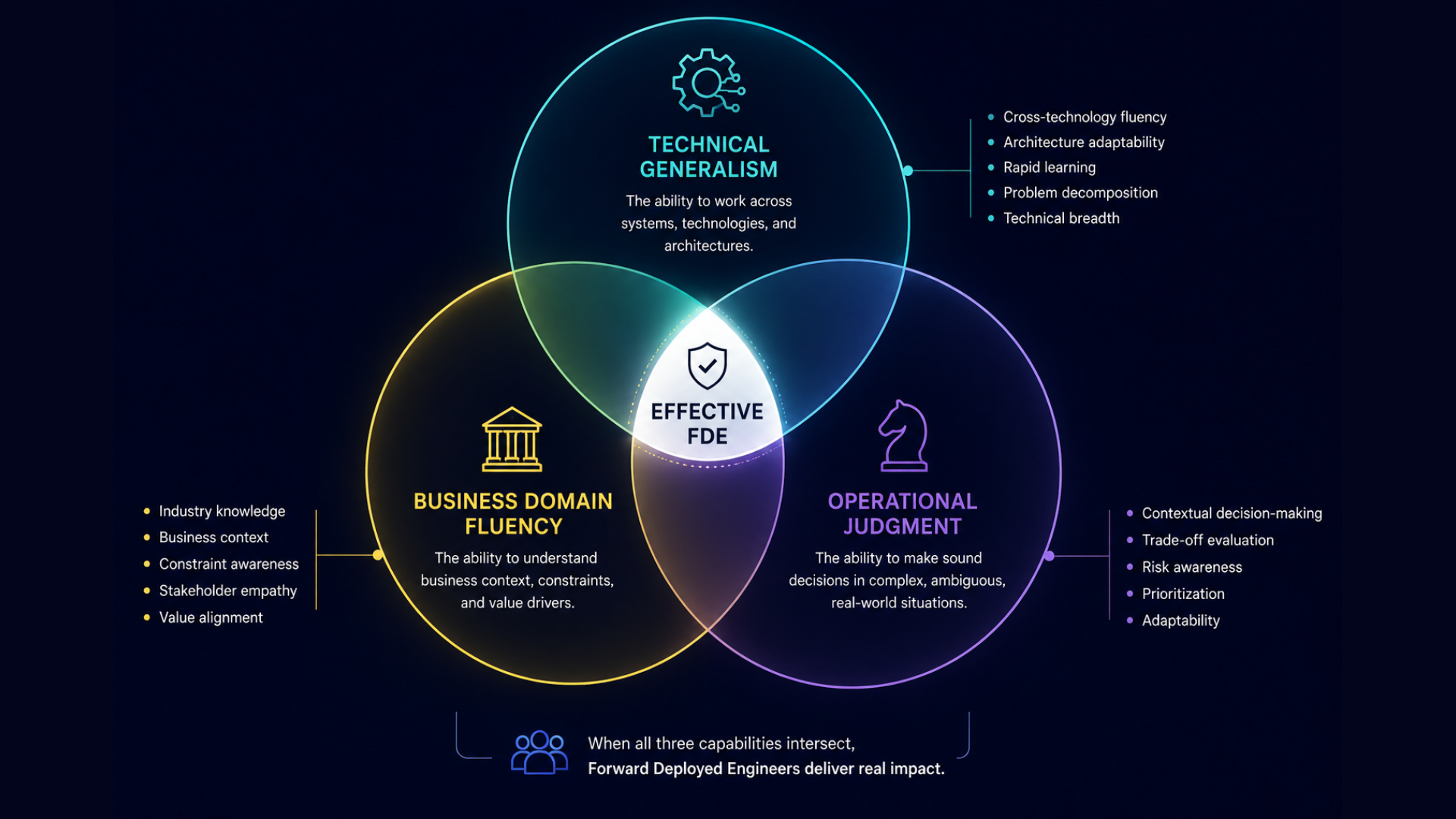
3. Operational Judgment Under Ambiguity
The third capability stack is the hardest to assess in a hiring process and the most important in practice.
Operational judgment is the ability to make good decisions when the situation is ambiguous, information is incomplete, the requirements are unclear, and waiting for clarification is not an option because the deployment timeline does not accommodate it.
In a traditional engineering engagement, ambiguity is managed through the requirements process. Questions are escalated. Specifications are clarified. The engineer waits for an answer before building. This process exists for good reasons, and it works reasonably well when the work is being done at a distance from the client environment and time pressure is measured in weeks.
In a forward deployed engagement, the engineer is inside the client's environment, the time pressure is measured in days, and the ambiguity is often about things that cannot be fully resolved through a requirements process because they involve judgment calls about how to handle real-world complexity that was not anticipated when the requirements were written.
A forward deployed engineer with strong operational judgment makes defensible decisions in these situations, communicates them clearly to the relevant stakeholders, and builds systems that are designed to accommodate the corrections that become necessary when those decisions turn out to be partially wrong. An engineer without strong operational judgment either escalates everything, which creates bottlenecks, or decides unilaterally in ways that misalign with what the business actually needed, which creates rework.
The Interpersonal Capabilities That Determine Whether Technical Capability Gets Used
Beyond the three core capability stacks, two interpersonal capabilities determine whether a technically competent FDE is actually effective inside a client environment.
Stakeholder navigation:
A forward deployed engineer is not just building a system. They are working inside an organisation with its own politics, priorities, and power dynamics. The data they need access to may be controlled by a team that did not ask for the AI system and does not particularly want it. The integration they need to build may require cooperation from an IT team that is already overloaded. The governance review they need to pass may be run by a compliance team that is cautious about AI.
An effective FDE understands that getting the technical work done requires navigating these stakeholder dynamics, and approaches them as a core part of the job rather than an obstacle to it. They build relationships across the client organisation, not just with the primary project sponsor. They understand who has authority over what, and they work within those authority structures rather than around them.
Clear communication across technical and non-technical audiences:
The forward deployed engineer is typically the primary connection between the technical work being done and the business stakeholders who need to understand it. They need to be able to explain what they are building and why to a CFO, a plant manager, and a compliance officer, using language that is accurate without being inaccessible. They also need to be able to translate business requirements into technical specifications precisely enough that there is no ambiguity about what is being built.
This communication capability is not the same as presentation skill. It is the ability to have substantive, useful conversations across the technical and business divide, in both directions, as a normal part of daily work.
What This Means for Enterprises Evaluating FDE Partners
For enterprises evaluating whether a partner has genuine forward deployed engineering capability, the capability profile described above provides a useful evaluation framework.
Ask to meet the engineers who will actually be embedded in your environment, not the account team. Evaluate their technical depth across the domains relevant to your integration environment. Probe their business domain understanding by asking how they have handled specific types of business constraints in previous deployments. Ask for examples of situations where requirements were ambiguous and how they navigated them.
The skills that make a great forward deployed engineer are visible in conversation if you know what to look for. The engineer who can describe a previous deployment in terms of the specific business constraint they were solving, the integration challenges they encountered, the stakeholder navigation they had to do, and the judgment calls they made when requirements were unclear, is demonstrating the profile. The engineer who describes their work primarily in technical terms, without reference to the business context and the organisational dynamics, is demonstrating a different profile.
The evaluation questions that apply to the partner firm also apply to the individual engineers who will do the work. The firm's methodology matters. The capability of the specific people matters more.
The Rarity That Explains the 1,165% Job Posting Growth
The combination of full-stack technical generalism at production depth, business domain fluency, and operational judgment under ambiguity is genuinely rare. Most engineering careers develop deep technical specialisation within a narrow domain. Most business-facing roles develop stakeholder and communication skills without the technical depth to build production systems. The operational judgment that comes from working repeatedly inside complex client environments accumulates slowly, through experience that most career paths do not provide.
This is why FDE job postings grew 1,165% in a year while the talent supply has not grown at anywhere near the same rate. The demand is clear. The supply is genuinely constrained, not by willingness to hire but by the scarcity of people who have developed the full combination of capabilities the role requires.
For enterprises building internal FDE capability, this scarcity has a practical implication: the engineers most likely to be effective in forward deployed roles are often not the ones with the most impressive pure technical credentials. They are the ones who have demonstrated the ability to work effectively in ambiguous, client-facing environments, who have developed business understanding alongside technical capability, and who have shown the judgment to make good decisions when the situation is unclear.
Those engineers exist in most large organisations. They are often underutilised in roles that do not use their full capability profile. Identifying and developing them is frequently more effective than trying to hire the role from scratch in a market where demand significantly exceeds supply.
Vishleshan AI's forward deployed engineers combine the technical generalism, business domain fluency, and operational judgment that production AI deployment in complex enterprise environments requires. They work inside client environments across automotive, consumer electricals, financial services, and supply chain, staying accountable until the AI is genuinely live and generating measurable outcomes. Book a Consultation