


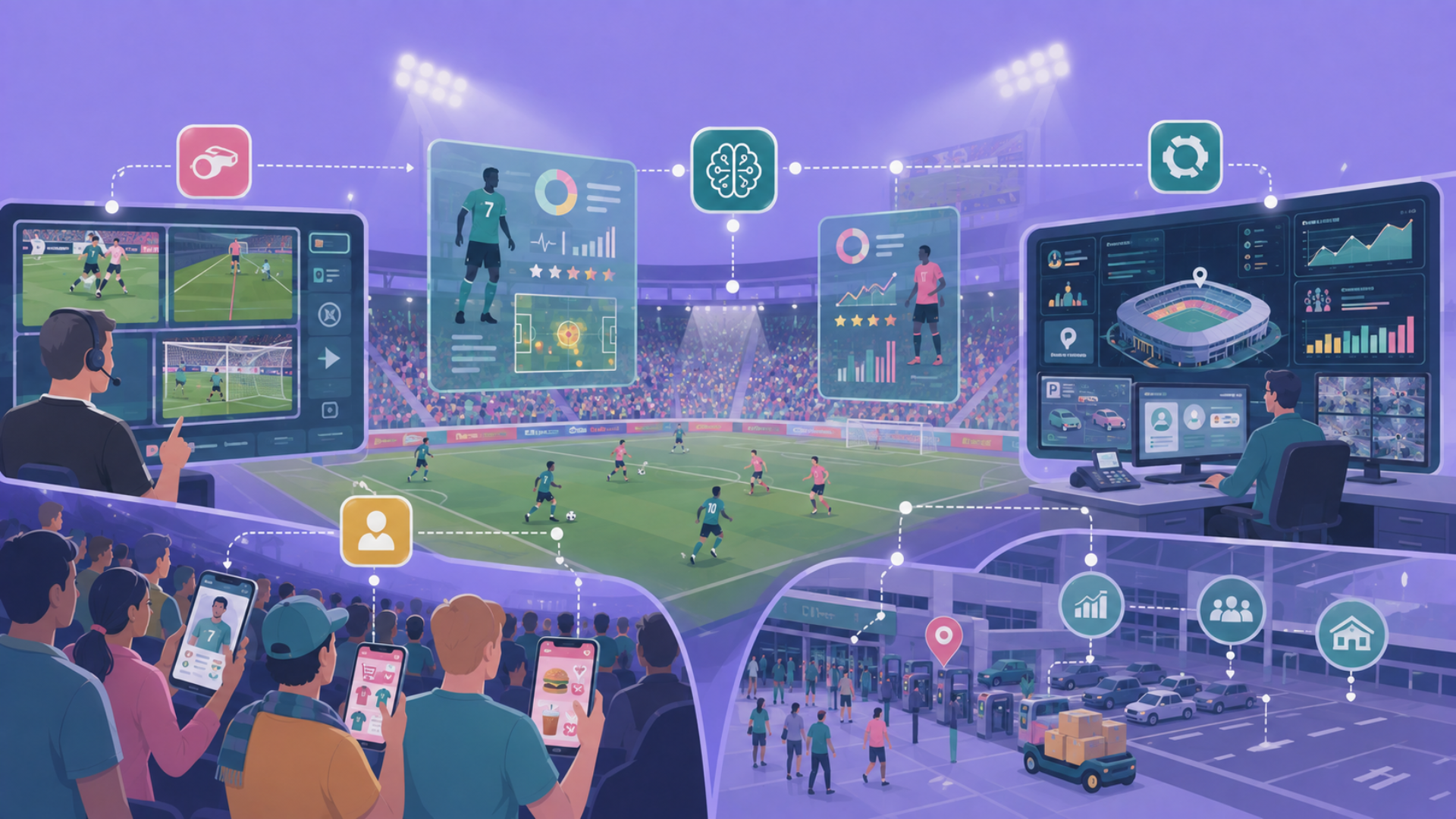
Sports organisations face a version of the same challenge that large enterprises face every day. They generate enormous volumes of data. They make high-stakes decisions under competitive pressure. They need to turn raw information into coordinated action faster than their competitors.
The difference is visibility. When a sports organisation makes a decision, millions of people watch the outcome in real time. When the decision is wrong, the result is immediate and public.
This makes sports one of the most useful places to observe how AI performs under real operational conditions. Deloitte's 2026 Global Sports Industry Outlook describes AI as the operating backbone of sports organisations, separating leaders from laggards across performance, operations, fan engagement, and commercial strategy.
Here is what is actually happening and what enterprise leaders can take from it.
Performance Analysis and Athlete Intelligence
AI performance analysis has been in professional sports for over a decade. What changed in 2026 is the depth and speed of the analysis.
AI-powered video analysis platforms now process every frame of every game, tracking player positions, movements, physical load, and tactical patterns in real time. A coaching staff that previously needed 48 hours to produce a detailed opponent breakdown can now receive it within minutes of a match ending.
The application to injury prevention is where the returns are most clearly documented. The NFL's Digital Athlete programme uses AI to model injury risk based on movement patterns, load data, and environmental conditions. By identifying players at elevated injury risk before symptoms appear, teams can adjust training loads and protect long-term performance.
AI-powered wearable devices track biometric data continuously. Heart rate variability, sleep quality, recovery markers, and movement efficiency are all inputs to athlete readiness models that inform training and selection decisions.
Advanced analytics, once affordable only to major franchises, are now accessible to organisations at every level of sport. IBM's Sports Tech Startup Challenge, launched with Web Summit in 2025, reflects the recognition that AI sports technology is a growth sector with enterprise-grade applications at every scale.
Officiating and Decision Support
AI in officiating is one of the most watched and most discussed applications in professional sport.
By 2026, most top football leagues are using AI for video assistant referee decisions in real time. The FIFA World Cup 2026, played across 16 host cities with 104 matches, uses Hawk-Eye for video review across its entire operation.
MLB is on track to introduce automated strike zones in the regular season in 2026 or 2027, ending the most variable human judgment call in the sport's history. The AI system applies the same strike zone definition to every pitch, regardless of the count, the score, or the reputation of the batter.
AI officiating does not eliminate controversy. It shifts the controversy. Instead of debating whether a human referee made the right call, sports now debate whether the AI system has the right rules. This is a useful parallel for enterprise AI governance: automated systems enforce rules consistently, but the rules themselves still require human design and regular review.
The consistency that AI officiating provides is itself commercially valuable. Predictable enforcement reduces the uncertainty that undermines competitive integrity. Leagues with more consistent officiating report higher fan confidence in results. The same principle applies to AI systems in enterprise operations: consistency builds the trust that enables adoption.
Fan Engagement and Commercial Operations
Sports organisations were early adopters of AI personalisation because the fan data they collect is extraordinarily rich and the commercial value of personalised engagement is directly measurable in ticket sales, merchandise revenue, and broadcast subscriptions.
By 2026, sports fans expect personalised experiences. Location-based promotions when they enter a venue. Flexible pricing that reflects demand. Curated content recommendations based on their engagement history. AI agents for end-to-end ticketing workflows that handle queries, process changes, and resolve issues without human involvement.
Dynamic pricing, where ticket and merchandise prices adjust in real time based on demand, weather, team form, and opponent quality, is now widespread across major leagues. The same demand-sensing and pricing optimisation capabilities are being applied in retail and consumer goods. Sports adopted them first because the data was cleaner and the feedback loop was faster.
The 2026 FIFA World Cup's 17,000 device deployment by Lenovo, with edge computing at the Dallas broadcast centre to meet real-time latency requirements, illustrates a principle that enterprise operations face regularly. Global coordination at scale requires infrastructure that is positioned close to where decisions need to happen, not centralised where it is easiest to manage.
Operations at Scale: The Enterprise Parallel
The Forbes analysis published in June 2026 made the enterprise parallel explicit. Sports events expose the same ERP, supply chain, data, security, and AI challenges that manufacturers, distributors, healthcare providers, and government agencies face every day.
The 2026 FIFA World Cup required coordination across venues, workforce planning, logistics, transportation, security, sponsors, governing bodies, technology providers, media organisations, and public agencies. Many of these operate independently and do not share common systems or processes.
This is the same integration problem that enterprise AI deployment addresses. Data that lives in separate systems. Decisions that need to be coordinated across functions that do not naturally communicate. Real-time intelligence that needs to reach the right person before the opportunity to act on it has passed.
The competitive advantage in sports, as in enterprise, comes from turning information into coordinated action through trusted data, strong processes, and operational discipline. The technology is the enabler. The coordination model is the differentiator.
What Enterprise Leaders Can Take From Sports AI
Sports organisations are not a perfect model for enterprise AI. The timelines are faster, the decisions are more visible, and the operational environment is more controlled than most enterprise contexts. But three principles from how sports uses AI apply directly to enterprise deployment.
Real-time intelligence requires real-time data:
Sports AI that operates on data from the previous match is not useful for decisions made during the current one. The data infrastructure investment that makes real-time AI possible in sports is the same investment that makes operational AI effective in enterprise. Data that arrives too late to influence decisions is not intelligence. It is history.
Consistency builds trust faster than accuracy alone:
AI officiating in sports is trusted not because it is always correct but because it is consistent. Users know what to expect from it. Enterprise AI systems that behave consistently, even if imperfectly, generate adoption faster than systems that are occasionally brilliant and unpredictably wrong. Managing AI drift is, in part, a trust management exercise.
Human judgment and AI operate best at different layers.
The best sports AI deployments give coaches, officials, and operations teams better information faster. They do not replace the judgment calls that genuinely require human expertise. The failure mode in sports AI, as in enterprise AI, is deploying automation at decisions that require judgment, or retaining human processes at decisions where speed and consistency matter more than judgment. Getting this boundary right is a design decision, not a default.
Vishleshan AI works with enterprises across automotive, consumer electricals, financial services, and supply chain to build the real-time data infrastructure, integration architecture, and operational AI that turns information into coordinated action at enterprise scale. The same principles that separate leading sports organisations from the rest apply to the enterprises we work with. Book a Consultation