


Until 2023, most enterprise AI meant text in, text out. You gave the system a written input. It gave you a written output.
That worked well for a specific category of business problems. Summarising documents. Answering questions. Drafting communications. Classifying text data.
It did not work for the problems where the data is not text. A photo of a damaged component. A voice call with a customer. A scanned invoice with handwritten annotations. A video of an assembly line.
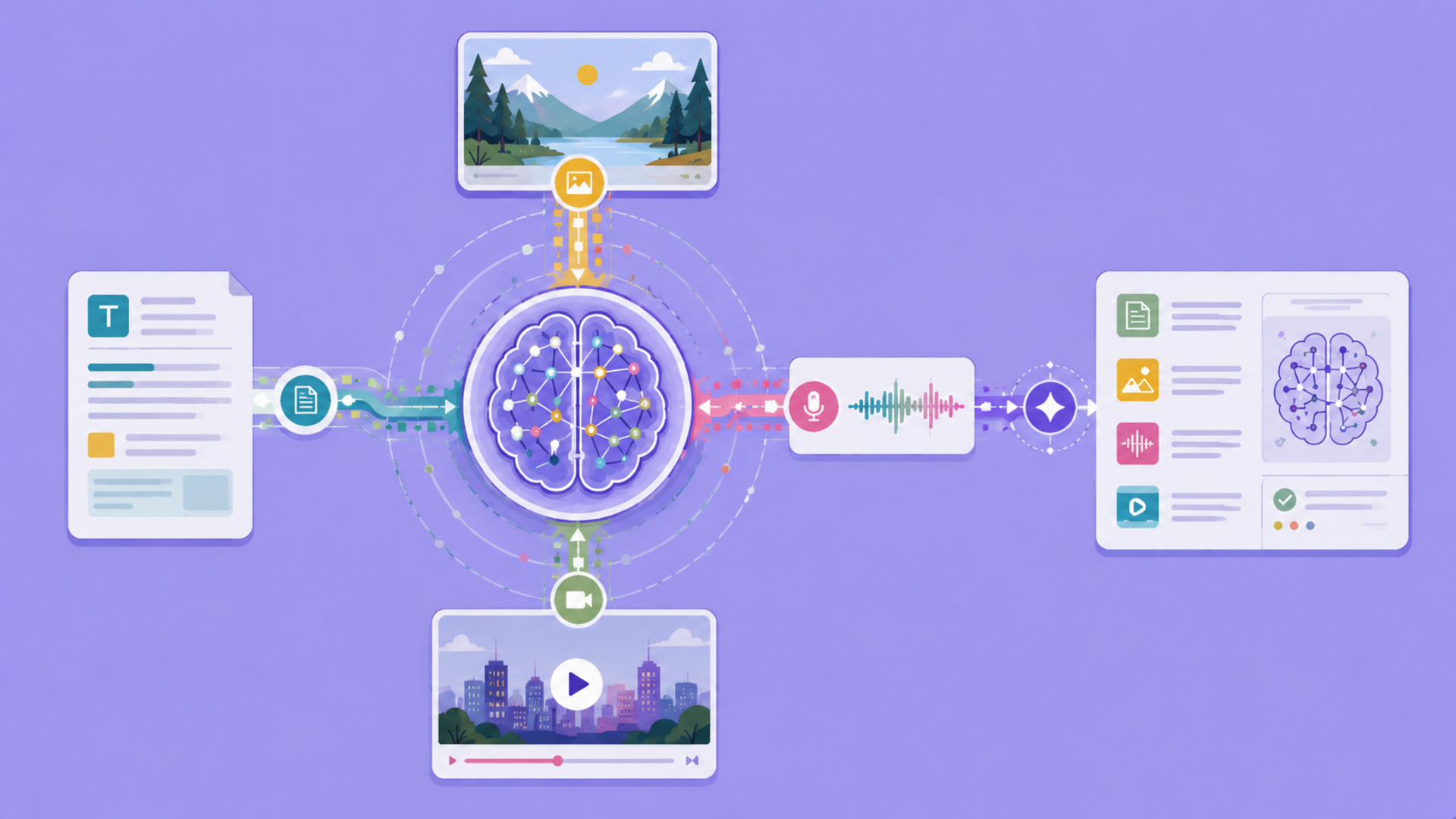
Multimodal AI changes this. It processes text, images, audio, and video together in a single system. Not separately with results merged later. Together, in one inference pass, with reasoning that draws on all of them simultaneously.
This is not a technical upgrade. It is a different class of capability. And it opens up enterprise use cases that text-only AI could never address.
What Multimodal AI Actually Is
A standard AI model takes one type of input and produces one type of output. Text in, text out. Image in, classification out.
A multimodal AI model takes multiple types of input simultaneously and reasons across all of them.
Ask a multimodal system: "A customer sent this photo of what they received. Is it damaged? If so, which return policy applies?"
A text-only system cannot answer this. It has no way to interpret the photo. A multimodal system sees the image, understands the customer's question, checks the relevant policy, and returns an answer that draws on all three inputs.
This is what makes multimodal AI genuinely different. It handles the problems where the data is mixed. And in most real business environments, the data is always mixed.
The multimodal AI market is projected to reach $10.89 billion by 2030. The growth is not driven by enthusiasm for the technology. It is driven by enterprises finding it useful for problems they could not solve before.
The Three Enterprise Use Cases With the Clearest ROI
Not every business problem benefits from multimodal AI. Start where the data is genuinely mixed and the reasoning across inputs adds measurable value.
Three use cases have the clearest return on investment in 2026.
Document intelligence:
Most enterprise documents are not clean digital text. They are PDFs with tables. Scanned invoices with stamps and handwriting. Contracts with diagrams and footnotes. Forms with boxes and ticked options.
A text-only AI system struggles with these. It sees the text but misses the structure. It misses the diagram. It cannot interpret the handwritten annotation.
A multimodal system reads the document as a combination of text, layout, and image. It understands that the number in the top-right corner of the invoice is the total amount due. It reads the handwritten delivery date. It extracts the table into structured data.
Multimodal AI achieves more than 90% extraction accuracy on structured documents. This replaces manual data entry at scale.
A logistics company processing 50,000 invoices per month at $3.50 per invoice in manual handling cost saves $175,000 per month by switching to multimodal document intelligence. The ROI is specific and immediate.
This applies directly to enterprise procurement, accounts payable, contract management, and compliance documentation. If your team is manually extracting data from documents, multimodal AI is the right tool.
Visual quality inspection:
Manufacturing quality inspection is one of the oldest and most expensive manual processes in industrial operations.
Human inspectors are expensive. They get tired. They are inconsistent. They cannot maintain the same attention across an entire production shift. And they cannot inspect faster than the line moves.
Multimodal AI using computer vision inspects every unit passing through the line. It applies consistent criteria regardless of shift time. It detects defects at a granularity human inspectors cannot match. And it logs every inspection result, creating a quality data trail that enables pattern analysis.
For manufacturing operations, this is one of the fastest-growing AI applications in 2026. The accuracy improvement is measurable. The cost reduction is direct. And the quality data generated by the system is itself valuable for downstream process improvement.
Voice-plus-screen AI assistants:
Field technicians, call centre agents, and service engineers work with information coming from multiple places simultaneously. A technician has the customer in front of them, equipment they are diagnosing, a technical manual on their device, and a voice channel to a support team. A call centre agent has the customer on a call, a CRM screen, a product database, and a chat window for internal escalation.
Multimodal AI can assist in this environment in a way that text-only AI cannot. It hears the conversation. It sees the screen. It reads the document the agent has open. It surfaces the right information at the right moment without the agent needing to formulate a text query.
For field service applications, this connects directly to the Technician Plus use case. A technician who can ask a voice question while looking at a component and receive an immediate answer drawn from the technical knowledge base is significantly more effective than one who has to stop work, type a query, and wait for a result.
Where Multimodal AI Adds the Most Value in Your Verticals
Automotive and manufacturing:
Visual inspection on production lines. Reading technical documentation alongside physical components during service. Analysing sensor data, machine logs, and visual inspection results together for predictive maintenance. These are all multimodal problems. The data is mixed. The reasoning needs to span all of it.
Consumer electricals and FMEG:
Product damage assessment from customer photos for warranty claims. Reading handwritten dealer forms alongside typed order data. Visual verification of product compliance markings. These are document and image problems that multimodal AI addresses more accurately than text-only systems.
Financial services:
Reading complex financial documents that combine tables, charts, and text. Analysing voice calls alongside CRM records for compliance monitoring. Processing handwritten client forms alongside typed data in account opening workflows. Multimodal AI achieves document processing accuracy that manual review cannot match at the required volume.
Supply chain and logistics:
Reading shipping documents, manifests, and customs forms that combine structured and unstructured data. Visual inspection of goods at receiving. Analysing driver voice reports alongside GPS and route data. These are the mixed-data problems that multimodal AI is built for.
What to Start With
The most common mistake with multimodal AI is starting with video.
Video is the most computationally expensive modality. It is the least mature for most enterprise use cases. It generates the most data and requires the most infrastructure. For most enterprises in 2026, video is not the right starting point.
Start with document intelligence if your team processes significant volumes of structured documents manually. The accuracy improvement is proven. The cost reduction is immediate. The implementation is well-understood.
Start with visual inspection if you have a manufacturing or quality process that relies on human visual review. The consistency improvement is measurable. The integration with existing production systems is manageable.
Start with voice-plus-screen if you have high-volume human-AI interaction in a customer-facing or field service context. The productivity improvement is significant and the user adoption is typically high because the interface is natural.
The Right Architecture for Enterprise Multimodal AI
A practical point worth understanding before evaluating multimodal AI solutions.
Most enterprise deployments use multimodal input with text output. The model receives an image and a text prompt and returns a text response. This is the architecture with the clearest ROI and the most mature tooling.
Multimodal output — generating images or audio alongside text — is significantly more complex. It is rarer in production enterprise systems. For most business use cases, text output from multimodal input is what you are building toward.
Use multimodal AI where the data is genuinely mixed and the reasoning across inputs adds value. Use simpler text-only models where text input is sufficient. The two trends driving enterprise AI in 2026 — multimodal models and agentic AI — are converging. The systems that will define the next phase of enterprise AI are agents that can see, hear, and read simultaneously, then act.
Vishleshan AI's forward deployed engineering (FDE) approach builds multimodal AI deployments across automotive, consumer electricals, financial services, and supply chain environments. We identify where mixed-data problems exist in your operations and build the architecture that makes multimodal AI work in production, not just in a demonstration. Book a Consultation