


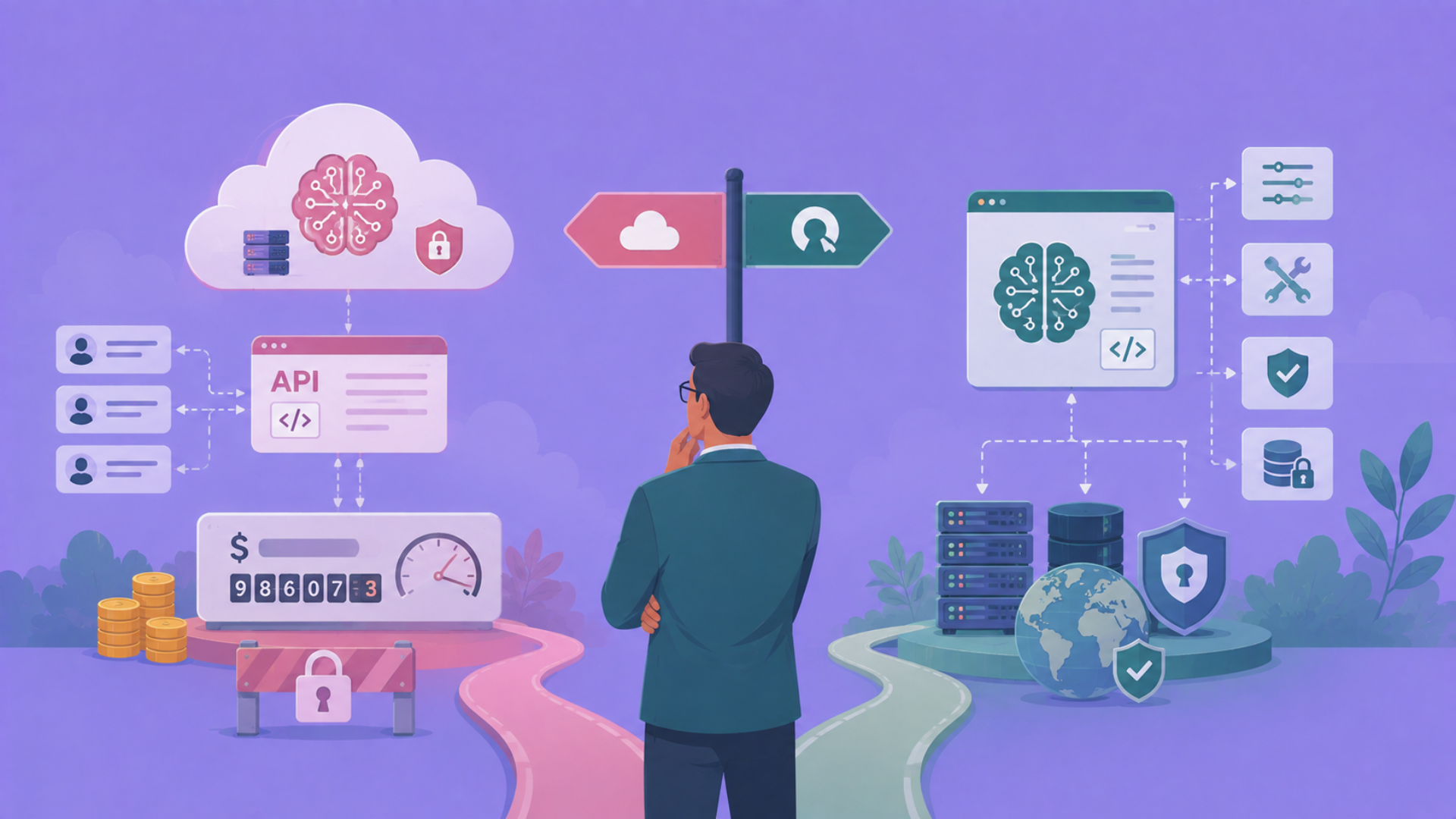
Open source AI platforms are now the default for 62% of enterprises. That is up from a minority position two years ago. It surpasses proprietary AI for the first time.
Open source AI adoption in large organisations has reached 89%. Deployments using open source show 25% higher return on investment compared to closed-source stacks. The average enterprise switching to open source saves $1.2 million per year on licensing.
These numbers reflect a genuine shift. Not a developer preference or an ideology. An economic and strategic calculation that more enterprises are making in favour of open source.
Understanding what open source AI is, why the numbers are moving this way, and when open source is and is not the right choice is now a practical question for any enterprise leader making AI investment decisions.
What Open Source AI Actually Is
Open source AI refers to AI models and frameworks where the core assets are publicly available. The source code is available to inspect, modify, and redistribute. The model weights, the numerical values that determine how the model behaves, are available to download and run. In some cases, the training data and training methodology are also available.
This is different from proprietary AI, where the model runs on a vendor's infrastructure, you access it through an application programming interface, and you pay per query. You cannot see how the model works. You cannot run it yourself. You cannot modify it. You use it as a service.
The most widely used open source AI models in enterprise in 2026 include Meta's Llama family, Mistral models, and a growing range of Chinese models including DeepSeek and Qwen. Microsoft, Google, and Amazon all run open source models internally. Meta's Llama powers 85% of their internal natural language processing workflows at zero licence cost.
The term "open source" is used loosely in AI and the distinctions matter for enterprise use. Some models are fully open source, with code, weights, and training data available under permissive licences. Others are "open weight," meaning the weights are available but the training data or full code is not. Others have licences that restrict commercial use, or that limit deployment above a certain number of users. Checking the specific licence terms before building a production system on an open source model is not optional.
Why Enterprise Adoption Has Accelerated
Three forces are driving the shift toward open source AI in enterprise in 2026.
Cost:
Proprietary API costs scale linearly with usage. Every query costs money. At pilot scale, this is manageable. At production scale, across millions of inference calls per month, it is significant. Inference cost now represents 85% of enterprise AI budgets and is the primary driver of AI budget overruns.
Open source models, once deployed on your own infrastructure, scale at marginal cost. The compute cost continues but the per-token licence fee disappears. For high-volume use cases, this difference is material.
Data sovereignty and compliance:
When you send data to a proprietary AI model via API, that data leaves your environment. For enterprises in financial services, healthcare, defence, and industrial sectors with strict data governance requirements, this creates a compliance challenge. Some regulators require that sensitive data does not leave specific geographic boundaries or specific infrastructure environments.
Open source models deployed on your own infrastructure keep data in your environment. Your data does not leave. This is the reason government restrictions on access to certain proprietary AI models are accelerating open source adoption, as organisations seek alternatives that give them control over their AI infrastructure rather than dependence on vendors subject to external restrictions.
Technical sovereignty and control:
With a proprietary model, the vendor controls the model version, the deprecation schedule, and what the model can and cannot do. When a vendor changes their model, your system's behaviour changes. When they deprecate a version, you are forced to migrate.
With an open source model, you control the version. You decide when and whether to upgrade. You can fine-tune the model on your own data without sharing that data with a vendor. You own the AI capability rather than renting it.
What Open Source AI Costs to Run
Open source AI is not free. It is free of licence fees. The operational costs are real.
Running an open source model at production scale requires GPU infrastructure. Either your own hardware, which is expensive to acquire, operate, and maintain, or cloud GPU instances from AWS, Google Cloud, or Azure. The compute cost is real and ongoing.
It also requires engineering capability. Someone needs to deploy the model, manage the infrastructure, monitor performance, handle updates, and maintain the system over time. This is not a one-time task. It is an ongoing operational commitment.
Gartner and Andreessen Horowitz both frame the open source AI economics the same way. Proprietary models cost money at the query level. Open source models cost money at the infrastructure and engineering level. The crossover point, where open source becomes cheaper than proprietary, depends on your query volume and your internal engineering capacity.
For most enterprises running millions of queries per month, open source is cheaper. For enterprises running tens of thousands of queries per month, proprietary may still be more cost-effective once engineering overhead is accounted for.
The other cost is quality. Proprietary frontier models from Anthropic, OpenAI, and Google are still ahead of open source alternatives on the most demanding reasoning tasks. That gap is closing, and some open source models now match or exceed proprietary models on specific tasks. But for complex reasoning, nuanced judgment, and the most demanding analytical use cases, frontier proprietary models are still the stronger choice for most enterprises.
When to Use Open Source and When Not To
This is the practical question most enterprise decision-makers actually need answered.
Use open source when:
Volume is high enough that per-token API costs are a significant line item. The crossover varies by model and use case but for most enterprise deployments, volume above one million queries per month makes open source economics compelling.
Data cannot leave your environment. Financial records, health data, legal documents, proprietary product data. If your governance requirements prohibit sending data to external APIs, open source deployed on your own infrastructure is the only viable path.
You need to fine-tune the model on your own data and you cannot share that data with a vendor. Fine-tuning proprietary models typically requires sending your training data to the vendor. Open source models can be fine-tuned entirely within your own environment.
The task is well-defined and the model quality of open source alternatives is sufficient. Document classification, named entity extraction, summarisation of structured documents, sentiment analysis. These tasks are well served by open source models. You do not need a frontier model for them.
Use proprietary models when:
Volume is low enough that per-token costs are manageable. At low query volumes, the engineering overhead of running your own infrastructure exceeds the API cost savings.
The task requires frontier reasoning capability. Complex legal analysis, sophisticated synthesis across multiple long documents, high-stakes decision support where model quality matters significantly. Frontier proprietary models are still ahead for these use cases.
Speed matters more than cost. Proprietary APIs are simpler to access and faster to integrate. If time to deployment is the constraint, proprietary is faster to get live.
You do not have the engineering capacity to operate AI infrastructure. Running open source models in production is an engineering commitment. If that capacity does not exist internally, proprietary models are the realistic option.
The Hybrid Approach Most Enterprises Are Taking
The practical answer for most large enterprises in 2026 is neither fully open source nor fully proprietary. It is hybrid.
Proprietary frontier models handle the high-value, high-complexity tasks where model quality justifies the per-token cost. Open source models handle the high-volume, well-defined tasks where the economics of self-hosting are compelling and the model quality is sufficient.
This approach requires a model routing layer that directs queries to the appropriate model based on the task type, the complexity, and the cost threshold. This is the same model routing principle discussed in AI inference cost management.
Cloud providers are accelerating this approach by integrating open source models into their managed infrastructure, providing the compute and operational management while the enterprise retains control of the model and the data. This removes some of the operational burden of self-hosting while maintaining the data sovereignty benefits of open source deployment.
What to Check Before Committing to an Open Source Model
Licence terms:
Not all open source licences allow unrestricted commercial use. Llama 4 has a user limit of 700 million. Mistral's Apache 2.0 licence is genuinely permissive. Read the licence before building a production system.
Model performance on your specific tasks:
Benchmarks measure performance on standardised tests. Your tasks are not standardised tests. Test candidate models on a representative sample of your actual use cases before committing.
Community and maintenance activity.
An open source model that is not actively maintained will not receive security patches, bug fixes, or capability improvements. Check the model's repository activity and the size and activity of the community behind it.
Your infrastructure capacity:
Running open source models at production scale requires GPU infrastructure and engineering expertise. Assess whether that capacity exists internally or needs to be built or contracted before committing to an open source path.
Vishleshan AI's forward deployed engineering (FDE) approach helps enterprises across automotive, consumer electricals, financial services, and supply chain design the right model architecture for their specific use cases, including where open source models are the stronger choice and where proprietary frontier models are worth the cost. The decision is always specific to the use case, the volume, and the governance requirements. Book a Consultation