


Financial services AI has crossed a threshold that the sector has been approaching for several years. With 47% sector-wide adoption and an average 180% ROI on deployed applications, the question in 2026 is no longer whether AI belongs in banking and insurance. It is which deployments are generating commercial returns and which are still producing reports.
The median time from AI proof of concept to production deployment in financial services has compressed from 18 months two years ago to significantly less today. The pace is not driven by reduced caution. If anything, regulatory expectations have increased. It is driven by the combination of more capable models, more mature governance frameworks, and more organisations that have done this before and know what the path to production actually requires.
This piece covers what banks and insurers are actually deploying in 2026, where the returns are most visible, and what separates the deployments that are working from those that are not.
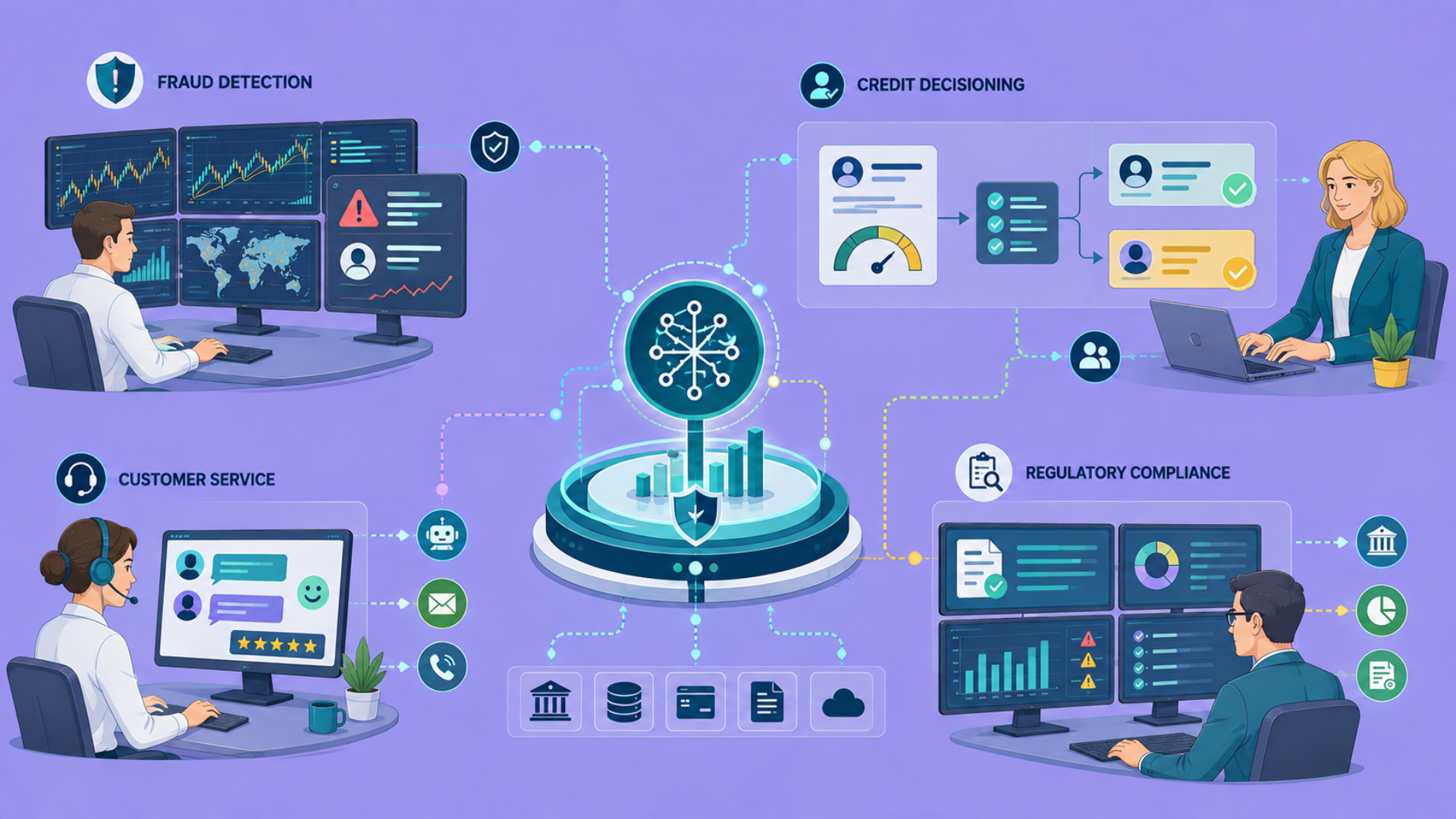
The Four Use Cases Where AI Is Generating Documented Returns
Fraud detection and financial crime prevention
Fraud detection was the earliest AI use case in financial services and remains the one with the most documented and consistent return. Nearly two-thirds of banks surveyed by Capgemini in the World Cloud Report for Financial Services 2026 are using agentic AI for fraud detection, making it the second most common deployment after customer service.
The returns are significant and measurable. AI-powered fraud detection systems processing transaction patterns in real time, comparing against behavioural baselines, and flagging anomalies for review before settlement are consistently outperforming rule-based systems that were the previous standard. The advantage is not only accuracy, though accuracy improvements are real and material but speed. A fraud system that identifies a suspicious transaction in milliseconds and can trigger an automatic hold or challenge before the transaction settles is operating in a different regime from a system that flags transactions for human review on a batch basis.
The AI systems delivering the best fraud outcomes in 2026 use the full transaction context. This includes account history, device fingerprint, merchant category, transaction timing, and network relationships. They do not score transactions in isolation. The contextual integration is what allows them to identify the sophisticated, multi-step fraud patterns that single-transaction scoring consistently misses.
Credit decisioning and loan processing
A US bank that used AI agents to change how it creates credit risk memos reported a 20 to 60% increase in productivity and a 30% improvement in credit turnaround time. The improvement came not from replacing credit analysts but from changing what they spend their time on: AI handles the data retrieval, document processing, and initial analysis, freeing analysts to focus on the judgment calls that genuinely require human expertise.
Three in five banks surveyed by Capgemini are using agentic AI for loan processing and customer onboarding. The most advanced deployments have moved beyond using AI to assist credit analysts. AI agents now handle standard loan applications end to end. They pull credit bureau data, verify income documents, apply policy rules, and generate decisions within defined parameters. Human reviewers step in only for exceptions and edge cases.
The regulatory context matters here in ways that differ from other industries. Credit decisions in most jurisdictions are subject to explainability requirements. The applicant has a right to know why their application was declined. AI credit systems that cannot produce an explainable basis for their decisions are not deployable in regulated credit markets regardless of their accuracy. The deployments that are working have built explainability into the model architecture rather than attempting to interpret black-box decisions after the fact.
Customer service and advisory
Seventy-five percent of banks surveyed by Capgemini cite customer service as the most common use case for agentic AI. The deployment landscape ranges from sophisticated AI agents handling complex customer enquiries across multiple products and accounts to more limited deployments that handle defined transaction categories with human escalation paths for exceptions.
The deployments generating the highest customer satisfaction outcomes are the ones that have designed the human-AI handoff explicitly. Customers do not object to interacting with AI for transactional requests such as balance enquiries, transaction history, payment processing, account changes. They object to being unable to reach a human when the situation warrants human judgment. The deployments that have designed clear, friction-free escalation paths when AI reaches the boundary of its competence generate higher satisfaction scores than those where the escalation path is unclear or difficult to access.
AI-powered financial planning tools are a specific deployment category showing strong results. Tools that generate personalised retirement projections, insurance recommendations, and estate planning alerts by monitoring a client’s full financial picture are showing stronger client retention. They consider factors such as income, spending, asset allocation, and tax position. They also encourage clients to initiate planning conversations more frequently.
Regulatory compliance and reporting
Regulatory compliance is the use case where financial services AI is generating the least visible commercial return and the most significant operational risk reduction. The return is not revenue generation, it is cost avoidance and operational resilience.
AI systems monitoring transaction flows for regulatory compliance obligations, including AML, sanctions screening, and suspicious activity reporting, are processing transaction volumes that would require significantly larger compliance teams without AI assistance. The operational economics of compliance at scale in a large bank or insurer are fundamentally changed by AI systems that can screen every transaction rather than sampling, flag genuinely suspicious patterns rather than generating false positives that require human review, and generate regulatory reports with the audit trail documentation that regulators expect.
The regulatory expectations around AI in compliance are themselves evolving. The EU AI Act's August 2026 enforcement of high-risk AI system requirements applies directly to AI systems used in credit decisioning, insurance pricing, and financial access decisions. Financial institutions that build governance into their AI systems from the start are better positioned than those that add it later. This includes audit trails, explainability documentation, and human oversight mechanisms.
The Shift to Agentic AI: What It Means for Financial Services Operations
The most significant structural change in financial services AI in 2026 is the shift from AI that assists human decision-making to AI agents that execute defined workflows autonomously.
Nearly 50% of banks and insurers are creating dedicated roles to supervise AI agents, according to the Capgemini World Cloud Report. This is not a sign of AI replacing human roles. It is a sign of human roles changing to supervise AI that is taking on the workflow execution that previously required human operators.
According to McKinsey research, early agentic AI deployments in financial services have enabled zero-touch operations and reduced manual workloads by 30 to 50% in targeted workflows. PwC research finds that agents can reduce cycle times by up to 80% in purchase order transaction processing and matching. These are not projections. They are reported outcomes from live deployments.
The governance requirement for agentic AI in financial services is significantly more demanding than for advisory AI. An AI that recommends a decision that a human then makes is subject to review of the recommendation quality. An AI agent that executes a decision — raises a payment, initiates a transfer, closes a position — needs the governance infrastructure to be in place before execution, not available for review after the fact. Defined autonomy boundaries, human oversight thresholds, comprehensive audit trails, and real-time monitoring are architectural requirements for agentic financial services AI, not compliance additions.
This is why forward deployed engineering in regulated industries is particularly well-suited to financial services AI deployments. Building governance into the deployment architecture from day one, rather than discovering governance gaps after a system has been running in production, is the difference between deployment that passes regulatory review and deployment that requires remediation.
Where Financial Services AI Is Still Struggling
The honest picture of financial services AI in 2026 includes significant areas where deployment has not produced the returns that were projected.
The data governance constraint is more persistent than anticipated:
Financial services firms are rich with data but that richness is simultaneously a challenge. Data governance is critical. Institutions that treat data as a business risk and track accuracy, completeness, and timeliness are getting more value from AI than those that do not. The institutions still struggling to deploy AI at scale are almost always struggling with data foundation problems rather than model capability problems.
The cultural risk aversion in credit and underwriting is slowing deployment:
The sector leads all industries in AI governance maturity, a product of decades of model risk management discipline. That governance maturity is a competitive asset when it produces well-governed AI. It is a deployment constraint when it produces risk aversion that prevents technically validated AI models from reaching production. The institutions that have resolved this tension — by building validation and governance processes that satisfy risk management requirements without creating indefinite delays — are deploying significantly faster than those that have not.
Legacy system integration remains the most consistent bottleneck:
Insurers and wealth and asset managers face heavier constraints from legacy systems than banks, which slows AI progress regardless of the AI capability available. The same pattern visible in manufacturing and supply chain AI deployment applies in financial services: AI capability is not the constraint, the integration architecture between AI and the core systems where business runs is.
What Distinguishes the Deployments That Are Working
The financial services AI deployments generating documented returns in 2026 share three characteristics that are worth understanding clearly.
They are integrated with core systems rather than operating alongside them. AI that cannot read from and write to the core banking system, the policy administration system, or the trading platform is generating insights that humans need to act on separately. AI that is integrated generates outputs that directly change what the core system does. The integration is the difference between AI that reduces work and AI that eliminates it.
They have defined accountability for AI outcomes at the business level. The same accountability structure that research identifies as the differentiator in enterprise AI revenue impact broadly applies in financial services: shared accountability between the technology function that builds and maintains the AI and the business function that is measured against the outcomes it produces. Without this structure, AI deployment proceeds but outcome accountability does not.
They are governed from deployment, not audited after the fact. Financial institutions whose AI deployments pass regulatory review with minimal remediation build governance into the architecture from the start. This includes explainability documentation, audit trails, human oversight, and model monitoring. The ones requiring remediation are the ones that treated governance as a validation step at the end of a build process.
Financial services AI in 2026 is generating real returns in the use cases where it has been deployed with the right integration architecture, the right governance framework, and the right accountability structure. The 47% sector-wide adoption number is accurate. The 180% average ROI on deployed applications is also accurate. The distance between the two is explained by the organisations that have gotten the deployment right and those that have not.
Vishleshan AI works with financial services organisations to deploy AI with the governance architecture, ERP and core system integration, and outcome accountability that regulated environments require, using forward deployed engineers who work inside client environments until AI is genuinely in production and generating measurable results. Book a Consultation