


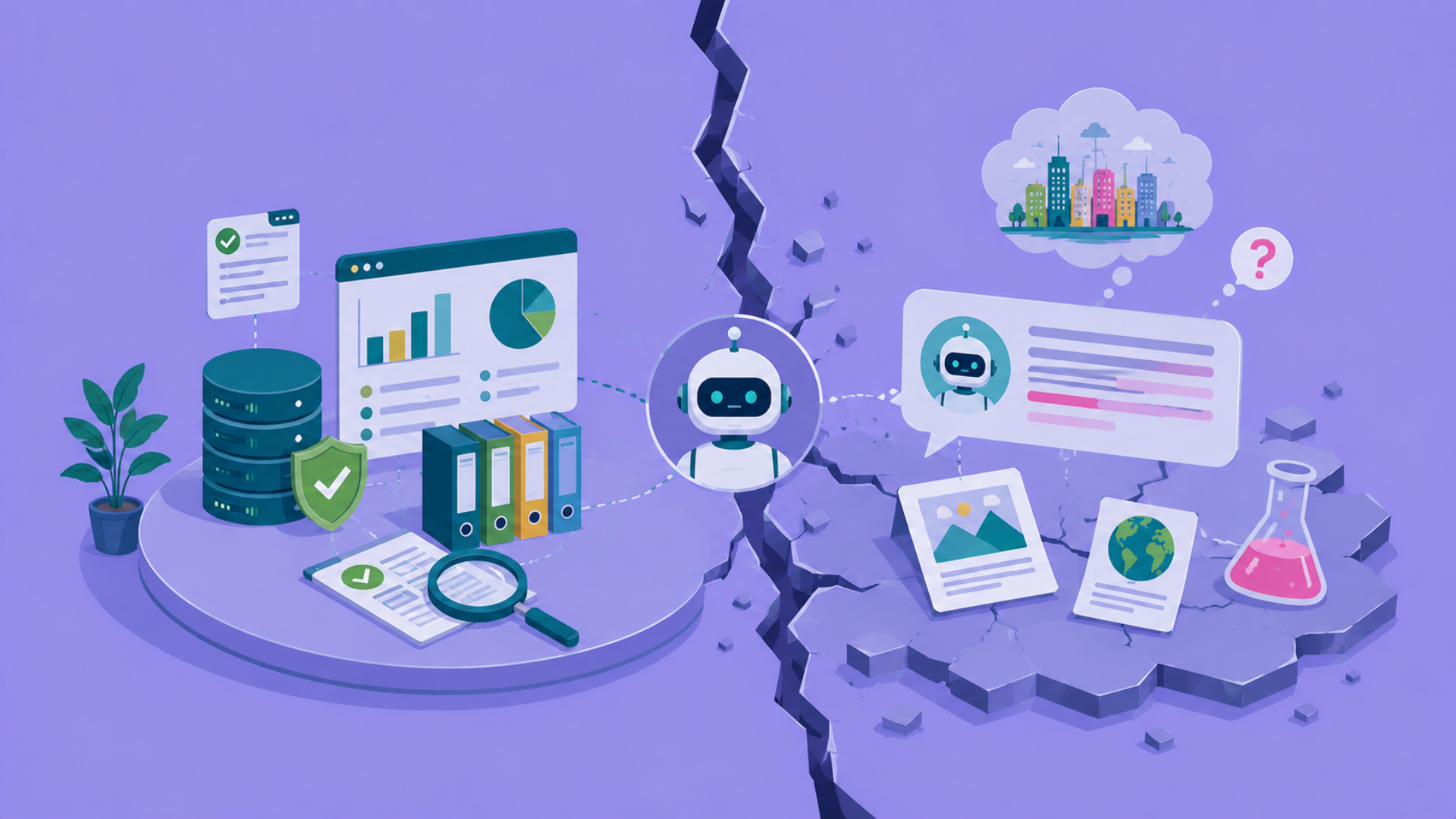
AI hallucination is when an AI gives you an answer that sounds right but is wrong.
The AI does not know it is wrong. It does not flag uncertainty. It just answers. With confidence. With detail. Sometimes with made-up citations that look completely real.
This is not a bug that will be fixed in the next software update. It is a characteristic of how large language models work. Understanding why it happens is the first step to managing it in an enterprise setting.
What Causes AI Hallucination?
Large language models are trained to predict the most likely next word based on patterns in their training data. They are very good at this. But they are not looking up facts. They are generating text that fits the pattern of a correct-sounding answer.
When a model does not know something, it does not say "I don't know." It generates what a correct answer would look like. That is hallucination.
Think of it this way. If you ask a model about a real legal case and it does not have that case in its training data, it will not admit the gap. It will generate a case name, a judge, a ruling, and a date. All plausible. All potentially false.
This happened in a real US court in 2023. A lawyer submitted a brief with six AI-generated case citations. None of them existed.
Why It Is a Serious Risk for Enterprise Use
In a consumer setting, an AI getting a fact wrong is annoying. In an enterprise setting, it can cause real damage.
Consider these scenarios.
A procurement team uses AI to summarise supplier contracts. The AI misrepresents a key clause. The team acts on the summary. The contract dispute costs more than the deal was worth.
A financial analyst uses AI to pull regulatory guidance. The AI cites a rule that does not exist. The analyst includes it in a compliance report. The regulator spots it.
A service technician uses an AI knowledge tool. The AI gives incorrect repair instructions. The technician follows them. The product fails again.
The common thread is the same. The AI sounded right. Nobody checked. The cost was real.
The Types of Hallucination Worth Knowing
Not all hallucination looks the same. Here are the most common forms enterprise teams encounter.
Factual hallucination. The AI states something that is simply not true. A wrong date, a wrong name, a wrong statistic. This is the easiest type to catch if you verify the source.
Citation hallucination. The AI invents sources. It names a report, a paper, or a regulation that does not exist. The citation looks real. The content sounds credible. The source cannot be found because it never existed.
Reasoning hallucination. The AI follows a logical chain that sounds coherent but reaches a wrong conclusion. This is the hardest type to catch because the steps look right even when the output is wrong.
Context drift. In a long conversation or document, the AI loses track of earlier facts and contradicts them later. It does not notice the contradiction.
Does RAG Fix Hallucination?
Retrieval-augmented generation, or RAG, significantly reduces hallucination for use cases where the AI needs to draw on specific documents or data.
RAG works by giving the AI access to a set of verified sources before it generates an answer. The AI is more likely to stay grounded in those sources rather than generating from its training data alone.
It does not eliminate hallucination. An AI using RAG can still misread a document, draw the wrong conclusion, or drift outside the source material. But for enterprise use cases like internal knowledge search, document summarisation, or policy Q&A, RAG-based systems are significantly more reliable than open-ended generation.
This is why retrieval-augmented generation is one of the most widely deployed enterprise AI architectures in 2026.
How Enterprise Teams Can Reduce Hallucination Risk
You cannot eliminate hallucination entirely. You can design systems and workflows that catch it before it causes damage.
Ground the AI in your data:
Use RAG or fine-tuning to anchor the AI to verified, relevant sources. Open-ended generation from a general model is the highest-risk setting for enterprise use.
Build in human review for high-stakes outputs:
Any AI output that will be acted on without verification is a risk. Contracts, regulatory submissions, medical records, financial reports: these need a human check before they become decisions.
Test with adversarial prompts:
Before deploying an AI tool, test it with questions you know it might get wrong. Ask it about edge cases. Ask it about things outside its knowledge. See what it does. The results will tell you where the guardrails need to be tighter.
Log and monitor outputs in production:
Once a system is live, track where it is being corrected by users. High correction rates in a specific area signal a hallucination problem in that domain. Use that signal to improve the system rather than hoping users keep catching the errors.
Set clear expectations with users:
Teams that understand AI can hallucinate are more likely to verify important outputs. Teams that treat AI as an oracle will not. Training matters as much as the technical design.
The Bottom Line for Enterprise Leaders
AI hallucination is not a reason to avoid AI. It is a reason to deploy it carefully.
The enterprises getting the most value from AI in 2026 are not the ones that trust every output. They are the ones that have designed systems, workflows, and human checkpoints that make hallucination a manageable risk rather than a hidden liability.
The question to ask about any AI deployment is simple: what happens when this is wrong and nobody catches it? If the answer is "nothing serious," deploy it. If the answer is "significant damage," add the review step.
Vishleshan AI builds enterprise AI systems with the retrieval architecture, governance frameworks, and human oversight mechanisms that keep hallucination risk within acceptable limits for production enterprise use. Book a Consultation