



A study released this week by a major global technology company, surveying 500 enterprise decision-makers across industries, produced a number that deserves more attention than it is getting.
90% of organisations report that AI is transforming their workflows. 91% say AI has improved their data access. 90% report productivity gains. Only 18% say AI is delivering significant revenue impact.
That 72-point gap between workflow transformation and revenue impact is the defining challenge of enterprise AI in 2026. It is not a technology problem. It is not an adoption problem. It is an execution and operating model problem, and the data from this study makes clear what is causing it.
This Is Not the First Time the Data Has Said This
The same research organisation released a separate study in May 2026, surveying 467 senior executives responsible for AI investments at enterprises with more than one billion dollars in annual revenue. The finding was consistent with the July data from a different angle: nearly 43% of major AI initiatives at these organisations are expected to fail.
The risk, the report was explicit, is not driven by lack of experimentation or access to tools. It is driven by the difficulty of translating ambition into consistent, enterprise-wide outcomes.
Two studies, two samples, two months apart, converging on the same conclusion. AI adoption has succeeded in reaching nearly every enterprise. AI execution has not succeeded in reaching most of them.
What Separates the 18% From the 82%
The July study identifies a clear distinction between what it calls AI Leaders and AI Followers. The leaders are the 18% seeing significant revenue impact. The followers are the 82% seeing workflow improvement without revenue movement.
The distinction is not in which AI tools they are using. It is not in their AI budget. It is in how they have organised around AI and what they hold it accountable to.
AI Leaders are embedding AI into core workflows and decision-making rather than deploying it as a productivity layer on top of unchanged processes. They are measuring AI against revenue outcomes rather than activity metrics. They are treating AI as an operating model shift rather than a technology adoption initiative. And critically, they are scaling and adapting continuously rather than running deployments as discrete projects with fixed end states.
AI Followers are doing something that looks similar from the outside but is structured differently at the execution level. They have AI tools in use across the organisation. They can report on adoption rates, productivity improvements, and workflow changes. What they cannot report is a clear line from their AI investment to their revenue.
The gap between those two things is exactly where forward deployed engineering operates. The workflow improvement is relatively easy to generate. The revenue impact requires AI that is integrated into the actual decision-making and operational execution of the business, not deployed alongside it.
Why Workflow Improvement Does Not Become Revenue Impact
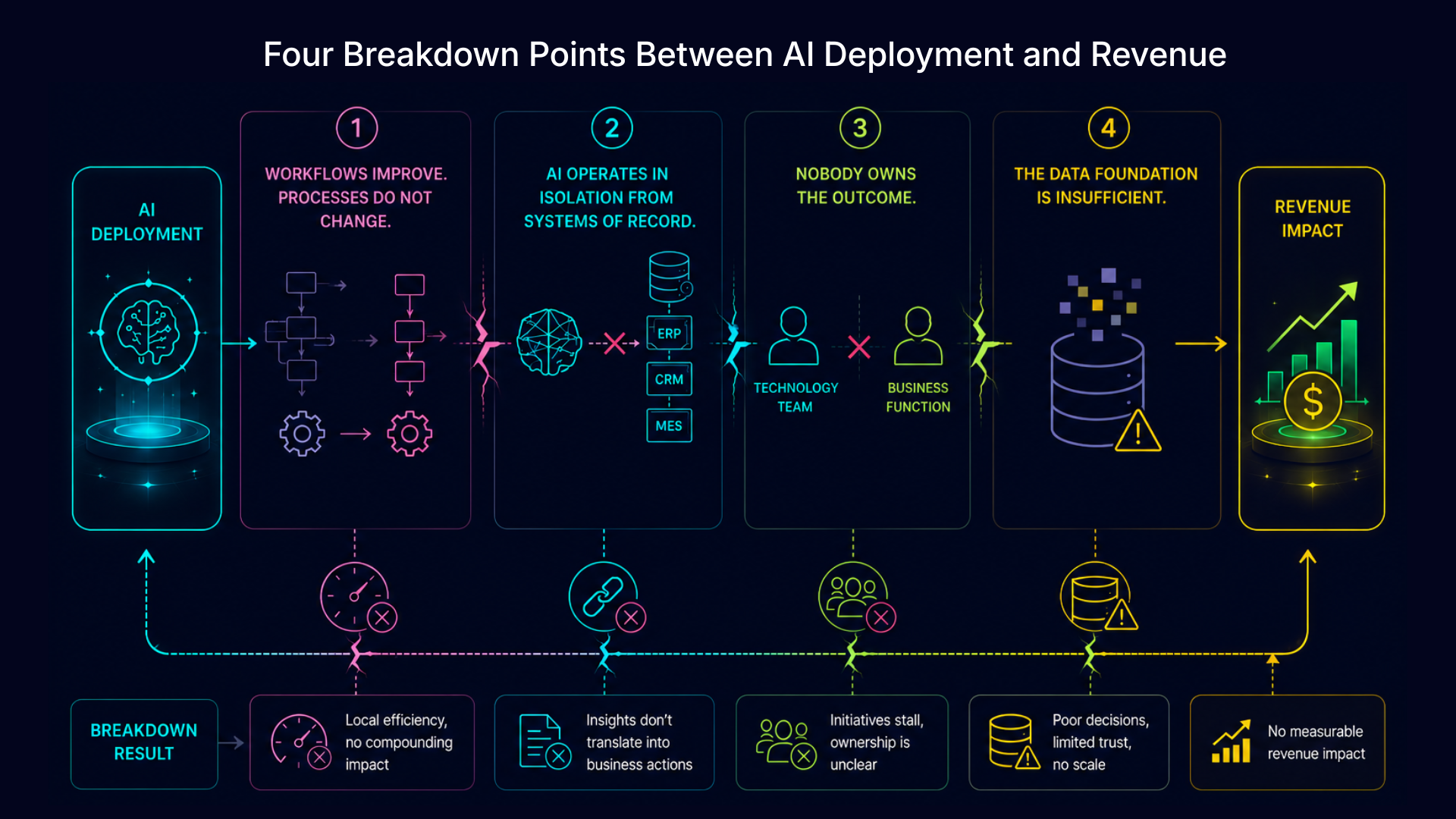
The pathway from "AI is transforming our workflows" to "AI is delivering significant revenue impact" is shorter in theory than it is in practice. Understanding why it breaks is the starting point for fixing it.
Workflows improve. Processes do not change:
The most common pattern in AI Follower organisations is that AI tools are deployed inside existing workflows, making those workflows faster or less manual, without changing what the workflow is optimising for or how its outputs connect to revenue outcomes. A procurement team that uses AI to process invoices faster is more efficient. If the procurement process itself is not redesigned around what AI now makes possible, that efficiency does not compound into revenue impact.
AI operates in isolation from systems of record:
AI tools that do not integrate with the ERP, CRM, and operational systems where business decisions are actually made and recorded cannot close the loop between AI intelligence and business action. An AI insight that does not trigger a purchase order, update a customer record, or change a production schedule has not generated revenue impact. It has generated a recommendation that a human may or may not act on. The integration layer that connects AI to systems of record is not a technical nicety. It is the mechanism through which AI intelligence becomes business outcome.
Nobody owns the outcome:
In most enterprise AI programmes, the team deploying AI is accountable for deployment metrics. The business function using AI is accountable for its own function metrics. Nobody is accountable for the line between them. The 18% who are seeing revenue impact have closed this accountability gap by making AI outcomes a shared metric between the technology and business sides of the organisation, as covered in how enterprises should structure AI ownership.
The data foundation is insufficient:
AI is only as good as the data it operates on. Enterprises that have not invested in the data infrastructure that makes AI outputs reliable will see workflow changes that are not underpinned by reliable intelligence. Recommendations based on inconsistent or incomplete data may be implemented, but they will not systematically improve revenue outcomes because the intelligence generating them is not reliable enough to trust at scale.
What AI Leaders Are Actually Doing Differently
The study's characterisation of AI Leaders is worth examining specifically, because it identifies the operating model characteristics that produce revenue impact rather than just workflow change.
AI Leaders are building AI into core operational decisions, not deploying it as an optional productivity tool. The AI is present in the decision about which supplier to use, which customer to prioritise, which production schedule to run, and which service intervention to make. It is not available as a tool for analysts who want to use it. It is embedded in the process.
AI Leaders are treating their AI infrastructure as a strategic asset that requires ongoing investment, not as a project that has a completion date. The data infrastructure, the model governance, the integration architecture, the organisational capability to use AI effectively: these are maintained and developed continuously, not built once and handed over.
AI Leaders have leadership sponsorship at the level that controls resource allocation and operating model decisions. The study found that AI Leaders are four times more likely to be scaling agentic and autonomous AI, which requires the kind of cross-functional authority and organisational commitment that only executive-level sponsorship can provide.
And AI Leaders are measuring outcomes, not activities. Not "how many employees are using AI" but "what did AI contribute to revenue, margin, and customer outcomes this quarter."
Why This Matters for How You Think About AI Investment
The 72-point gap between AI adoption and AI revenue impact is not going to close by deploying more AI tools. The 82% who are transforming workflows but not generating revenue impact are not failing because they lack access to powerful AI. They are failing because they have not made the organisational and architectural changes that convert AI capability into business outcome.
For enterprise leaders evaluating their AI programmes, the practical implication is to evaluate them against the characteristics of AI Leaders rather than against adoption metrics. Are your AI deployments integrated with your systems of record, or operating alongside them? Is your AI connected to the operational decisions that drive revenue, or generating insights that sit in dashboards? Do you have clear accountability for AI outcomes at the business leadership level, or is AI still owned primarily by the technology function? And are you continuously developing the data infrastructure and AI governance that makes outcomes reliable, or treating those as one-time investments?
The enterprises in the 18% are not using fundamentally different AI. They are using AI fundamentally differently.
Vishleshan AI's forward deployed engineers work inside client environments specifically to close the gap between AI adoption and AI revenue impact, connecting AI to the actual systems, workflows, and decision-making processes where business outcomes are generated. That is the work that moves an enterprise from the 82% to the 18%. Book a Consultation