


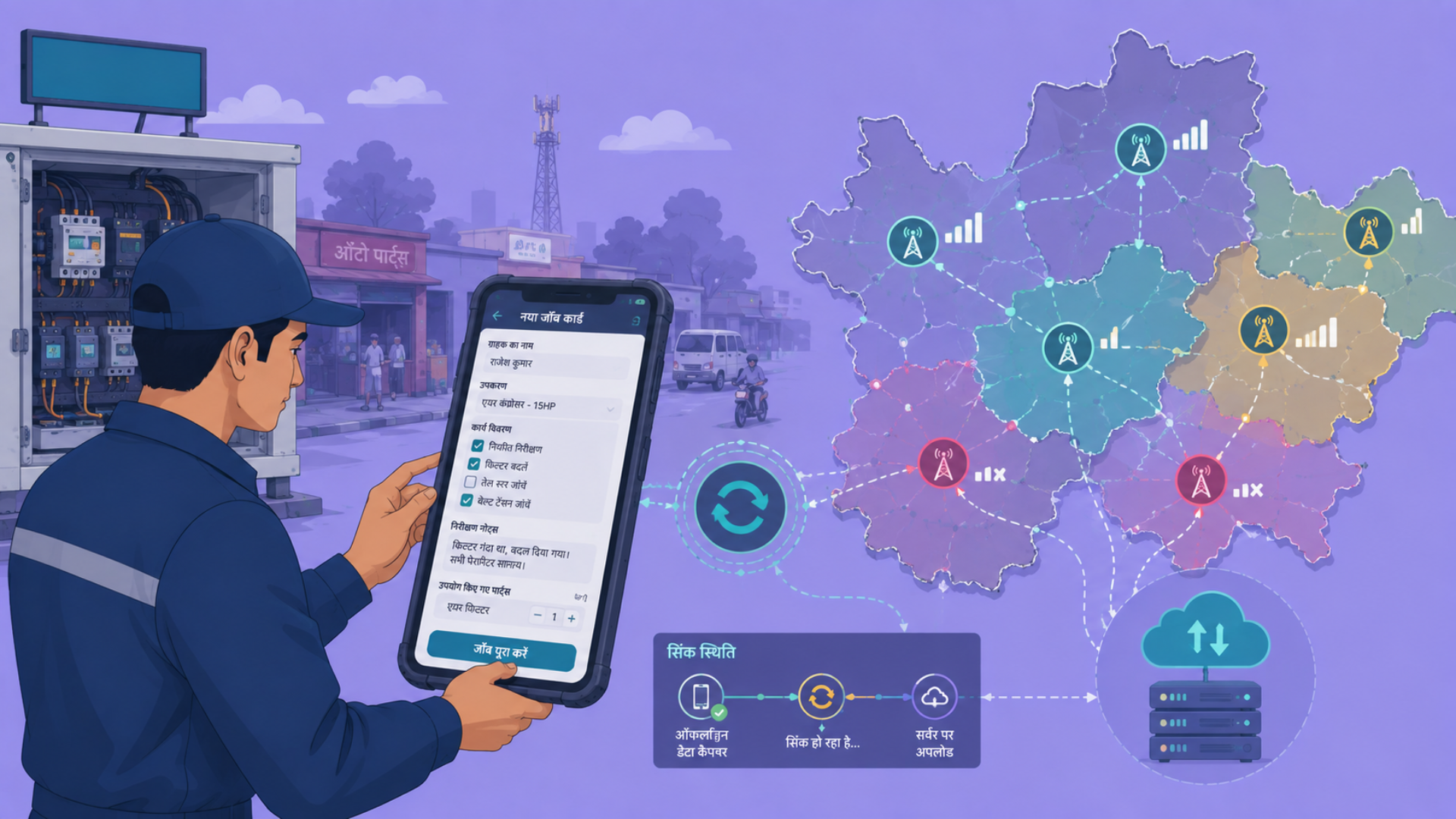
Most field service management platforms are designed around a set of assumptions that are accurate for a specific type of technician: English-speaking, smartphone-proficient, working in an urban environment with reliable 4G connectivity, employed by a company that manages them directly.
In the markets where large automotive and FMEG OEMs actually manage their field service operations, those assumptions fail consistently. A national service network in a large emerging market spans metropolitan areas where connectivity is excellent, tier-two cities where it is adequate, semi-rural areas where it is intermittent, and industrial sites where it effectively does not exist. The technicians working across this network speak different languages, have varying levels of digital literacy, and access the service platform on consumer-grade smartphones rather than enterprise devices.
A platform built on the assumptions above will work well in the top tier of this network and fail progressively as it reaches into the rest. The failure is not dramatic. It is a quiet failure of adoption. Technicians stop using the app because it does not work reliably in the field. They revert to WhatsApp and phone calls, leaving their work invisible to the service intelligence layer the platform was designed to provide.
Solving this is not a configuration problem. It is a design problem. And it starts by building for the hardest case rather than the easiest one.
The Connectivity Problem Is Structural, Not Incidental
The assumption that field technicians have reliable mobile connectivity is embedded in the architecture of most enterprise field service platforms. The application logic runs in the cloud. The device is a thin client that sends requests and receives responses. When connectivity is absent, the device does not work.
This architecture is appropriate for knowledge workers in office environments. It is inappropriate for field technicians in environments where connectivity cannot be assumed.
The scale of the connectivity challenge in large OEM service networks is significant. India alone has over 500,000 villages with mobile coverage gaps. Industrial facilities like factories, warehouses, power plants, processing facilities frequently block or degrade mobile signals. Basement and ground-floor apartment service visits in dense urban areas consistently produce connectivity gaps that no network investment is going to eliminate in the relevant timeframe.
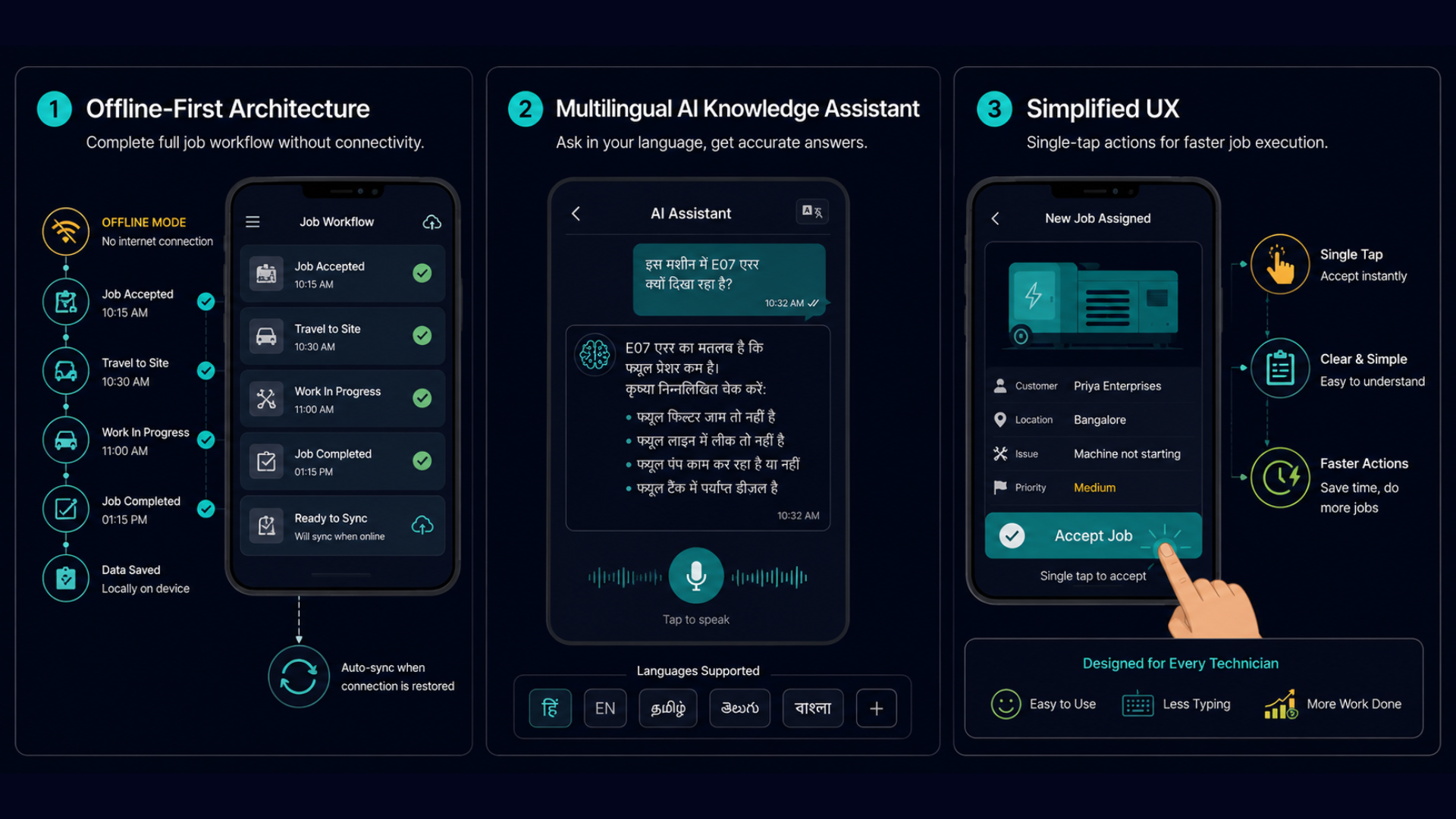
Offline-first architecture has become a recognised requirement for enterprise field service mobile applications in 2026. Not offline-capable, which typically means the app handles brief disconnections gracefully. Offline-first, which means the app is designed to function completely without connectivity as its baseline state, with connectivity being used when available to sync data rather than to enable functionality.
The distinction is architectural. An offline-capable app stores some data locally and degrades gracefully when disconnected. An offline-first app runs the full job workflow on the device, queues updates, and syncs them to the cloud when connectivity is restored. The technician does not need to know whether they are online or offline.
For a technician in a location with intermittent connectivity, the offline-first app is indistinguishable from a fully-connected app in terms of what they can do. They accept the job, access the job details, complete the work, photograph the completion, submit the job card, and check their next job, all without a live connection. The sync happens when the device connects, without any action required from the technician.
The offline-capable app, by contrast, requires the technician to be aware of their connectivity status and to manage their workflow around it. In practice, this means technicians in low-connectivity areas either avoid using the app for the steps that require connectivity or complete steps manually and update the app later from memory. Both behaviours produce data that is incomplete, delayed, or inaccurate, which undermines the service intelligence layer that depends on that data.
The Language Problem Is a Design Problem, Not a Translation Problem
The second assumption that most field service platforms embed is that technicians interact with the system in English. In OEM service networks that span multiple linguistic regions, this assumption excludes a significant proportion of the technician population from using the platform effectively.
The conventional solution to this is translation: the platform interface is translated into local languages, and technicians access the translated version. This solves the basic accessibility problem. It does not solve the deeper problem, which is that language in a field service context is not just an interface problem. It is a knowledge access problem.
A technician who receives a job for a product they have not serviced before needs to access the technical documentation for that product. If that documentation is in English, the translated interface does not help them. They cannot access the information they need to complete the job correctly.
A technician who needs information about a job, such as a warranty condition, parts specification, or diagnostic procedure, should be able to ask in their preferred language and receive the answer in the same language. A translated FAQ does not serve this need. An AI knowledge assistant that understands queries in the technician's language, retrieves relevant information from technical documentation regardless of what language that documentation is in, and responds in the technician's language does.
This is what multilingual AI enables in field service. It goes beyond a translated interface. It gives technicians access to the same job support in Hindi, Tamil, or Telugu as they would get in English. It does this without requiring every document to be manually translated for every language in the network.
The compact multilingual models now available for on-device or edge deployment make this capability viable even in low-connectivity environments. Dispatchers who shift to governance and exception management become more effective after the transition. They focus their expertise on cases that need human judgment instead of routine allocation decisions that AI can handle.
The Digital Literacy Problem Is a UX Problem
The third assumption embedded in most field service platforms is that technicians are comfortable with complex digital interfaces. In OEM service networks that include mechanics, electricians, and technicians who came to their trade through apprenticeship rather than formal training, digital literacy varies significantly.
A job management interface that requires navigating multiple screens, filling in multiple fields, and understanding workflow states that are described in technical terminology will be adopted by technicians who find this intuitive and avoided by those who do not. In a large network, the technicians who find the app difficult to use are often the most experienced. Their non-adoption is especially costly because their job data is highly valuable and their productivity is more affected.
Designing for variable digital literacy means designing for the technician who has never used a smartphone for work before, while not frustrating the technician who has. In practice, this means:
A job acceptance flow that requires a single tap rather than a multi-step form. A job briefing that uses images and icons alongside text rather than text alone. A job completion flow that is guided step-by-step rather than requiring the technician to know which fields to fill and in what sequence. A voice input option for job notes that eliminates the need to type in conditions where typing is awkward or the technician types slowly. A photographic job completion workflow that makes documentation as simple as taking a photograph.
None of these are technically complex features. They are UX design decisions that require understanding how the technician population actually interacts with mobile devices, which requires spending time with that population rather than designing for an assumed user.
What the Data Looks Like When the Platform Works for the Full Network
The operational impact of a platform designed for the full network rather than the easiest part of it shows up in adoption rates that are consistent across the network rather than concentrated in the best-connected, most digitally fluent segment.
When adoption is consistent, the data the platform generates is consistent. Job completion data from rural areas is as reliable as job completion data from metropolitan areas. Parts usage data from technicians with basic digital literacy is as accurate as data from technicians with high digital literacy. The service intelligence layer depends on complete data. This data enables AI to monitor job completion, identify technicians who need support, flag parts availability issues, and surface AMC renewal opportunities.
When adoption is concentrated in the best-connected, most digitally fluent segment, the data the platform generates is systematically biased toward that segment. The AI's view of the network is accurate for the easiest part of the network and blind to the rest. Service intelligence cannot improve the entire network if it misses the most challenging areas. These areas often have the greatest opportunities for improvement.
A platform that achieved adoption across 9,500 technicians spanning metropolitan areas, tier-two cities, and semi-rural locations did so because it was built for the hardest case from the start. The offline-first architecture worked in locations where connectivity was genuinely absent. The multilingual interface worked for technicians who did not read or write English comfortably. The simplified job completion flow worked for technicians who had never used a work management app before. The result was 85% app-based job closure across a network that includes every one of those technician profiles — not 85% in the metropolitan segment and 40% in the rest.
Why Configure-It-Yourself Platforms Cannot Solve This
The challenge of building for multilingual, low-connectivity, variable digital literacy environments is not a configuration challenge. It is a design and architecture challenge that needs to be addressed at the platform level, not the deployment level.
A configurable FSM platform designed for English-speaking, well-connected, digitally fluent users can be translated into other languages. But translation only changes the interface. The underlying architecture may still not support the conditions in which technicians actually work. The offline capability can be added, but retrofitting offline-first architecture onto a platform that was built cloud-first produces an offline experience that is incomplete rather than seamless. The UX can be simplified, but simplifying an interface that was designed for a specific user profile without redesigning it for a different one produces compromises rather than solutions.
The platforms that work for the full OEM service network in large emerging markets were designed for that network from the start. The offline-first architecture, the multilingual knowledge layer, and the simplified UX were design decisions made at the beginning, not features added in response to deployment failures.
This is the same principle that applies to enterprise AI deployment broadly: building for the actual operating environment from the start produces better outcomes than configuring a generic platform for an environment it was not designed for.
What to Look For in a Platform Evaluation
When evaluating FSM platforms for a large OEM service network that spans multiple linguistic regions and connectivity profiles, five questions cut through vendor claims quickly.
Does offline functionality cover the full job workflow?
Ask specifically whether a technician can accept a job, access job details, complete the work, photograph completion, submit the job card, and check their next job, all without connectivity. If any step in that sequence requires connectivity, the platform is offline-capable, not offline-first.
How does multilingual support work beyond interface translation?
Ask how a technician accesses technical knowledge in their language. Ask whether the knowledge assistant works offline. Ask how queries in local languages are handled when the relevant documentation exists only in English.
Has the platform been deployed in networks with significant low-connectivity coverage?
Ask for specific reference deployments in markets with connectivity profiles similar to yours. Ask how adoption rates compared between high-connectivity and low-connectivity segments of those deployments.
How was the mobile UX designed?
Ask whether the UX was designed with input from technicians with varying digital literacy levels. Ask what user testing was done with the actual technician population rather than with internal users or enterprise technology professionals.
What does the deployment model look like for a network of this complexity? As covered in why field service software fails at enterprise scale, the deployment model determines whether the platform actually works in the conditions it is deployed into. A platform evaluated in a controlled environment and deployed into the full complexity of a large multilingual, low-connectivity service network without engineers who understand that complexity will fail in ways that no subsequent configuration can fix.
Vishleshan AI's Technician Plus was built for large OEM service networks in markets where connectivity cannot be assumed, digital literacy varies across the technician population, and multiple languages are in use simultaneously. It has been deployed at Fortune 500 OEM scale across automotive and FMEG service networks with consistent adoption across the full network, not just its most accessible segment. Book a Consultation