


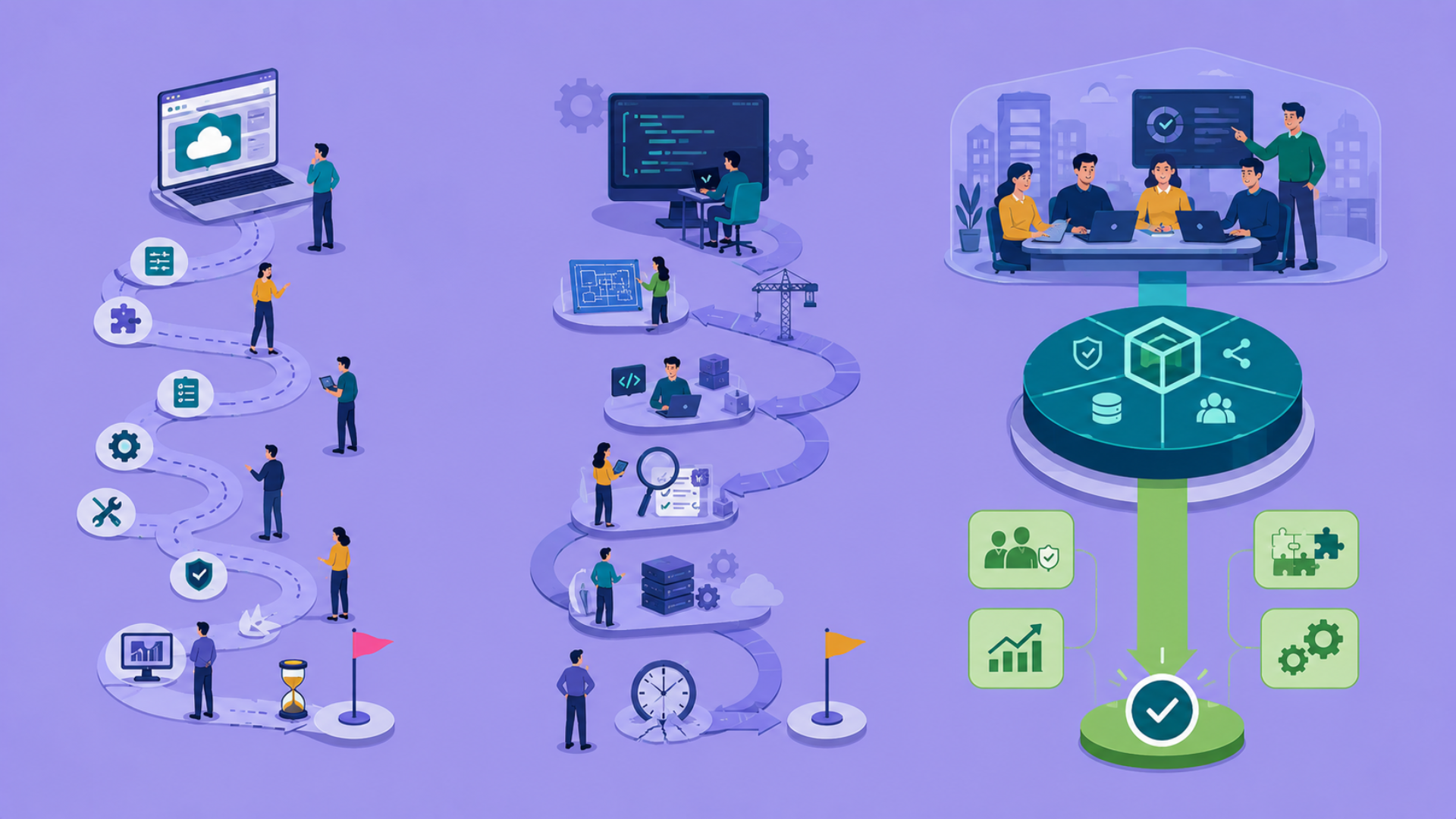
The standard framework for enterprise software decisions is buy versus build. Buy a commercial platform and configure it to your requirements. Or build a custom solution that fits your requirements from the start. Both options are real, both have legitimate use cases, and most enterprise software guidance presents them as the complete decision set.
For OEMs managing large technician networks across dealer ecosystems, the framework is missing an option. The option most likely to deliver the outcome OEMs actually need is a platform that works in production, is adopted across the full network, integrates with existing ERP systems, and delivers the service metrics it was built to improve.
That option is to deploy. It means using a platform built specifically for the OEM operating environment and implementing it with engineers embedded in the client’s operations. The team is accountable for production outcomes, not just delivery milestones.
Understanding why buy and build fall short for this use case, and why deploy works better, is the starting point for making the right field service management for a large enterprise service network.
Why Buy-and-Configure Fails for OEMs at Scale
The Field Service Management (FSM) Buyer's Guide 2026 gives buy-and-configure the default recommendation for most enterprise FSM decisions. The logic is sound for most use cases: commercial platforms have ten-plus years of feature development, they are maintained by dedicated product teams, and they are significantly cheaper and faster to get running than a custom build.
The guidance also contains a qualification that applies directly to OEM service networks: before concluding that no commercial tool meets your needs, pressure-test the configuration ceiling of at least two enterprise-tier platforms.
The configuration ceiling of commercial FSM platforms for OEM requirements is the precise problem this piece addresses. The issue is not that commercial platforms are poorly built. It is that they are built for a different operating model.
The OEM operating model has three characteristics that commercial FSM platforms were not designed for. These include indirect technician networks, multi-tier channel relationships where warranty, parts, and payment terms span multiple parties, and ERP integrations that need to operate in real time rather than through batch updates.
These are not configuration problems. They are data model problems. A commercial FSM platform built around the concept of an employed workforce with direct organisational control cannot be configured into a platform that manages indirect technician networks through dealer relationships. The data model does not accommodate it. The configuration surface exists to adjust how the platform works within its design assumptions, not to change what those design assumptions are.
The practical consequence for OEMs that have attempted to implement commercial FSM platforms is predictable. The platform works for the simplest parts of the technician network, such as metropolitan areas, directly employed technicians, and high-connectivity environments. It becomes less effective as it encounters the complexity it was not designed to handle. The configuration effort to close the gap is significant, never fully successful, and creates a technical debt that makes every subsequent upgrade more complex.
Switching FSM vendors typically costs six to twelve months of the new vendor's SaaS pricing once contract overlap, retraining, and productivity loss are factored in. For OEMs that have invested in configuring a commercial platform toward their requirements, that switching cost is amplified by the loss of the configuration investment.
Why Build Fails for Most OEMs
The build option addresses the configuration ceiling problem by starting from scratch with a platform designed for the specific requirements. The argument for building is real: you get exactly what you need, you own the intellectual property, and you are not constrained by a vendor's product roadmap.
The FSM Buyer's Guide 2026 is direct about when build is and is not appropriate: custom FSM only makes sense with a $500,000-plus engineering budget and three to five dedicated engineers ongoing.
A platform designed to handle hundreds of thousands of technicians, millions of job cards annually, real-time ERP and dealer inventory integration, offline-first mobile workflows, and multilingual support across a national technician network is not a $500,000 engineering project.
That investment is not inherently wrong. It is appropriate for organisations that are building a platform that is a core competitive asset and a source of ongoing differentiation. For most OEMs, field service management is an operational necessity rather than a competitive differentiator. The competitive advantage comes from the quality of service delivered, not the technology platform that manages it. Building a world-class FSM platform from scratch requires significant engineering and financial resources. It also diverts those resources from the areas that genuinely differentiate the business.
The build option also has a timeline problem. A custom-built FSM platform for a large OEM service network typically takes 18 to 24 months from inception to production deployment. It can take another six to twelve months to reach the adoption levels needed for operational effectiveness. Three years from the decision to start building to a platform that is working across the full network is a long time in a competitive environment where service quality is a growing factor in OEM brand differentiation.
What Deploy Actually Means and Why It Produces Different Outcomes
The deploy option starts from a different premise than either buy-and-configure or build: that the platform question and the implementation question cannot be separated for an operating environment as complex as OEM field service.
A platform built for the OEM operating model is the starting point. It should support indirect technician networks, multi-tier warranty and parts integration, real-time ERP connectivity, offline-first mobile workflows, and multilingual support at its core. These capabilities should be built into the platform rather than added to a generic framework. Implementation then happens through forward deployed engineers who work within the client’s actual operating environment. They configure the platform for the specific network, ERP setup, and technician population.
Three things make this approach consistently produce better outcomes than buy-and-configure or build for OEM service networks.
The integration is done by engineers who understand both the platform and the environment:
The ERP integration is built by engineers with experience in similar environments. They work within the client’s actual ERP configuration rather than building against a specification. This ensures warranty checks happen in real time, parts availability is confirmed before dispatch, and job completion data flows correctly into the system of record. The integration work that typically consumes months of post-deployment remediation in buy-and-configure projects happens correctly the first time because the engineers building it have the contextual knowledge to do it right.
Adoption is designed into the implementation, not assumed:
The gap between a technically deployed FSM platform and one that is genuinely used across a network of thousands of technicians is primarily an adoption problem rather than a technical one. Forward deployed engineers work inside the client’s service operations and understand the technician population they are building for. They consider digital literacy, connectivity, and daily workflows. The implementation is then designed around these realities. The result is adoption rates that reflect the full network rather than the most accessible segment of it, which is the difference between 85% app-based job closure across 9,500 technicians and 85% adoption in the metropolitan segment and 40% everywhere else.
The timeline to production is measured in months, not years:
A platform already built for the OEM operating model does not require the product development phase that a custom build requires. The implementation work, including integrating the specific ERP, configuring scheme and incentive structures, and tuning allocation logic for the network geography, takes months rather than years. OEMs that have implemented Technician Plus across their service networks have moved from deployment decision to production operation in months. This is significantly faster than the timelines typically required to buy and configure or build a platform for networks of comparable complexity.
The Total Cost Comparison That Changes the Decision
The standard total cost of ownership comparison for FSM decisions focuses on licence fees, implementation costs, and ongoing maintenance. For OEMs evaluating the three options, two costs are consistently underweighted in standard frameworks.
The cost of the configuration gap:
Buy-and-configure projects for OEM service networks consistently encounter a point where the configuration surface of the commercial platform is exhausted and the remaining requirements cannot be met without custom development. That custom development is billed at integration rates rather than licence rates and is not included in the original cost estimate. The configuration gap cost is not visible at the point of the decision. It becomes visible at the point of implementation when the gap is discovered.
The cost of delayed production:
Every month between the decision to deploy FSM and the point at which the platform is genuinely operational across the full network is a month of service operations running on the systems the FSM is supposed to replace. The opportunity cost of that delay is real and measurable. First-time fix rates do not improve, AMC revenue remains uncaptured, and spare parts efficiency does not improve. These gaps show up in the service metrics the FSM was deployed to improve.
The deploy model consistently produces the shortest elapsed time between decision and full network production for OEM-scale deployments, which is the metric that determines when the business case starts generating returns.
The Decision Framework for OEM FSM
Three questions guide the decision for OEMs evaluating FSM options.
Does the commercial platform have a production deployment at comparable scale in an OEM-dealer-technician network?
If the answer is no, the configuration ceiling will be reached during implementation rather than discovered in advance. The reference check should not ask whether the platform can be configured to meet the requirements. Vendors will always say yes. It should involve speaking directly with the operational team at an OEM deployment of comparable scale and asking whether the platform actually met those requirements in production.
What is the realistic total cost of the custom build including ongoing maintenance?
The initial build cost is only part of the picture. A custom FSM platform for an OEM network requires ongoing engineering capacity to maintain, upgrade, and extend as requirements evolve. That ongoing cost, modelled over a five-year period, typically makes the custom build significantly more expensive than it appears at the decision point.
What is the implementation team's experience in OEM-dealer-technician operating environments?
For both commercial platforms and deploy-model implementations, the quality of the implementation team is the primary determinant of whether the deployment produces the intended outcomes. Ask the implementation team how they have handled indirect technician networks, real-time ERP integration for warranty and parts, and offline-first mobile capability in previous OEM deployments. This reveals whether they have the required experience or whether the current engagement will be their learning experience.
The buy versus build framework has served enterprise software decisions well for decades. For OEM field service management at enterprise scale, the missing option is a platform built for the operating environment and implemented by engineers embedded in that environment. These engineers are accountable for the production metrics the platform is deployed to improve.
Vishleshan AI's Technician Plus is the deploy model applied to OEM field service management. Built for the OEM-dealer-technician operating model, implemented by forward deployed engineers who work inside client environments until the platform is genuinely live and generating measurable service outcomes. Book a Consultation