



Deploying AI in a regulated industry introduces a category of complexity that most AI deployment frameworks are not built to handle. The governance obligations are binding, not aspirational. The audit requirements are specific and enforced. The liability frameworks create accountability that does not disappear when a vendor's statement of work concludes. And the tolerance for the kind of iterative, move-fast approach that works well in unregulated environments is essentially zero in sectors where a compliance failure has consequences that extend beyond the project team.
Forward deployed engineering (FDE) was not designed exclusively for regulated industries. But its operating model is particularly well-suited to them, because the things that make regulated deployment hard are precisely the things the model is structured to address.
This piece covers what changes when you deploy AI in a regulated environment, and how the forward deployed engineering model adapts to those constraints.
What Regulated Industries Actually Require That Others Do Not
The distinction between regulated and unregulated AI deployment is not simply about having more compliance paperwork. It is about a fundamentally different set of requirements that shape every architectural and delivery decision.
Auditability by design:
In financial services, automotive manufacturing under IATF 16949, and healthcare, the ability to demonstrate what an AI system did, on what basis, with what human oversight, at what point in time, is not a reporting requirement. It is a condition of deployment. An AI system that cannot produce a complete, structured audit trail of its decisions and actions is not deployable in these environments regardless of its technical performance.
Explainability at the decision level:
Regulators increasingly require that AI-influenced decisions be explainable to the individuals they affect. A credit decision, a quality classification, a safety alert: each needs to be traceable to the inputs and logic that produced it. Black-box models that perform well on aggregate metrics but cannot explain individual outputs face significant regulatory exposure in these sectors.
Data governance that extends into AI:
Regulated industries operate under data governance frameworks, including GDPR in Europe, RBI data localisation requirements in India, and sector-specific data handling obligations, that directly constrain how AI systems can access, process, and store the data they operate on. These are not IT policy questions. They are legal obligations with material penalties for breach.
Human oversight at defined thresholds:
Most regulated sector frameworks require human review and approval for decisions above defined impact thresholds. An AI system that executes autonomously without a defined human oversight mechanism is not just a governance gap. In many regulated contexts it is a breach of the framework the organisation is operating under.
These requirements do not make AI deployment impossible in regulated industries. They make it significantly more complex, and they make the gap between a controlled pilot and a compliant production deployment significantly wider than in unregulated environments.
Why Traditional Delivery Models Struggle in Regulated Environments
The standard approach to enterprise AI delivery, where a vendor team builds a system against a specification and hands it over at project completion, has a structural weakness in regulated environments that becomes visible at the point of deployment.
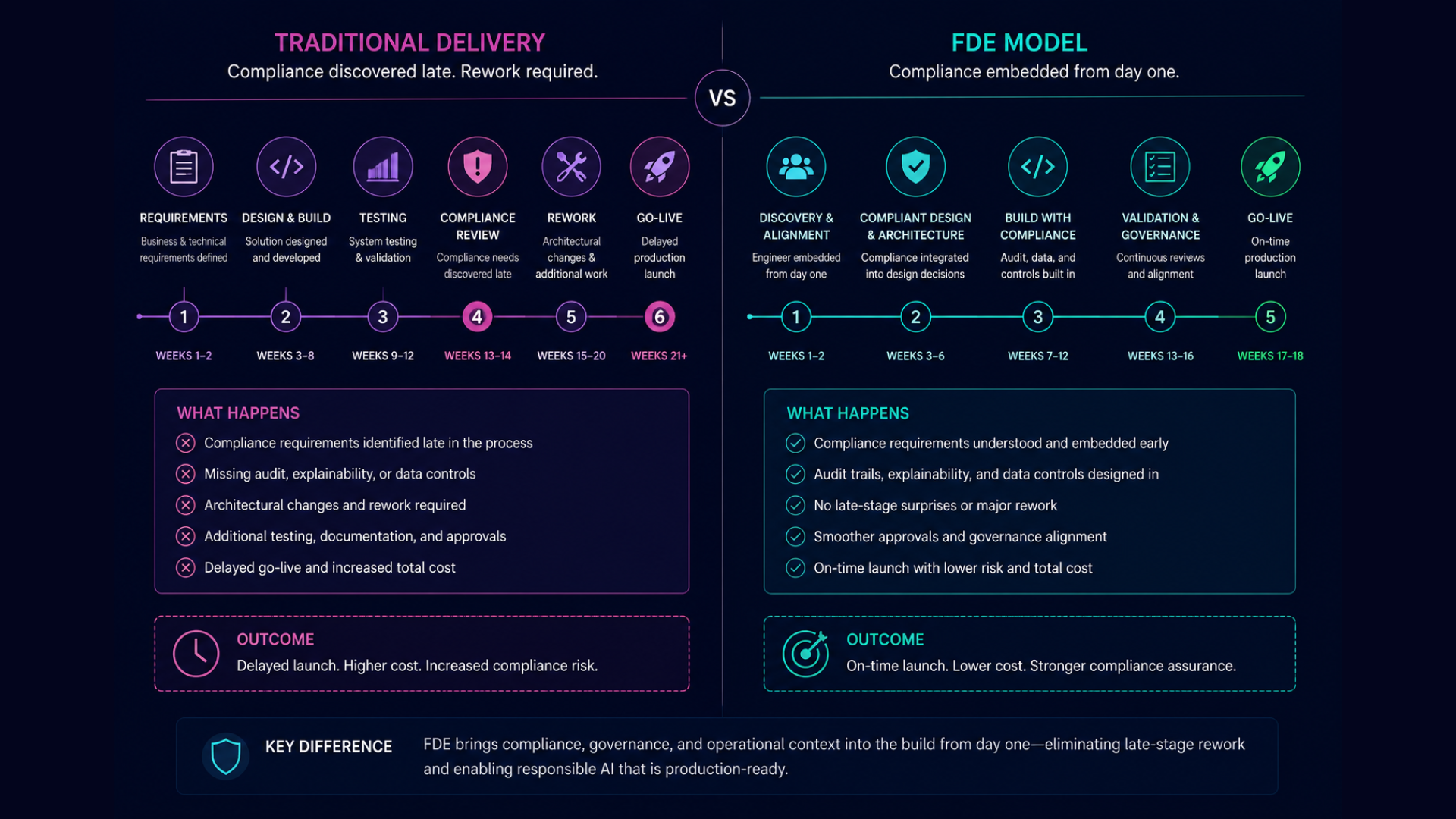
Compliance in regulated industries is not a checklist that can be completed at the end of a project. It is a characteristic that needs to be embedded in the architecture from the start. Audit trails that are added after the fact are incomplete. Explainability mechanisms that are retrofitted into a model that was not designed for them are unreliable. Data governance controls that are imposed on a system that was built without them require architectural rework that is expensive and disruptive.
A delivery team working from a specification and building remotely will typically treat compliance as a requirements category alongside functional requirements. They will build what was specified. The problem is that the full compliance requirement in a regulated environment is almost never fully captured in a specification document, because significant portions of it only become visible when the system is being integrated with the actual operational environment, against actual data, within the actual governance framework the organisation runs under.
This is the discovery problem that makes regulated deployment particularly prone to late-stage surprises. The compliance gaps surface at integration time, when addressing them requires rework rather than initial design decisions.
How Forward Deployed Engineering Adapts in Regulated Environments
The forward deployed engineering operating model addresses the regulated deployment problem through the same mechanism it addresses the general deployment problem: proximity to the actual environment, from the start of the engagement.
A forward deployed engineer working inside a financial services organisation from day one of an engagement is not learning about the compliance framework from a document. They are operating within it. They attend the governance review meetings. They work alongside the compliance team. They see which data handling practices trigger alerts in the existing monitoring systems and which do not. They understand the approval thresholds not because they were written in a requirements document but because they have seen them applied in real decisions.
This accumulated contextual understanding changes what gets built. Audit trail architecture is not added as a feature. It is designed into the system from the first technical decisions, because the engineer building it understands specifically what the audit trail needs to capture to satisfy the regulatory requirement in this jurisdiction for this type of system. Explainability is not a retrofit. It is a design constraint that shapes model selection, feature engineering, and output formatting from the beginning.
The compliance integration that typically causes late-stage rework in regulated AI deployments happens early in an FDE engagement, when it is cheap to address, rather than late, when it requires architectural revision.
Financial Services: Where the Compliance Stakes Are Highest
Financial services is the regulated sector where AI deployment constraints are most acute and where the consequences of compliance failure are most material.
AI systems used in credit decisioning, fraud detection, trading, and customer communications operate under frameworks including the EU AI Act's high-risk system obligations, sector-specific model risk management guidelines, and consumer protection regulations that impose specific requirements on automated decision-making.
The model risk management framework, which requires financial institutions to validate, monitor, and govern AI models used in material decisions, creates specific challenges for enterprise AI deployment. Models need to be documented at a level of technical detail that most delivery teams do not produce as a matter of course. Performance monitoring needs to be designed in from deployment, not added when a model starts to drift. The validation process, typically conducted by a team independent of the model developers, needs to happen before production deployment and requires documentation that reflects the actual deployed system, not a specification of the intended system.
A forward deployed engineer working inside a financial services institution understands this framework operationally, not theoretically. The documentation they produce during development is structured to satisfy model risk management requirements. The monitoring architecture they build is designed around the specific metrics and thresholds the validation team will review. The human oversight mechanisms they implement reflect the specific approval authorities and escalation paths that the institution's governance framework requires.
The difference in practice is not just faster deployment. It is deployment that passes the validation and governance review on the first submission rather than requiring multiple revision cycles.
Automotive Manufacturing: Safety, Quality, and Supply Chain Compliance
Automotive manufacturing operates under quality management frameworks, primarily IATF 16949, that impose specific requirements on how processes are documented, validated, and controlled. AI systems used in production quality management, supplier qualification, or safety-critical process monitoring are subject to these frameworks in ways that most AI deployment methodologies do not account for.
The practical consequence is that AI systems in automotive manufacturing need to demonstrate statistical process control characteristics that are familiar to quality engineers but unfamiliar to most AI teams. Capability studies, measurement system analyses, and control plan integration are not typical AI project deliverables. But they are requirements for AI systems that are intended to operate within an IATF-compliant quality management system.
A forward deployed engineer embedded inside an automotive manufacturer's quality or supply chain function encounters these requirements directly. The AI system they build is designed to integrate with existing control plans, generate the process performance data that IATF auditors require, and operate within the documented work instructions that define how quality decisions are made and reviewed. This integration happens naturally when the engineer is working inside the environment where these frameworks are being applied daily. It happens through document review and multiple revision cycles when the engineer is working from the outside.
The Governance Architecture That Works Across Regulated Sectors
Across financial services, automotive manufacturing, and other regulated environments, the AI deployment architecture that consistently satisfies compliance requirements shares several characteristics.
Immutable audit logging captures every agent action, every data access, every decision output, and every human override in a tamper-evident log that can be queried by compliance teams and regulators. This is not a reporting system. It is an architectural component that is active from the first day of production operation.
Explainable output design ensures that every AI-generated decision or recommendation includes the inputs and reasoning that produced it, in a format that can be reviewed by both technical and non-technical stakeholders. The level of explainability required varies by use case and jurisdiction, but the architectural commitment to explainability needs to be made before model selection, not after.
Tiered human oversight defines the specific thresholds above which AI outputs require human review before action, the specific individuals or roles authorised to provide that review, and the escalation path when those individuals are unavailable. This is the context layer implementation for regulated environments: business rules that are binding, not advisory.
Data lineage tracking maintains a complete record of where every piece of data used in an AI decision originated, how it was transformed, and what access controls governed its use. This is a prerequisite for demonstrating data governance compliance in most regulated sector frameworks and for responding to data subject access requests in GDPR-applicable contexts.
These architectural components are not difficult to build. They are consistently underbuilt when the team building the AI system does not have direct, operational experience of the regulatory requirements they need to satisfy.
What Enterprises in Regulated Industries Should Look for in an FDE Partner
The evaluation criteria for any forward deployed engineering partner apply in regulated industries, with additional weight on two specific dimensions.
Demonstrated experience in your regulatory framework. A forward deployed engineer who has worked inside a financial services institution's model risk management process, or inside an automotive manufacturer's IATF quality management system, brings compliance understanding that cannot be replicated by reading the framework documentation. Ask for specific examples of AI deployments in your sector that went through the relevant regulatory or quality validation process successfully.
Governance architecture as a delivery output. The compliance architecture, including audit logging, explainability mechanisms, human oversight implementation, and data lineage tracking, should be a named deliverable of the engagement, not an afterthought. Ask specifically what governance components the partner will build and how they will be validated before production deployment.
Regulated industries are where the gap between AI that works technically and AI that is deployable in production is widest. The compliance requirements, governance obligations, and audit frameworks that define these environments are not obstacles to AI deployment. They are the constraints within which deployment needs to be designed from the start.
Vishleshan AI's forward deployed engineers have deployed production AI systems inside financial services, automotive manufacturing, and industrial manufacturing environments, building compliance architecture into the system from day one rather than retrofitting it before go-live. Book a Consultation