


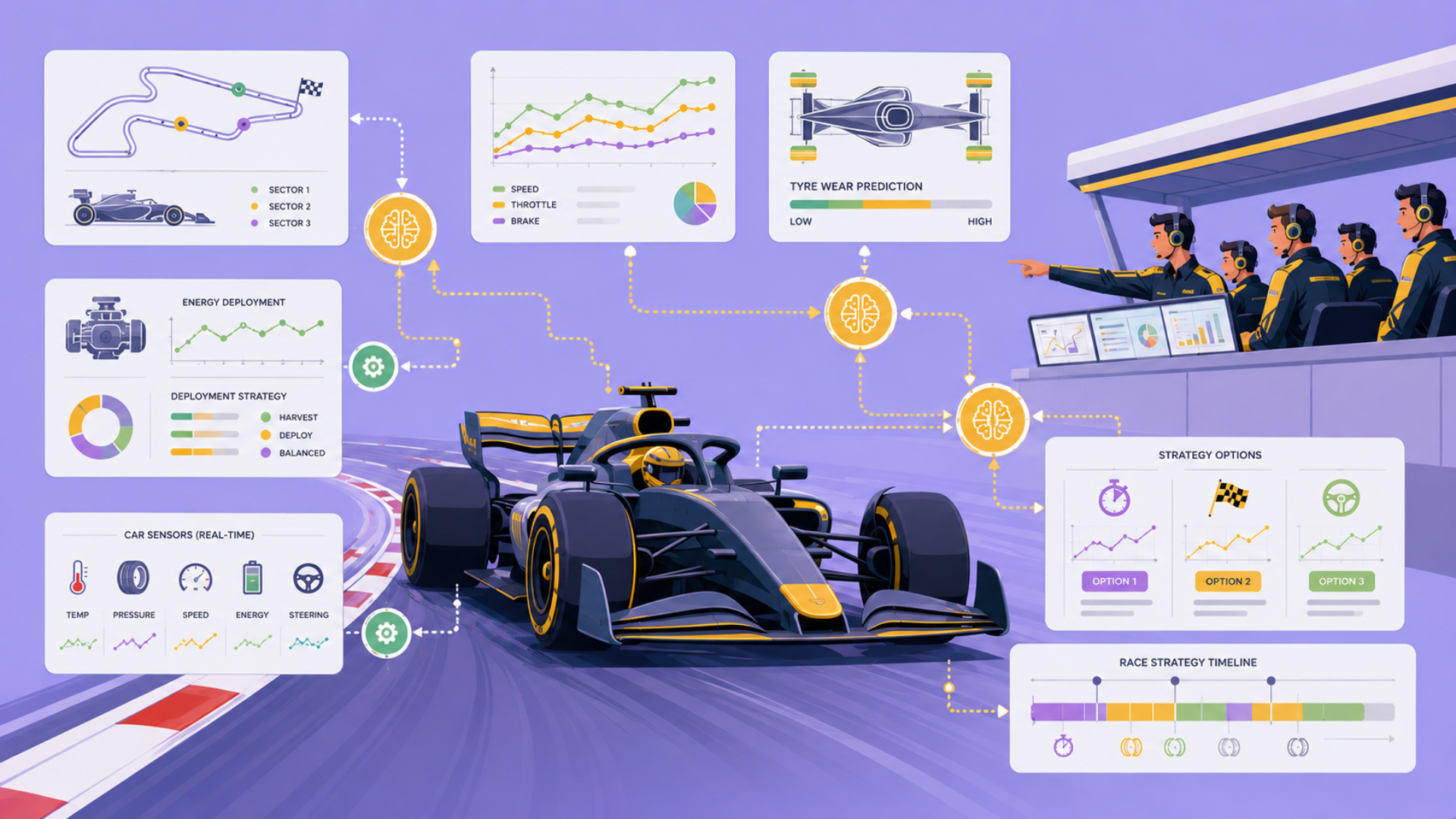
Formula 1 has always been a data sport. Engineers have monitored telemetry, modelled tyre degradation, and optimised pit stop windows for decades.
In 2026, it became an AI sport.
Eight new AI partnerships were signed across Formula 1 and its eleven teams in the six months to May 2026 alone. AI and machine learning brands now account for four of the top fifteen new sponsorship investors in the sport. The technology category has overtaken almost every other line in team budgets.
This is not branding. It is competitive infrastructure.
The teams that understand how to use AI effectively in 2026 are winning. The teams that do not are losing to software as much as to cars and drivers.
The 2026 Regulations Changed Everything
To understand why AI matters so much in 2026, you need to understand what the new technical regulations did.
The 2026 cars are shorter, narrower, and up to 30 kilograms lighter than their predecessors. They run on near 50/50 split between combustion and electric power. They have active aerodynamics, where front and rear wings move in real time based on conditions. And the power unit incorporates self-learning energy management algorithms that continuously calculate how to deploy the electric power around each lap.
Each car carries between 300 and 600 sensors. Together they stream over a million data points per second. Aerodynamic, mechanical, electrical, thermal, and driver input channels all feed into the same telemetry system.
No human team can process this data fast enough to make decisions at the speed the car needs them. AI is not an optional upgrade in this environment. It is the only way to operate competitively.
Where AI Is Deciding Race Outcomes
Energy management:
The most consequential AI application in 2026 F1 is energy deployment. The self-learning algorithms in the power unit predict, lap by lap and corner by corner, the optimal moment to deploy electric power and when to harvest it back from braking.
These algorithms forward-plan based on wind, track grip, tyre condition, driver inputs, and lap history. They learn from previous laps. They adapt continuously to what the driver does. They predict optimal deployment for the next lap based on what happened on the last one.
McLaren driver Oscar Piastri described the situation plainly after Spa: results are being decided by computers either behaving or misbehaving. When the algorithm makes optimal decisions, the driver has the power they need at the right moment. When it does not, the driver is powerless to compensate.
This is the first time in Formula 1 history that a race outcome has been determined, meaningfully and repeatedly, by the quality of an AI system rather than by driver skill or car design alone.
Race strategy:
Race strategy in Formula 1 covers pit stop timing, tyre compound choice, fuel load management, and the response to safety cars and weather changes. It has always been a data-intensive discipline. In 2026 it is an AI discipline.
Red Bull runs Oracle's AI strategy agent on the pit wall. The system processes real-time telemetry, competitor data, weather forecasts, and tyre degradation models to recommend pit stop windows and strategic responses to changing conditions. The strategy team evaluates the recommendation and makes the call. But the analytical work that previously took a team of engineers several minutes happens in seconds.
Research published in the journal Machine Learning in 2026 demonstrated that AI race strategy models develop what researchers call emergent tactics. The model learned to perform undercutting, where a car takes an early pit stop to gain a tyre advantage over the car ahead, without being explicitly trained to do so. The AI discovered the tactic from the data.
Car design and simulation:
McLaren runs Gemini across its design and simulation workflows. Cadillac's new team has named TWG AI as its primary partner, covering vehicle simulation, aerodynamic correlation between digital and physical testing, race strategy modelling, manufacturing, logistics, and driver performance analysis.
The 2026 aerodynamic regulations are complex enough that the simulation demands are significantly higher than in previous years. Teams that can run more simulations, more accurately, in less time have a design advantage. AI is the lever that determines how many simulation cycles a team can run in a development window.
Regulatory compliance:
The FIA, Formula 1's governing body, is deploying AI to monitor track limits. This is one of the sport's most contested enforcement challenges. Thousands of corner crossings per race weekend, each needing to be evaluated against precise track boundary definitions, with significant sporting consequences for decisions made incorrectly.
AI enforcement is faster, more consistent, and less susceptible to human judgment variation than manual review. For the teams, it means the compliance environment is more predictable. What the rules say is what the AI enforces.
Formula 1 itself, as the rights holder, has built AI workflows on AWS to accelerate race-day issue resolution. The system triages telemetry anomalies, surfaces broadcast-relevant context, and reduces the time between a pit lane incident and a televised explanation of what happened.
What F1 Teaches Enterprises About AI in High-Stakes Operations
Formula 1 is an extreme environment. The decisions happen in milliseconds. The competitive consequences are immediate and visible. The data volumes are enormous.
But the principles that determine whether AI works in Formula 1 are the same ones that determine whether AI works in manufacturing, supply chain, field service, and financial services. And F1 demonstrates them with a clarity that boardroom case studies rarely achieve.
The data infrastructure is the competitive asset, not the model.
Every team has access to similar AI models. The differentiation comes from the quality, speed, and completeness of the data those models operate on. The team with better telemetry integration, faster data processing, and cleaner historical data gets better outputs from the same AI. This is exactly what data infrastructure investment in enterprise AI produces. The AI is commoditising. The data is not.
Humans and AI have different roles, and confusing them is expensive.
In 2026 F1, the AI generates the strategy recommendation. The experienced strategist makes the call. The AI processes the data faster and more comprehensively than any human. The human brings context, judgment, and the ability to override when something the AI cannot see is affecting the situation.
Enterprises that use AI to replace human judgment in situations where judgment matters make expensive mistakes. Enterprises that use AI to inform human judgment, and that are clear about where the boundary sits, consistently outperform both extremes.
Governance of autonomous AI matters as much as the AI itself.
The energy management algorithms in a 2026 F1 car are making thousands of autonomous decisions per lap. The teams that win are the ones whose engineers understand what those algorithms are optimising for, can predict their behaviour in different conditions, and can intervene when the algorithm's assumptions do not match the actual race situation.
This is AI governance at its most operationally consequential. Not a compliance checkbox. A competitive capability. The team that understands its AI better than its competitors understands its car better than its competitors.
Agentic AI is not the future. It is already deciding outcomes.
Oscar Piastri's comment that results are decided by computers behaving or misbehaving describes agentic AI in production. The energy deployment algorithms are not suggesting actions. They are taking them. Autonomously. Thousands of times per lap.
Agentic AI in enterprise operations is following the same trajectory. The question is not whether enterprise AI will become agentic. It already is. The question is whether the governance, the data infrastructure, and the human oversight framework are ready for it.
The Anthropic Connection
One detail worth noting for context.
Anthropic, the company that created Claude and operates the Claude Partner Network that Vishleshan AI is part of, signed a team-level partnership with Williams Racing in 2026. This is described as an AI-native company with genuine AI deployment ambitions in a technical sport, not a branding arrangement.
The partnership covers AI applications across Williams' operational and technical workflows. It is one of the more substantive AI team partnerships on the 2026 grid, alongside McLaren's Gemini partnership and Red Bull's Oracle arrangement.
For enterprises evaluating AI partners, the F1 grid in 2026 is an unusually transparent demonstration of what different AI providers are actually deploying in a high-stakes, high-visibility operational environment. The results on track are the outcome data.
The AI that determines whether a Formula 1 team wins on Sunday is the same class of AI that determines whether an enterprise's supply chain responds to disruption effectively on Monday. The data infrastructure, the integration architecture, the governance framework, and the human-AI collaboration model are the same underlying challenge. F1 just runs the experiment at a speed and visibility that makes the lessons impossible to miss.
Vishleshan AI's forward deployed engineering (FDE) approach builds the production AI that enterprise operations require, with the same focus on data quality, integration depth, and governance clarity that separates AI that wins from AI that underperforms. Book a Consultation