


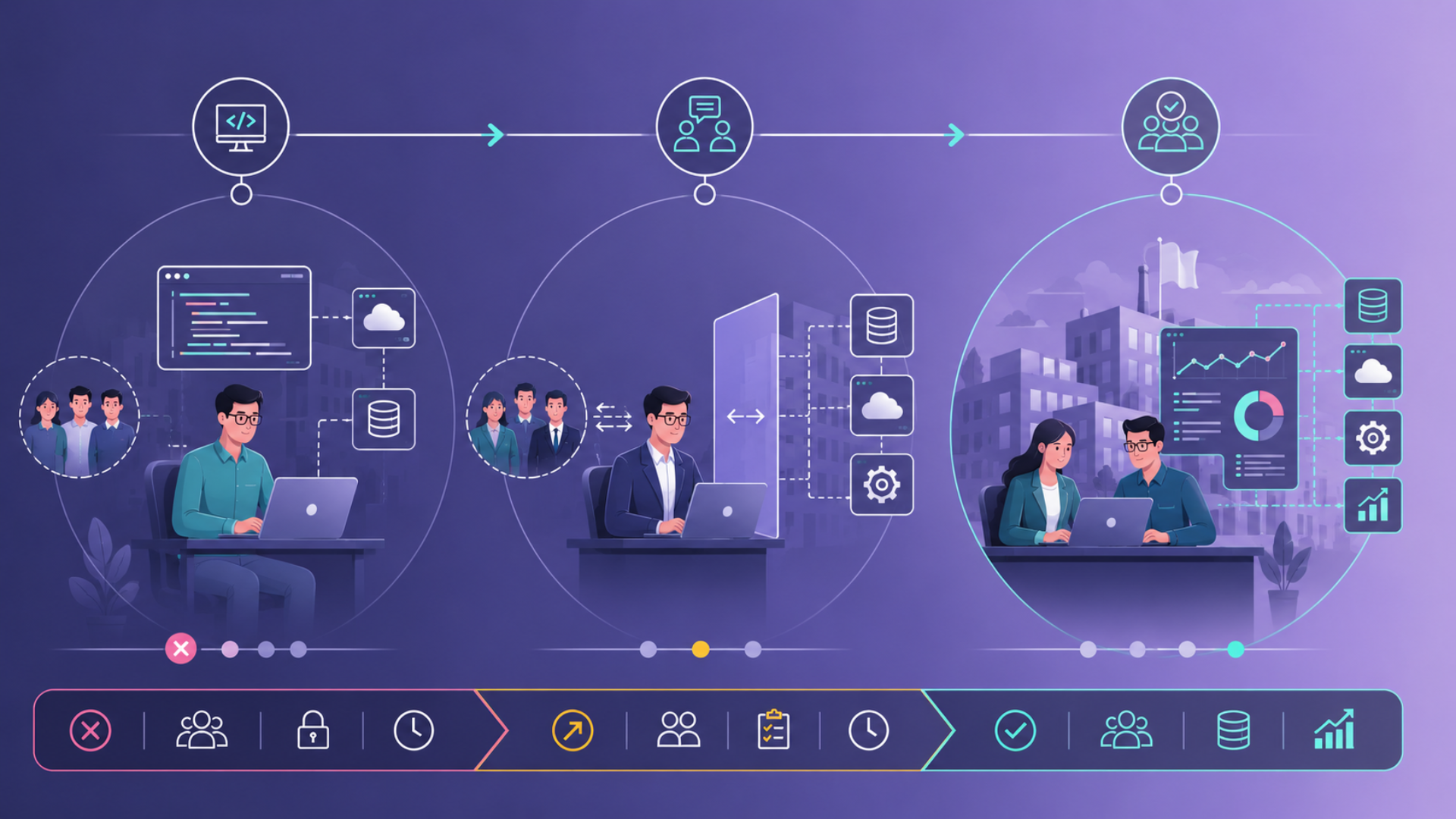
In May 2026, something notable happened. Within a two-week window, ServiceNow with Accenture, Cognizant, Anthropic, and OpenAI all formally launched forward deployed engineering programmes. Not individual hires. Not pilot initiatives. Formal, dedicated organisational functions built around the same core principle: engineers embedded directly inside enterprise client environments to take AI from concept to production.
This convergence is not coincidental. It reflects something the enterprise AI industry has collectively learned after several years of investment, pilots, and disappointment: the model that actually gets AI into production is fundamentally different from the model that builds AI products, and it is fundamentally different from the model that consults on AI strategy.
Forward deployed engineering is that model. This piece explains what it is, where it came from, why it is spreading now, and what it means for enterprises evaluating how to approach AI deployment.
The Origin: A Philosophy About How Enterprise Software Actually Gets Adopted
Forward deployed engineering did not emerge from a research paper or a consulting framework. It emerged from a practical observation about why enterprise software so consistently failed to deliver on its promise.
The standard enterprise software delivery model of the 2000s and 2010s looked like this: a company built a product, trained a sales team to pitch it, and handed it to an implementation team or systems integrator to deploy. The product team built for a general use case. The implementation team configured it for the specific client. The client's internal teams adopted it, or did not.
The failure rate of this model, measured against the business outcomes clients were actually trying to achieve rather than against the fact of deployment, was high. Not because the products were bad. Because the gap between what a product does in a controlled demonstration and what it does inside a specific organisation's actual operating environment, with that organisation's specific data, constraints, and operational dynamics, is almost always larger than the delivery model was designed to address.
Palantir made a different bet. Rather than building for the general case and deploying into the specific, they built for the specific case from the start. Engineers were embedded inside client organisations, not stationed in a delivery centre. They worked against actual client data, inside actual client systems, until the software was actually running in production and actually being used. Palantir had more forward deployed engineers than software engineers until 2016. That ratio reflected a deliberate philosophy: the hard part of enterprise software is not building the capability. It is deploying the capability inside the real environment where it needs to work.
The commercial validation of this philosophy came in Palantir's results. The company reported 85% total year-over-year revenue growth in Q1 2026, with US commercial revenue growing 71% year-over-year. The model that critics argued was too expensive and could not scale had produced the kind of enterprise stickiness and expansion revenue that the traditional delivery model rarely achieves.
Why AI Has Made This Model Urgent
Forward deployed engineering existed before AI. But AI has made it urgent in a way that it was not before.
The reason is the nature of AI deployment. Traditional software, once configured, behaves deterministically. The same input produces the same output. Integration complexity is real and often underestimated, but the integration challenge is at least clearly bounded.
AI deployment is different. AI systems do not just need to be connected to enterprise data. They need to reason correctly within the context of that specific organisation's operational constraints, business rules, approval hierarchies, and compliance requirements. An AI system that can answer general questions about supply chain management may produce unreliable outputs when operating against a specific manufacturer's actual data, because that data has quality issues, structural idiosyncrasies, and domain-specific conventions that the general model was not trained on.
The context required to make AI work inside a specific enterprise is not something that can be fully specified in a requirements document and delivered from the outside. It accumulates through proximity to the actual environment. A forward deployed engineer working inside an organisation absorbs that context directly, and builds it into the system architecture, the data processing logic, and the governance framework in ways that make the AI actually work rather than technically being deployed.
This is the gap that the MIT NANDA study of 300 enterprise AI projects was identifying when it found that 95% produced no measurable business impact. Not model failure. Not concept failure. Deployment failure, caused by the gap between how AI performs in a controlled environment and how it performs inside the real operational environment of a specific organisation.
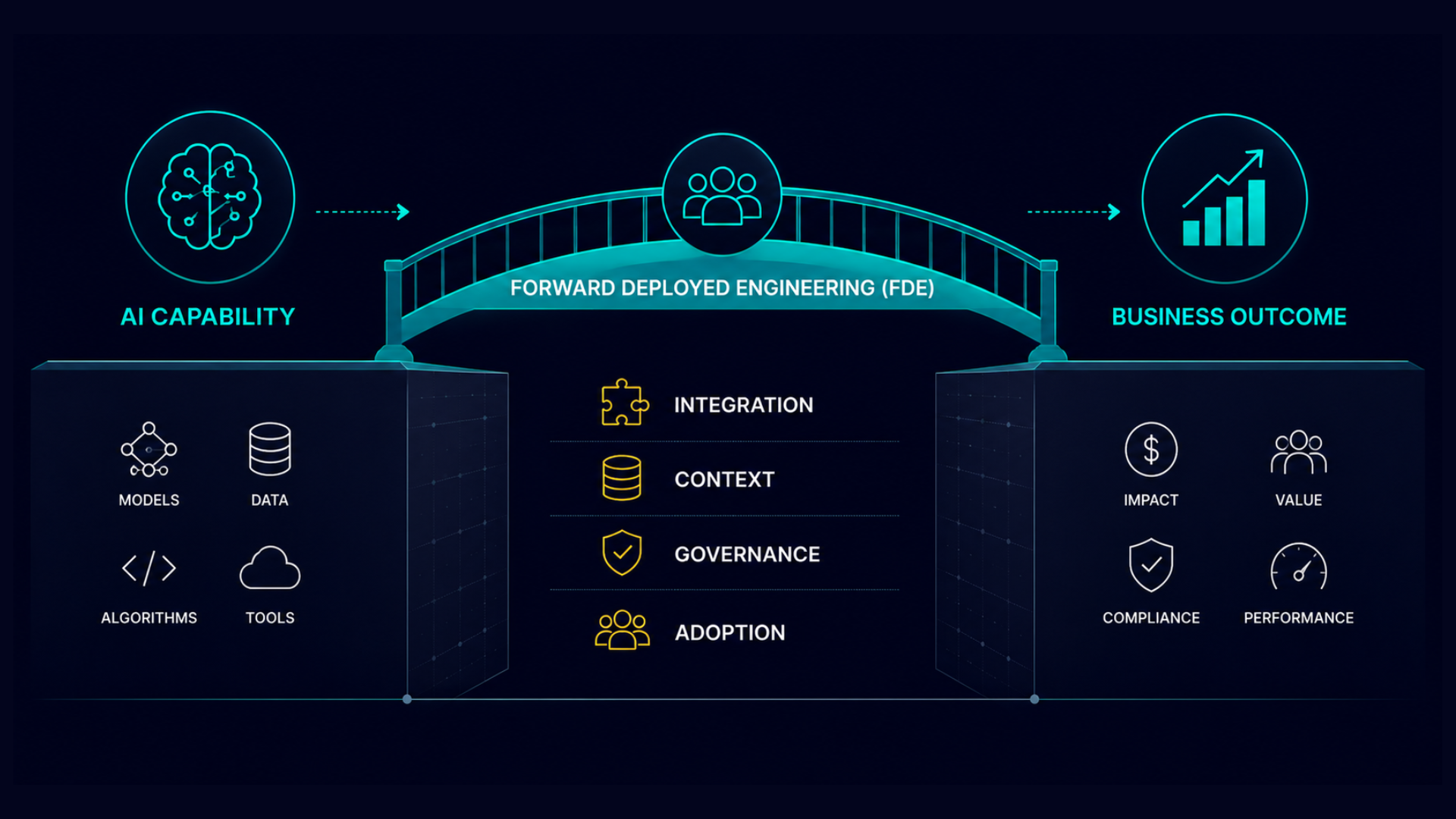
What Forward Deployed Engineering Actually Is
Forward deployed engineering is the practice of embedding engineers directly inside client organisations to close that deployment gap. Not as consultants who visit and produce recommendations. Not as implementation teams who work from a specification at a distance. As engineers who are physically or virtually inside the client's operational environment, working against the client's actual systems and data, from the first day of the engagement through to genuine production deployment and adoption.
The term "forward deployed" is borrowed from military logistics, where it describes resources positioned close to where they will be needed rather than held in reserve at a distance. The analogy is deliberate. A forward deployed engineer's value comes from proximity to the problem, not from the quality of analysis conducted at a comfortable remove.
Three things distinguish forward deployed engineering from other delivery models.
The engineer works inside the actual environment from day one:
Not after a discovery phase conducted through interviews and document review. Not once the integration architecture has been agreed. From day one, the forward deployed engineer is inside the actual systems, against the actual data, discovering the real constraints rather than building against a description of them.
The scope adjusts continuously based on what is discovered:
Enterprise environments are not fully knowable in advance. The constraints that matter most are often the ones that surface only when the build is underway and real data is being processed. A forward deployed engineering engagement is structured to incorporate these discoveries rather than treating them as scope changes that require formal change control.
Accountability extends through to genuine adoption:
A forward deployed engagement does not conclude when the system is technically deployed. It concludes when the system is genuinely being used by the people it was built for, generating the measurable business outcome it was designed to produce. Technical delivery without adoption is not considered success.
Why Every Major AI Company Is Building It Now
The convergence of forward deployed engineering programmes across the AI industry in 2026 reflects a collective realisation that has been building since the first wave of enterprise AI investment.
OpenAI launched a dedicated deployment company backed by more than four billion dollars from 19 investment firms, including acquiring an applied AI consultancy with approximately 150 forward deployed engineers. The explicit rationale was that selling model access was insufficient to drive the enterprise outcomes that justify enterprise AI investment.
Anthropic partnered with major financial services organisations to co-design enterprise AI systems through embedded teams rather than platform sales. Databricks formalised its forward deployed engineering organisation in 2026, reporting over 1,900 customer engagements in the prior 12 months. Google Cloud expanded hiring specifically for forward deployed engineering roles focused on generative AI deployments.
The pattern is consistent. Every major AI organisation has reached the same conclusion: the winners in enterprise AI will not be the ones with the best models. They will be the ones who can reliably get those models working inside real customer environments.
This is not a services business. It is a recognition that the last mile of enterprise AI deployment, from working prototype to production system that generates measurable business outcomes, requires a fundamentally different operating model than the one that builds AI products or advises on AI strategy.
What Forward Deployed Engineering Is Not
Understanding what forward deployed engineering is not matters as much as understanding what it is, because the label is now being applied broadly enough that meaningful distinctions are being obscured.
It is not consulting:
A forward deployed engineer does not produce recommendations for implementation by others. They build the implementation themselves, inside the client's environment. The output is working production software, not a strategy document or a roadmap.
It is not solutions engineering:
A solutions engineer works pre-contract, building demonstrations and proof of concepts to support the sales process. A forward deployed engineer works post-contract, building production systems that replace the proof of concept with something that actually runs in the enterprise.
It is not a rebranded implementation team:
An implementation team configures existing software according to a predefined methodology, typically from outside the client's operational environment. A forward deployed engineer builds custom production AI against the client's specific environment, adjusting the approach as real constraints surface.
It is not a temporary fix:
The knowledge a forward deployed engineer accumulates inside a client's environment, about the data, the systems, the constraints, the organisational dynamics, is the asset that makes subsequent deployments faster and more reliable. Enterprises that build or access genuine forward deployed engineering capability are building something that compounds. Enterprises that treat it as a one-time engagement for a specific project are not.
What This Means for Enterprise Leaders
For enterprise leaders evaluating AI programmes, the emergence of forward deployed engineering as the dominant delivery model for enterprise AI has a direct practical implication.
The question of how to resource an AI programme is no longer just a question of technical capability. It is a question of operating model. Software engineers build for the general case. Systems integrators deliver defined scope from the outside. Forward deployed engineers build for your specific case, from inside your environment, accountable to your production outcomes.
Each model has its place. The mistake that is most consistently expensive is applying the wrong model to the wrong problem, specifically applying a product engineering or traditional delivery model to an enterprise AI deployment problem that requires proximity, contextual understanding, and outcome-based accountability.
The build vs buy vs embed decision that every enterprise AI programme eventually faces is, in part, a decision about whether forward deployed engineering capability will be built internally, accessed through a partner, or absent from the programme entirely. The programmes where it is absent are the ones most likely to produce pilots that never reach production.
The Compounding Advantage
There is a compounding dimension to forward deployed engineering that does not receive enough attention.
The first deployment in a new enterprise environment is always the hardest. The integration constraints are unknown. The data quality issues are undiscovered. The organisational dynamics that affect adoption are opaque. A forward deployed engineer working through this for the first time in a specific environment accumulates knowledge that makes the second deployment significantly faster.
Enterprises that have built or accessed genuine forward deployed engineering capability over multiple deployments develop institutional knowledge about their own AI deployment environment that is genuinely difficult for competitors to replicate quickly. They know which integration patterns work. They know where the data quality gaps are. They know which stakeholders need to be engaged at which points. That knowledge compounds into a structural speed and reliability advantage over enterprises still discovering these things for the first time in each new AI initiative.
This is why forward deployed engineering is not just a delivery model. It is a strategic capability. And it is why the enterprises investing in it now, whether by building internal capability or by building deep relationships with partners who practice it genuinely, are not just getting better outcomes on current AI programmes. They are building an advantage that will widen over the next several years.
Vishleshan AI was built around forward deployed engineering from the start. Every engagement embeds our engineers directly inside client environments across automotive, consumer electricals, financial services, and supply chain, taking AI from a named use case to production in 90 days. The model is not a service we offer. It is how we operate. Book a Consultation