


The conversation about AI and jobs has been running for a decade. It has passed through several distinct phases, the prediction phase, where economists and technologists argued about which roles would be automated and when; the anxiety phase, where those predictions generated significant organisational and policy debate; and the pilot phase, where enterprises began experimenting with AI in real workflows and generating the first actual evidence.
In 2026, we are in a fourth phase: the data phase. There is now enough real deployment experience, across enough sectors and geographies, to move beyond prediction and look at what is actually happening to work, workers, and workplace organisation when AI is deployed at scale.
The picture is more nuanced than the headlines on either side of the debate suggest. AI is not eliminating jobs at the scale the pessimistic predictions forecast. It is also not leaving work unchanged in the way the optimistic dismissals implied. What it is doing is more specific, more sector-dependent, and more actionable than either narrative captures.
What the Data Actually Shows on Employment
The headline employment data from 2026 does not support the mass displacement narrative that dominated AI coverage in 2023 and 2024.
The McKinsey Global Institute's 2026 workforce report found that across the 47 countries tracked, net employment in sectors with high AI adoption in technology, financial services, professional services, and advanced manufacturing, grew faster than in sectors with low AI adoption. The productivity gains from AI deployment created demand for new roles faster than automation eliminated existing ones, at least at the aggregate level.
However, the aggregate data obscures significant variation at the task and role level. The World Economic Forum's Future of Jobs Report 2026 found that approximately 40 percent of core work tasks in knowledge-intensive roles are now partially or fully supported by AI tools compared to 25 percent in 2024. That shift is happening faster than hiring and training cycles can adapt, creating a growing skills gap in the short term even where overall employment is stable or growing.
The roles most affected are not the ones most commonly predicted. Manual, physical roles in logistics and manufacturing have been more resilient than forecast, partly because the real-world deployment of physical robotics has been slower than anticipated. The roles experiencing the sharpest transformation are mid-level knowledge work roles like financial analysis, legal research, customer service management, and procurement coordination where AI is taking over the data-intensive, repeatable elements of work that previously required trained human effort.
The Productivity Reality: Gains Are Real but Unevenly Distributed
The productivity gains from AI deployment are real and measurable. They are also significantly less evenly distributed than the technology's proponents initially suggested.
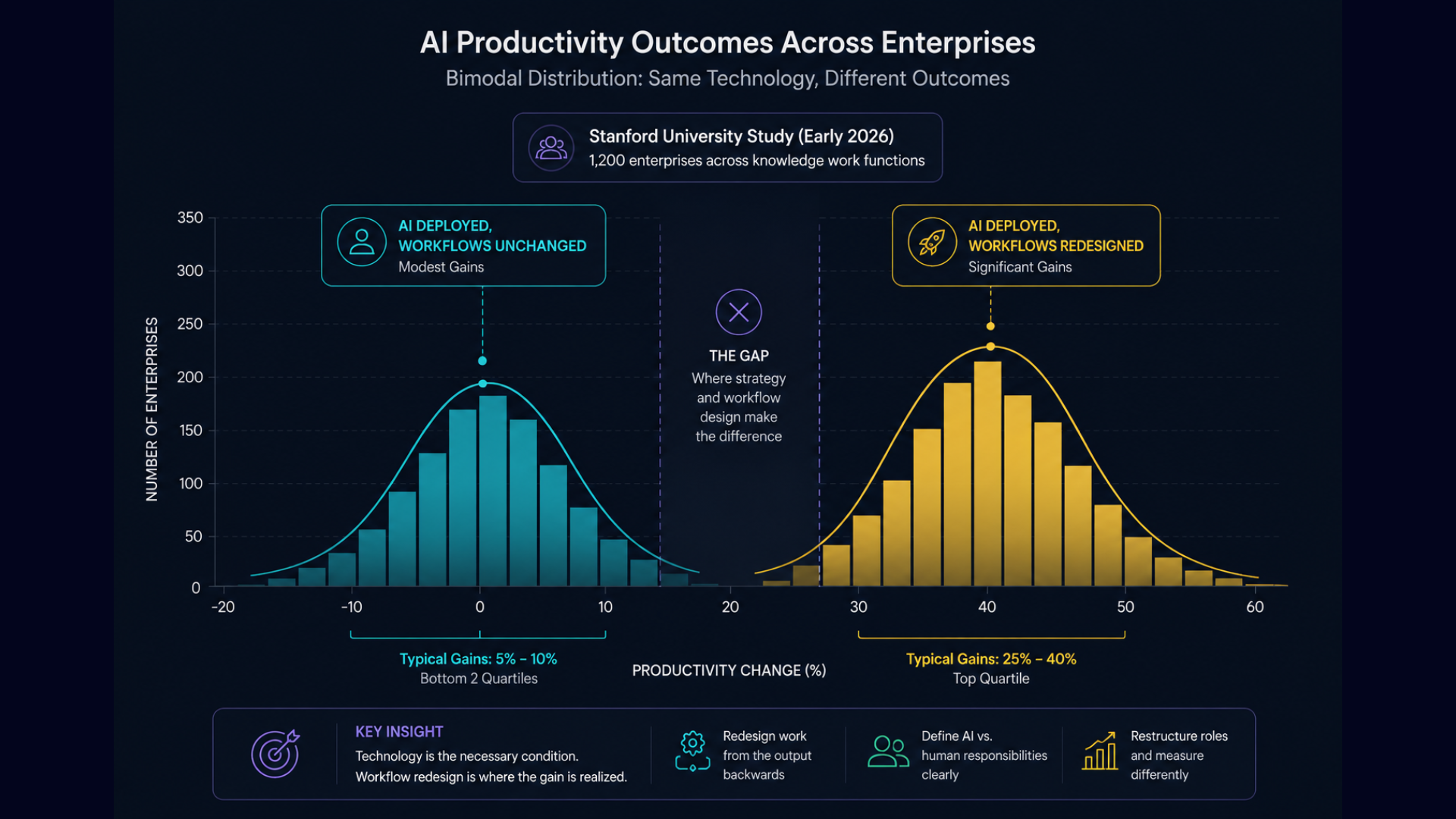
A Stanford University study published in early 2026 examined productivity outcomes across 1,200 enterprises that had deployed AI tools in knowledge work roles. The results showed a bimodal distribution. Enterprises in the top quartile of AI adoption maturity saw productivity gains of 25 to 40 percent in the functions where AI was deployed. Enterprises in the bottom two quartiles saw productivity gains of 5 to 10 percent, and in some cases saw productivity fall during the transition period before stabilising.
The difference was not the technology. The technology was largely the same across all groups. The difference was in how the work was redesigned around the AI capability. Enterprises that deployed AI without redesigning workflows essentially giving people an AI assistant to use as they saw fit within unchanged processes captured modest gains. Enterprises that systematically redesigned workflows from the output backwards, defining what AI would handle and what humans would handle, and restructuring roles accordingly, captured the large gains.
This finding has direct implications for how enterprises should approach AI deployment. The technology is a necessary condition for the productivity gain. It is not a sufficient one. The workflow redesign is where the gain is actually realised which is exactly the problem that forward deployed engineers embedded inside client organisations are specifically structured to solve.
The Skills Shift: What Enterprises Are Actually Paying For
The skills that enterprises are prioritising has shifted measurably in 2026, and the shift is not primarily about technical AI skills.
LinkedIn's Global Skills Report 2026 found that the fastest-growing skill categories in enterprise hiring are not machine learning or data science, those remain important but are not the growth leaders. The fastest growing categories are AI workflow design, the ability to understand what AI can and cannot do and to design human-AI workflows that extract maximum value from both; critical evaluation, the ability to assess AI outputs for accuracy, bias, and appropriateness rather than accepting them uncritically; and domain expertise combined with AI fluency, the combination of deep industry or functional knowledge with enough AI understanding to direct AI tools effectively.
This last category is significant. Pure AI technical skills without domain expertise produce AI systems that work technically but fail operationally they optimise for the wrong metric, they miss the constraint that makes an answer commercially viable, they produce outputs that are impressive in isolation and useless in context. The skills the market is paying the most for in 2026 are hybrid skills that combine domain depth with AI capability, not pure technical AI skills in isolation.
For automotive manufacturers, consumer electricals enterprises, and financial services organisations deploying AI across complex operational environments, this has a direct implication. The engineers who can operate most effectively in those environments are not pure AI engineers who learn the business context later. They are domain-fluent engineers who understand AI deeply enough to deploy it effectively inside a specific operational reality which is precisely the profile that makes forward deployed engineering work.
How Work Is Being Reorganised Around AI
Beyond employment levels and skill demands, the more fundamental change visible in 2026 is in how work itself is being structured inside enterprises that have moved beyond AI experimentation into production deployment.
The traditional knowledge work model organises humans into functional silos of procurement, finance, operations, and customer service where each function owns its data, its processes, and its outputs. AI does not fit cleanly into this model. An AI agent monitoring supply chain signals does not respect the boundary between procurement and operations. An agent managing customer escalations draws on data from sales, service, and finance simultaneously. The functional boundaries that made sense when work was primarily human become friction points when AI is coordinating across them.
The enterprises that are extracting the most from AI in 2026 have begun reorganising work around outcomes rather than functions defining the business result to be achieved and designing human-AI workflows to deliver it, rather than mapping AI tools onto existing functional structures. This is a significant organisational change, and it explains why AI ownership and accountability of getting the right governance structure in place is one of the defining challenges of enterprise AI in 2026.
The Human Role in an AI-Augmented Workforce
The data from 2026 suggests a consistent pattern in what the human role looks like in functions where AI has been deployed effectively.
Humans are doing less data retrieval, less routine analysis, and less coordination work, the tasks where AI's speed and consistency advantages are decisive. Humans are doing more judgment, more relationship management, more exception handling, and more strategic direction-setting, the tasks where human contextual understanding, ethical reasoning, and interpersonal capability remain superior to what AI can currently provide.
This redistribution is not inherently threatening. In most cases, the work humans are being moved toward is more interesting, more strategic, and more differentiating than the work they are being moved away from. The challenge is that the transition requires deliberate investment in reskilling and workflow redesign that many enterprises are underestimating.
The build vs buy vs embed decision that enterprises face when resourcing AI programmes is partly a workforce strategy decision. Building internal AI capability creates lasting organisational capacity. Buying platforms without embedding the capability to use them effectively creates a tool that does not get used. Embedding engineers who work alongside internal teams during deployment transfers knowledge that compounds after the engagement concludes.
What Enterprise Leaders Should Actually Be Doing
Three things separate enterprises that are capturing large productivity gains from AI from those capturing modest ones and all three are within the control of leadership teams right now.
Redesign workflows before deploying tools. The productivity gain from AI is realised in the workflow redesign, not in the tool deployment. Define what the outcome should be, map what AI should handle and what humans should handle, and restructure roles accordingly before rolling out the technology to the team.
Invest in hybrid skills development. The skills gap that is emerging in most large enterprises is not a shortage of AI engineers. It is a shortage of domain experts with enough AI fluency to direct AI tools effectively. Closing that gap through deliberate training investment is a faster path to productivity gain than hiring pure AI technical skills that lack the domain context to be useful.
Treat AI as an operating model question, not a technology question. The enterprises capturing large gains have made AI central to how they organise work, allocate responsibility, and measure performance. The enterprises capturing modest gains have treated AI as a productivity tool layered onto an unchanged operating model. The difference in outcome reflects the difference in ambition.
The future of work in 2026 is neither the mass displacement that pessimists predicted nor the unchanged landscape that optimists promised. It is a specific, measurable, manageable transition, one that rewards enterprises that approach it deliberately and creates widening gaps between those that do and those that do not.
The data is clear enough now to act on. The question is whether your organisation is treating AI as a transformation of how work gets done, or as a collection of tools that individuals can use as they see fit within processes that have not changed.
The first approach compounds. The second one does not.
Vishleshan AI's forward deployed engineers help enterprises redesign workflows around AI and deploy it into production in 90 days. Book a Consultation