



The enterprise AI partner market in 2026 is crowded, confident, and difficult to evaluate from the outside. Every major consulting firm has launched an AI practice. Every platform vendor has rebranded their professional services team as an AI delivery organisation. Every forward deployed engineering firm that launched in the last 18 months has a website full of impressive-sounding capabilities and a pipeline of case studies that all demonstrate successful pilots.
The demo is the problem. Enterprise AI vendor demos are controlled performances. The vendor selects the data, controls the conditions, and presents the best possible version of their system running against synthetic or pre-cleaned data in a sandbox environment. The enterprise that makes a significant investment decision based on a demo is buying a performance, not a capability.
Analysis of enterprise AI implementation outcomes in 2026 consistently finds that the gap between demo performance and production performance is the primary driver of failed enterprise AI investments. The median enterprise spends significantly on AI initiatives in the first 18 months, yet the majority of those projects stall in pilot phase or deliver no measurable return. The selection process is where that failure begins.
This guide gives you the evaluation framework that separates partners who can actually deliver AI into production in your specific environment from partners who are very good at demonstrating what AI can do in theirs.
Why Standard Procurement Criteria Are Insufficient
Most enterprise procurement frameworks for technology vendors assess the same dimensions: company size and stability, technology capability, security and compliance certifications, reference customers, and commercial terms. These are necessary criteria. They are not sufficient for AI.
The reason is that AI delivery requires a capability that traditional technology procurement does not assess directly: the ability to close the gap between what AI does in a controlled environment and what it needs to do in your specific operational environment with your specific data, systems, constraints, and people.
A partner can have excellent technology, a credible client list, strong compliance certifications, and competitive commercial terms, and still be structurally incapable of deploying AI in your production environment because their delivery model is not designed for the integration complexity, organisational dynamics, and contextual understanding that enterprise production deployment requires.
The evaluation criteria that matter most are the ones that reveal this capability, and they are almost never the criteria that feature in standard RFP processes.
The Six Evaluation Dimensions That Actually Predict Production Outcomes
1. Where do the engineers actually work?
This is the most revealing question in any enterprise AI partner evaluation and the one most likely to produce an answer that distinguishes genuine delivery capability from a well-packaged sales process.
A partner with genuine production delivery capability will tell you that the engineers who will build your AI system will be embedded inside your actual environment, working against your actual systems and data, from day one of the engagement. Not visiting on a schedule. Not building in their delivery centre against a specification. Inside your environment, discovering the real constraints before the build commits to a direction.
A partner without this capability will describe a process of regular client interactions, site visits, and collaborative sessions. This describes a coordination model, not a deployment model. The two produce systematically different outcomes when they encounter the integration complexity of a real enterprise environment.
This is why forward deployed engineering has become the defining delivery model for enterprise AI that reaches production. The proximity is not a preference. It is the mechanism that closes the gap between demo and production.
2. Where does accountability end?
The second question that reveals production capability is about where the partner's accountability concludes.
Ask directly: what does success look like for you at the end of this engagement? The answer tells you almost everything about whether you are evaluating a delivery partner or an advisory partner.
A genuine delivery partner defines success at production adoption and business outcome. The AI system is being used by the people it was built for. The business metric that justified the initiative has moved. The engagement is not complete until those conditions are met.
An advisory partner, or a partner whose model ends at technical delivery, will define success at handover: the system has been built, tested, and handed over to the client's teams. What happens next is outside the scope of the engagement.
This distinction matters enormously in the context of what research has consistently identified as the primary failure mode of enterprise AI investment: AI that is technically delivered but never operationally adopted. A partner whose accountability ends at technical delivery has no structural incentive to ensure the system is actually used. A partner whose accountability extends to adoption does.
3. Can they show production deployments in your sector, on your systems?
Reference checks are standard in enterprise procurement. The questions most commonly asked in reference checks are not the ones that reveal whether the partner can deploy in your specific environment.
The right reference questions are specific. Ask for deployments in your industry vertical. Ask for deployments involving the specific ERP or operational systems your environment runs on. Ask the reference contact directly: how did the engagement handle integration complexity that was not fully anticipated at the start? What happened when requirements changed because something was discovered in the production environment that the specification did not capture?
A partner with genuine production experience in your sector and on your systems will have specific, detailed, credible answers to these questions. Their reference contacts will describe specific integration challenges and how they were resolved, not generic satisfaction with the engagement outcome.
A partner without this experience will produce references from adjacent sectors or from engagements involving systems that are not directly comparable to yours. The integration complexity that defeated them in a previous engagement will defeat them in yours.
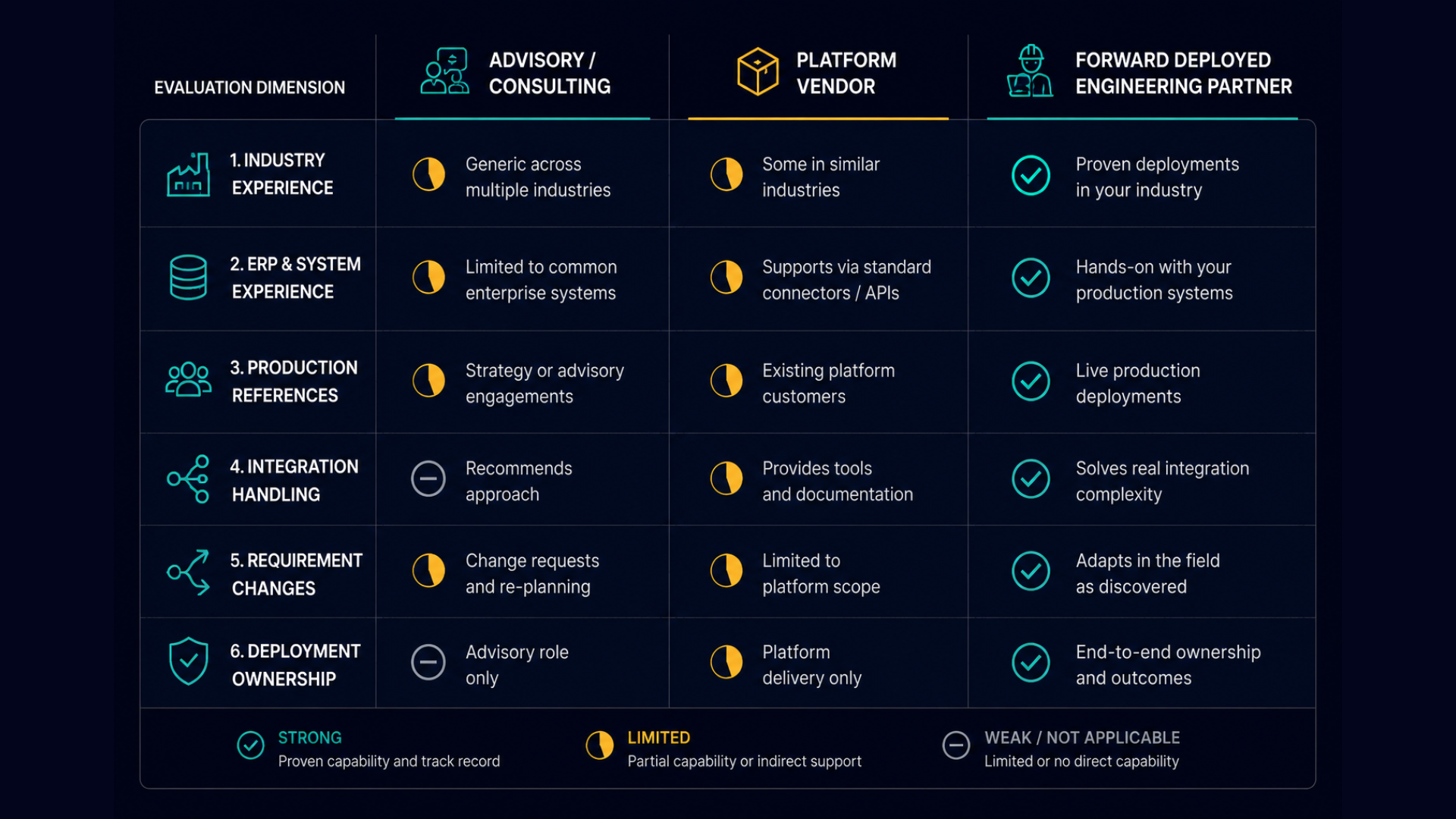
4. How do they handle scope change?
Enterprise environments are not fully knowable in advance. Requirements that were accurate at the start of an engagement change when the build is underway and the production environment reveals constraints that were not visible from the outside.
How a partner handles scope change tells you how their delivery model is structured and whether it is designed for the reality of enterprise AI deployment.
A partner with a traditional delivery model will describe a change control process: formal documentation of scope changes, commercial renegotiation, timeline adjustments. This is a legitimate process that protects both parties in a defined-scope engagement. It is also a sign that the model is not designed for the iterative, discovery-driven nature of enterprise AI deployment.
A partner with a genuine forward deployed engineering model will describe continuous adjustment as part of the normal operating rhythm. When something is discovered in the production environment that changes the approach, the team adjusts. This is not scope creep. It is the correct response to an environment that is more complex than any specification fully captures.
Ask specifically: tell me about an engagement where something discovered mid-build significantly changed the direction of the work. How was it handled? What was the outcome? The answer reveals whether the delivery model is designed for enterprise reality or for a controlled project environment.
5. How do they price the engagement?
Pricing structure is one of the clearest signals of delivery confidence, as the Forrester Wave Q2 2026 criteria made explicit by rewarding partners that can commit to outcome-based elements.
Ask whether any portion of the engagement fee is tied to production outcomes rather than delivery milestones. Ask what the milestone structure looks like and what triggers each payment. Ask what happens commercially if the system is delivered but not adopted.
A partner with genuine production delivery capability and a track record of consistent outcomes will be willing to discuss outcome-based elements because they have confidence in their ability to deliver them. A partner whose model ends at delivery will price against delivery milestones because that is the extent of what they can control and commit to.
You should also model the total cost at production scale, not just the engagement fee. AI inference costs are variable and consumption-based, and the cost structure that looks reasonable at pilot scale can produce significantly different numbers at production volume. Ask the partner how they manage inference costs at scale and whether their architecture includes cost governance mechanisms that prevent runaway spend as the system is adopted.
6. Do they build governance into the architecture or bolt it on at the end?
For organisations in regulated industries, including financial services, automotive manufacturing, and healthcare, this question is not optional. But it is relevant for every enterprise AI deployment regardless of sector.
AI governance, including audit trails, explainability mechanisms, human oversight structures, and access controls, needs to be built into the system architecture from the start. It cannot be retrofitted onto a system that was designed without it, at least not without significant rework that is expensive and typically incomplete.
Ask the partner to describe how governance is handled in their delivery process. Specifically: at what point in the engagement are audit trail requirements defined, who defines them, and how are they incorporated into the system design? If the answer suggests that governance is a review step that happens after the technical build, the architecture will likely require significant rework before it can be deployed in a production environment that has real compliance obligations.
A partner whose delivery model incorporates governance requirements from day one, because the forward deployed engineers working inside your environment are absorbing your compliance framework alongside your technical constraints, will produce a system that is deployable in production without a separate governance remediation workstream.
The Red Flags That Appear Before You Sign
Several patterns in the sales process signal delivery model gaps that will become delivery problems after the contract is signed.
The proposal is heavy on methodology and light on engineering specifics:
Genuine delivery-capable partners lead with engineering capability and integration experience. The proposal describes the team, their technical background, the integration patterns they will use, and the governance architecture they will build. A proposal that is primarily a methodology framework, a set of phases, and a list of deliverables without specific engineering content is describing an advisory engagement, not a deployment engagement.
The team presented in the sales process is not the team that will do the work:
This is one of the most consistent red flags in enterprise AI procurement. The senior people who run the sales process are often not the people who will be embedded in your environment. Ask specifically: who will be working in our environment, at what seniority, and can we meet them before we sign? A genuine forward deployed engineering team should be able to answer this question with specific names and backgrounds.
The demo runs on synthetic or pre-cleaned data:
Ask the partner to demonstrate their capability against a sample of your actual data, from your actual systems, with the messy characteristics that real production data has. A partner whose capability holds up in this scenario has real production experience. A partner who needs to prepare a clean dataset for any demonstration is showing you something that does not exist in production environments.
There is no clear answer to the adoption question:
Ask what happens if the system is technically complete but the operational teams are not using it. A delivery partner will have a specific answer that involves staying engaged until adoption is achieved. An advisory partner will have a general answer about change management recommendations.
What a Good Evaluation Process Looks Like
An evaluation process designed to identify genuine production delivery capability rather than impressive positioning has three stages.
Stage one: structured questions.
Issue the same set of questions to every partner being evaluated, covering the six dimensions above. Score the responses on specificity and credibility, not on confidence and polish. Confident answers to the wrong questions are a red flag, not a differentiator.
Stage two: reference conversations.
Speak directly to operational leaders at reference engagements, not to the executive sponsors who approved the contract. Ask about integration challenges, scope changes, adoption dynamics, and what the partner did when something did not go as planned. These conversations are the highest-signal evaluation step available.
Stage three: a bounded pilot evaluation.
Before committing to a full engagement, commission a bounded piece of work — not a demo, but an actual small deployment against a real use case in your real environment. The partner's behaviour during this bounded evaluation, how they handle the constraints they discover, how they communicate when something is more complex than anticipated, and whether the output actually works in your environment rather than a controlled one, is the most direct evidence of how they will behave in a full engagement.
The Decision That Determines Most of the Outcome
The enterprise AI partner evaluation is a consequential decision. The wrong choice does not just waste the engagement budget. It consumes the organisational bandwidth and leadership attention required to restart the initiative, often at a point where the organisation's appetite for AI investment has been diminished by the failed first attempt.
The enterprises that get this right consistently are the ones that evaluate production capability rather than demo capability, ask the questions that reveal delivery model rather than accepting positioning language at face value, and select partners based on what they do inside real enterprise environments rather than what they can demonstrate inside controlled ones.
That discipline in evaluation is what separates the 18% of enterprises seeing significant AI revenue impact from the 82% who are adopting AI without moving their bottom line.
Vishleshan AI's forward deployed engineers work inside client environments across automotive, consumer electricals, financial services, and supply chain, accountable to production outcomes rather than delivery milestones. We welcome the evaluation questions in this guide. Book a Consultation